AIP Protein Powder: What's Safe for the Autoimmune Protocol
Most protein powders fail the autoimmune protocol before you even open the lid. Whey and casein are dairy. Pea and soy are legumes. Rice protein is a grain. And nearly every option left still contains eggs, seed-based emulsifiers, artificial sweeteners, or gums — all eliminated on AIP. The safest AIP protein powder is bone broth collagen: it's derived from animal bones and connective tissue, contains zero common allergens, and provides the amino acids your gut lining uses for repair. That last part matters more than most AIP guides acknowledge.
If you're on the autoimmune protocol, you're probably not here because protein powder sounds fun. You're here because managing an autoimmune condition is exhausting, hitting your protein target on a restrictive elimination diet is genuinely hard, and you need something that won't set you back. Let's break down exactly what works, what doesn't, and why the details matter.
What Is the Autoimmune Protocol?
AIP is a temporary elimination diet designed to identify food triggers for autoimmune conditions — Hashimoto's, rheumatoid arthritis, IBD (Crohn's and ulcerative colitis), lupus, psoriasis, and others. It's not meant to be permanent. It's a diagnostic tool.
The protocol eliminates foods most likely to trigger immune reactions or increase intestinal permeability:
| Eliminated on AIP | Why |
|---|---|
| Grains (all) | Gluten/gliadin triggers zonulin release, increasing gut permeability (Lammers et al., 2008) |
| Dairy (all) | Casein may compromise intestinal barrier; A1 beta-casein releases BCM-7 opioid peptide (Jianqin et al., 2016) |
| Eggs | Top-8 allergen; egg white proteins (ovomucoid, ovalbumin) are common immune triggers |
| Legumes | Lectins and saponins may increase intestinal permeability |
| Nightshades | Alkaloids (solanine, capsaicin) may aggravate autoimmune inflammation |
| Nuts and seeds | Common allergens; phytic acid may impair mineral absorption |
| Refined sugars | Feed inflammatory pathways |
| Alcohol | Directly increases intestinal permeability |
| Food additives | Emulsifiers, carrageenan, and artificial sweeteners disrupt gut barrier (Wellens et al., 2025) |
What's allowed: meat, fish, vegetables (non-nightshade), fruit, bone broth, collagen, healthy fats, and organ meats. That's a strong food foundation — but hitting 100+ grams of daily protein on it requires eating a lot of meat.

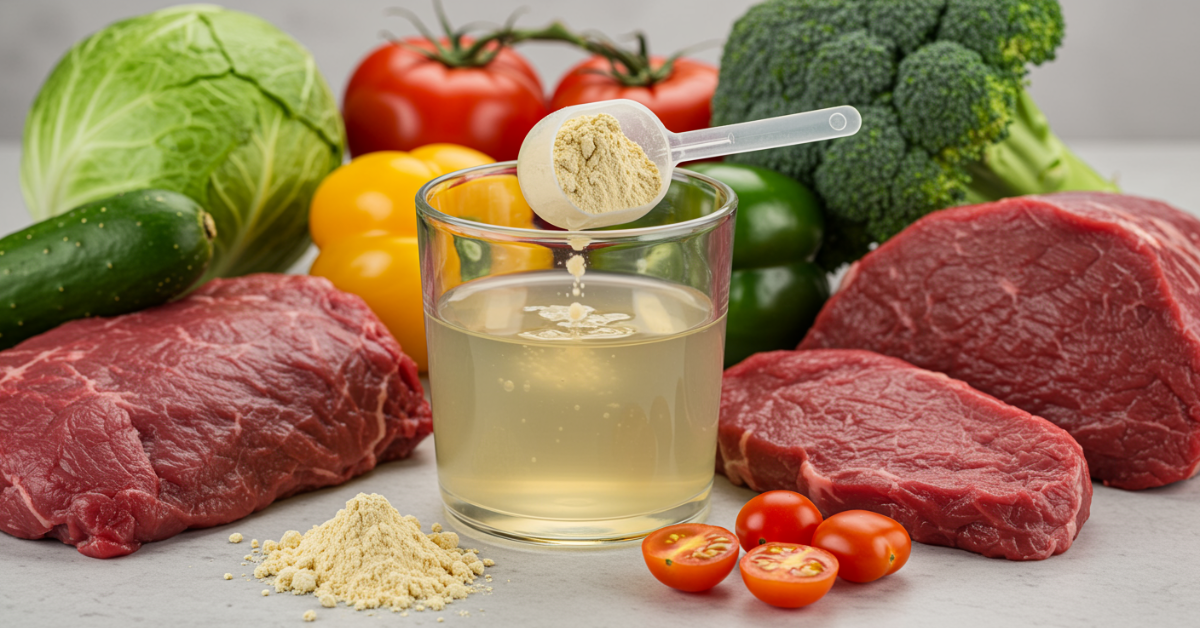
Dairy-free, gluten-free, soy-free, and gum-free — clean protein for a paleo reset.
Why Intestinal Permeability Matters for Autoimmune Conditions
This is the part most protein powder guides skip, and it's the part that actually explains why ingredient quality matters so much more when you have an autoimmune condition.
Dr. Alessio Fasano — the researcher who discovered zonulin, the protein that controls the opening and closing of intestinal tight junctions — proposed that autoimmune disease requires three co-existing factors (Visser et al., 2009):
- Genetic predisposition (you can't change this)
- Environmental trigger (food antigens, infections, stress)
- Increased intestinal permeability (you can influence this)
The third factor is the one you actually have leverage over. When tight junctions between intestinal cells become compromised — "leaky gut" in common terms — incompletely digested food proteins cross the gut barrier and encounter the immune system directly. In genetically predisposed individuals, this can trigger or worsen autoimmune responses.
Here's the connection to protein powder: every ingredient in your daily shake either supports or undermines those tight junctions. Dairy proteins, artificial sweeteners, and emulsifiers have research-backed mechanisms for increasing intestinal permeability. Glycine and collagen peptides have research-backed mechanisms for supporting it.
That's not a sales pitch. That's the science of why ingredient lists matter more for people with autoimmune conditions than for anyone else.
Which Protein Powders Are AIP-Compliant?
Let's be specific. Here's how every major protein type stacks up:
| Protein Type | AIP Status | Why |
|---|---|---|
| Bone broth collagen | Compliant | Animal-sourced, no common allergens, no additives needed |
| Beef protein isolate (plain) | Depends on formula | Pure beef isolate is fine; most formulas add egg white or seed-based emulsifiers |
| Collagen peptides (bovine) | Usually compliant | Check for additives — pure hydrolyzed collagen is fine |
| Whey / casein | Not compliant | Dairy |
| Egg white protein | Not compliant | Eggs eliminated during AIP |
| Pea protein | Not compliant | Legume |
| Soy protein | Not compliant | Legume |
| Rice protein | Not compliant | Grain |
| Hemp protein | Not compliant | Seed |
The practical answer during AIP elimination: bone broth collagen is the safest, most nutritionally relevant option.
Why Bone Broth Collagen Is the Best Fit
PaleoPro Bone Broth Collagen checks every AIP box — no dairy, no eggs, no grains, no legumes, no seeds, no nightshades, no artificial anything. It's sourced from grass-fed cattle and contains the amino acids most relevant to gut barrier support.
One serving delivers approximately 3 grams of glycine, which matters because glycine has documented anti-inflammatory properties. A comprehensive review in Current Opinion in Clinical Nutrition and Metabolic Care found that glycine inhibits TNF-alpha, IL-1, and IL-6 release from activated macrophages — the same inflammatory cytokines elevated in most autoimmune conditions (Zhong et al., 2003). A 2016 study in The Journal of Nutrition demonstrated that glycine directly upregulates tight junction proteins (claudin-3, claudin-7, ZO-3) and increased transepithelial electrical resistance by 46-111% in intestinal epithelial cells (Li et al., 2016).
Bone broth collagen also naturally provides Types I, II, and III collagen. Type II collagen is particularly interesting for autoimmune conditions — intact Type II collagen has been shown to modulate immune response through oral tolerance. A landmark study published in Science demonstrated that oral administration of Type II collagen to rheumatoid arthritis patients decreased swollen and tender joints, with four patients achieving complete remission (Trentham et al., 1993).
The caveat: collagen is not a complete protein. It lacks tryptophan and is low in BCAAs. It won't build muscle on its own. Use it as part of your total protein intake alongside whole food sources — steak, fish, organ meats — not as a replacement for them.
What About PaleoPro Paleo Protein on AIP?
Honest answer: PaleoPro Paleo Protein is NOT AIP-compliant during the elimination phase. It contains egg white protein. Eggs are eliminated on AIP because egg white proteins — particularly ovomucoid, ovotransferrin, and ovalbumin — are among the most common food allergens.
But here's the important part: egg whites are a Stage 2 reintroduction food. Once you've completed elimination, successfully reintroduced egg yolks (Stage 1), and confirmed tolerance to egg whites (Stage 2), Paleo Protein becomes an option. At that point, you'd have a complete protein powder (26g protein per serving, all nine essential amino acids) sweetened with monk fruit and emulsified with cold-pressed sunflower lecithin — no dairy, no grains, no legumes, no artificial anything.
For many people on AIP, the progression looks like this:
Month 1-2 (Elimination): Bone Broth Collagen + whole food protein (meat, fish, organ meats)
Month 2-4 (Early Reintroduction): Bone Broth Collagen + testing egg yolks → egg whites
Month 4+ (If Eggs Tolerated): Bone Broth Collagen in coffee/morning + Paleo Protein as complete protein shake
The timeline varies. Some people move through reintroduction in 8 weeks. Others take 6+ months. Some never tolerate certain foods. That's the whole point of the protocol — finding your individual triggers, not following someone else's.
What the Research Says About AIP
Let's be straight about the evidence. AIP has compelling rationale and promising early results, but the clinical data is limited.
The strongest data is in IBD. A 2017 study at Scripps Clinic enrolled 15 adults with active Crohn's disease or ulcerative colitis on an 11-week AIP protocol. By week 6, 73% achieved clinical remission — all of whom maintained it through week 11. Fecal calprotectin (an intestinal inflammation marker) improved from 471 to 112 (Konijeti et al., 2017). That's compelling. But it was 15 people with no control group.
Hashimoto's shows symptom relief without disease marker improvement. A 2019 pilot study of 16 women with Hashimoto's found AIP reduced symptom burden by 68% and lowered hs-CRP (an inflammation marker) by 29%. But thyroid antibodies — the actual measure of autoimmune disease activity — did not change (Abbott et al., 2019). A 2023 study of 28 Hashimoto's patients actually found thyroid antibodies increased on AIP, even while symptoms improved (Ihnatowicz et al., 2023).
Everything else is pilot-level or anecdotal. RA has one study with four completers. Psoriasis, lupus, and MS have no AIP-specific clinical trials.
A 2024 comprehensive review of all published AIP research concluded that every existing trial is "uncontrolled or underpowered" and called for high-quality RCTs (Pardali et al., 2024).
Here's the honest take: AIP's theoretical foundation is solid — Fasano's research on intestinal permeability and autoimmune disease is well-established and widely cited. The early clinical results are encouraging. But the evidence base is small. If AIP is working for you — fewer flares, better energy, improved digestion — that's real and it matters. Just don't expect to find a meta-analysis of 2,000 patients confirming it. That research hasn't been done yet.
Nutrient Gaps on AIP (and How to Fill Them)
AIP's restrictiveness is a feature — it's meant to eliminate potential triggers. But it's also a risk. One study found that 50% of participants developed deficiencies in folate, B12, or riboflavin during the protocol.
This is where organ meat supplements become more than a nice idea — they become nutritionally important.
| Nutrient at Risk | Why | Best AIP-Compliant Source |
|---|---|---|
| Folate | Grains and legumes eliminated | Beef liver (55% DV per 3 oz) |
| Vitamin B12 | Usually adequate from meat | Beef liver (2,944% DV per 3 oz) |
| Riboflavin (B2) | Dairy eliminated | Beef liver, organ meats |
| Calcium | Dairy eliminated | Bone broth (modest), sardines, leafy greens |
| Iron | Usually adequate | Beef spleen (highest food source), liver, red meat |
| Collagen amino acids | Less from whole food variety | Bone broth collagen |
PaleoPro Beef Liver capsules and PaleoPro Beef Organs (liver, heart, kidney, spleen) are AIP-compliant from day one. If the thought of eating liver makes you grimace, capsules are the practical workaround. Your grandmother was right about organ meats. She just didn't have capsules.
How to Choose an AIP Protein Powder
When evaluating any protein powder for AIP, check for these red flags:
Immediate disqualifiers:
- Whey, casein, or any dairy derivative
- Egg white protein (during elimination)
- Pea, soy, rice, or hemp protein
- Sucralose, aspartame, acesulfame potassium
- Carrageenan, guar gum, xanthan gum
- Soy lecithin
- Stevia (eliminated on strict AIP; some practitioners allow it)
What you want:
- Collagen, bone broth protein, or pure beef protein isolate
- Minimal ingredients (the fewer, the better)
- Grass-fed sourcing (reduces exposure to hormones and antibiotics)
- No sweeteners during elimination; monk fruit is typically reintroduced early
- Third-party testing for heavy metals (bone broth can accumulate lead if not tested)
The cleanest AIP protein supplement is one with a single ingredient: collagen peptides or bone broth protein from grass-fed cattle. Period.
FAQ
Is beef protein isolate AIP-compliant? Pure beef protein isolate is AIP-compliant. The issue is that most beef protein powders add non-AIP ingredients — egg white protein, seed-based emulsifiers, or artificial sweeteners. Always read the full ingredient list. PaleoPro Paleo Protein, for example, contains egg white protein and is NOT compliant during elimination but works well post-reintroduction.
Can you have collagen on AIP? Yes. Collagen from grass-fed bovine sources is fully AIP-compliant and arguably one of the most useful supplements on the protocol. It provides glycine for gut lining support without any eliminated food groups. Bone broth collagen is the whole-food version.
When can I add egg-containing protein powder back on AIP? Egg yolks are a Stage 1 reintroduction food (earliest). Egg whites are Stage 2 — typically introduced after 2-4 months of strict elimination, once Stage 1 foods are confirmed tolerated. Test egg whites separately from yolks using the standard micro-dose → small dose → full portion → 5-7 day washout protocol.
Is pea protein AIP-compliant? No. Peas are legumes, which are eliminated on AIP due to lectin and saponin content. This is one of the most common mistakes — plant-based protein powders are almost universally incompatible with AIP.
What about bone broth protein vs collagen peptides? Both are AIP-compliant. Bone broth protein provides a broader nutrient profile — trace minerals, hyaluronic acid, chondroitin, and glucosamine alongside collagen. Collagen peptides are pure collagen in a more concentrated, standardized form. Bone broth protein is the whole-food option; collagen peptides are the targeted-supplementation option.
Does AIP actually work for autoimmune conditions? The research is promising but limited. The best data is in IBD (73% clinical remission in a 15-patient study). Hashimoto's studies show symptom improvement without disease marker changes. No randomized controlled trials exist for AIP in any condition. The theoretical rationale — based on Fasano's research linking intestinal permeability to autoimmune disease — is well-established. If you're considering AIP, work with a practitioner who can monitor your progress and nutrient status.
How much protein do I need on AIP? The same as anyone else — 0.7-1.0 grams per pound of body weight for active adults, possibly higher if you're recovering from a flare or building back muscle mass. The challenge on AIP isn't the amount — it's the sourcing. Collagen contributes to total protein intake but shouldn't be your only source since it's incomplete (missing tryptophan). Pair it with meat, fish, and organ meats.
Can I use protein powder during an autoimmune flare? If it's AIP-compliant, yes — and it may be especially helpful during flares when appetite is low and eating enough whole food protein is difficult. Bone broth collagen in warm water or broth is gentle on the stomach and provides gut-supporting amino acids without requiring digestion of a full meal. Many people with IBD find collagen-based protein the easiest to tolerate during active symptoms.
The Bottom Line
AIP is one of the most restrictive therapeutic diets out there. When you add protein powder to the mix, you need something that clears every elimination hurdle while actually earning its place nutritionally — not just filling a protein number.
Bone broth collagen does both. It's AIP-compliant from day one, provides the glycine and collagen amino acids your gut lining uses for repair, and doesn't introduce a single ingredient that might trigger an immune response. Once you've moved through reintroduction and confirmed egg tolerance, a complete beef protein isolate like Paleo Protein adds another tool.
If you're navigating an autoimmune condition and looking for protein sources that won't work against you, start with PaleoPro Bone Broth Collagen during elimination and add PaleoPro Paleo Protein when your reintroduction protocol says you're ready.
Sources
-
Lammers KM, et al. (2008). Gliadin induces an increase in intestinal permeability and zonulin release by binding to the chemokine receptor CXCR3. Gastroenterology, 135(1), 194-204. PMID: 18485912
-
Jianqin S, et al. (2016). Effects of milk containing only A2 beta casein versus milk containing both A1 and A2 beta casein proteins on gastrointestinal physiology. Nutrition Journal, 15(1), 35. PMID: 27039383
-
Visser J, et al. (2009). Tight junctions, intestinal permeability, and autoimmunity: celiac disease and type 1 diabetes paradigms. Annals of the New York Academy of Sciences, 1165, 195-205. PMID: 19538307
-
Fasano A. (2012). Leaky gut and autoimmune diseases. Clinical Reviews in Allergy & Immunology, 42(1), 71-78. PMID: 22109896
-
Zhong Z, et al. (2003). L-Glycine: a novel antiinflammatory, immunomodulatory, and cytoprotective agent. Current Opinion in Clinical Nutrition and Metabolic Care, 6(2), 229-240. PMID: 12589194
-
Li W, et al. (2016). Glycine Regulates Expression and Distribution of Claudin-7 and ZO-3 Proteins in Intestinal Porcine Epithelial Cells. The Journal of Nutrition, 146(5), 964-969. PMID: 27029941
-
Trentham DE, et al. (1993). Effects of oral administration of type II collagen on rheumatoid arthritis. Science, 261(5129), 1727-1730. PMID: 8378772
-
Konijeti GG, et al. (2017). Efficacy of the Autoimmune Protocol Diet for Inflammatory Bowel Disease. Inflammatory Bowel Diseases, 23(11), 2054-2060. PMID: 28858071
-
Abbott RD, et al. (2019). Efficacy of the Autoimmune Protocol Diet as Part of a Multi-disciplinary, Supported Lifestyle Intervention for Hashimoto's Thyroiditis. Cureus, 11(4), e4556. PMID: 31275780
-
Ihnatowicz P, et al. (2023). Effects of Autoimmune Protocol (AIP) diet on changes in thyroid parameters in Hashimoto's disease. Annals of Agricultural and Environmental Medicine, 30(3), 513-521. PMID: 37772528
-
Pardali EC, et al. (2024). Autoimmune protocol diet: A personalized elimination diet for patients with autoimmune diseases. Metabolism Open, 25, 100342. PMID: 39850611
-
Wellens J, et al. (2025). Effect of dietary emulsifiers on intestinal permeability in healthy adults. Gut. PMID: 40816342
-
Drago S, et al. (2006). Gliadin, zonulin and gut permeability: effects on celiac and non-celiac intestinal mucosa. Scandinavian Journal of Gastroenterology, 41(4), 408-419. PMID: 16635908
