


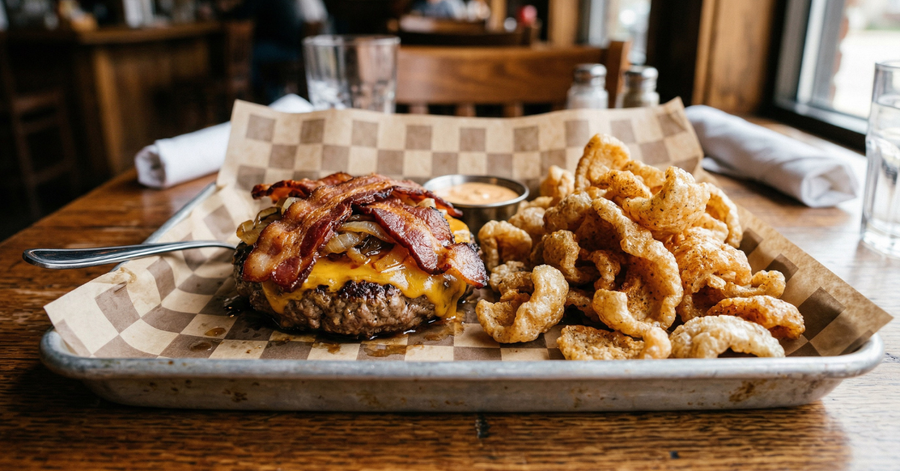
The dirty carnivore diet follows the same core rule as standard carnivore — only animal foods — but allows processed meats, fast food (no bun), convenience items, and doesn't worry about sourcing, quality, or ingredients beyond "is it animal-based?" Think bunless fast food burgers, gas station beef jerky, hot dogs, deli meats, and whatever's easiest. It's carnivore with the perfectionism stripped out.
The term exists because the carnivore community has its own purity culture. "Clean" carnivore means grass-fed, pasture-raised, nose-to-tail, organs weekly. "Dirty" carnivore means you eat at Five Guys and don't apologize for it. Both are carnivore. They're just different approaches with different trade-offs.
Dirty Carnivore vs Clean Carnivore
| Clean/Standard Carnivore | Dirty Carnivore | |
|---|---|---|
| Meat sourcing | Grass-fed, pasture-raised preferred | Whatever's available and affordable |
| Processed meats | Avoided or minimized | Freely included |
| Fast food | Avoided | Bunless burgers, rotisserie chicken, etc. |
| Organ meats | Encouraged | Rarely included |
| Ingredient labels | Checked carefully | Minimal scrutiny |
| Added sugar in meats | Avoided (sugar-free bacon) | Tolerated in small amounts |
| Seed oils | Strictly avoided | Accepted when eating out |
| Cost | Higher ($100-200+/week) | Lower ($60-100/week) |
| Effort | Moderate-high (meal prep, sourcing) | Low (grab and go) |
The Dirty Carnivore Food List
Commonly Eaten
- Bunless fast food burgers (McDonald's, Five Guys, Wendy's — order without bun and ketchup)
- Hot dogs and sausages (any brand)
- Bacon (including conventional with sugar cure)
- Deli meats (roast beef, turkey, ham)
- Rotisserie chicken (grocery store)
- Beef jerky (any brand, even with small amounts of sugar)
- Canned tuna and sardines
- Pork rinds (any brand)
- Eggs (any cooking method, any source)
- Ground beef (conventional, any fat ratio)
- Steak (whatever's on sale)
- Cheese and dairy (any type)
- Pepperoni, salami, prosciutto
What Dirty Carnivore Doesn't Include
Even dirty carnivore has boundaries:
- Buns, bread, wraps (not animal-based)
- French fries, onion rings (plant foods)
- Ketchup, BBQ sauce (sugar + plant-based)
- Coleslaw, salads (vegetables)
- Desserts (not animal-based)
The line is: if it comes from an animal, it's in. If it doesn't, it's out. Quality of the animal product isn't the filter — origin is.
Who the Dirty Carnivore Diet Is Actually For
The Entry Point
For someone eating the Standard American Diet — processed foods, seed oils, sugar, refined carbs — switching to dirty carnivore is a massive upgrade. They've eliminated sugar, grains, seed oils (mostly), and ultra-processed plant foods. That's 80% of the benefit right there.
Insisting that someone go from fast food and cereal to grass-fed ribeye with liver on the side is a recipe for quitting by day 3.
The Budget-Constrained
Grass-fed beef costs $8-15/lb. Conventional ground beef costs $4-6/lb. Over a month, that difference adds up to hundreds of dollars. If dirty carnivore is the version someone can afford, it's infinitely better than going back to the Standard American Diet because "clean" carnivore was too expensive.
The Traveler
Road trips, airports, hotel rooms, business dinners. Clean carnivore is nearly impossible in these situations. Dirty carnivore means pulling through a drive-through and ordering four bunless cheeseburgers. Problem solved.
The Simplicity Seeker
Some people don't want to research grass-fed sourcing, read every bacon label, or spend Sunday afternoon prepping organ meats. They want to eat animal foods, lose weight, and feel better without making it a lifestyle identity. That's valid.
The Honest Downsides
Dirty carnivore works as an entry point or a convenience tool. It has real nutritional costs compared to clean, nose-to-tail carnivore.
Nutrient Density Gap
Processed meats are less nutrient-dense than whole cuts. Hot dogs and deli meats are reconstituted, often from lower-quality trimmings. They provide protein and fat but lack the micronutrient density of a ribeye or ground beef from identifiable cuts.
The bigger gap: dirty carnivore dieters almost never eat organ meats. Without organs, a carnivore diet falls short on vitamin A, B12 (beyond base needs), folate, copper, CoQ10, and selenium [1]. Clean carnivore with nose-to-tail eating covers these. Dirty carnivore without a supplement doesn't.
This is the strongest argument for Carnivore Complete if you're doing dirty carnivore — it provides the organ nutrients (liver, heart, kidney, spleen) that your convenience-focused approach is missing entirely.
Seed Oil Exposure
This is the biggest hidden cost. Fast food burgers are cooked on flat-top grills that are often seasoned with seed oils. Restaurant bacon may be cooked in vegetable oil. Deli meats sometimes contain soybean oil or canola oil in the ingredient list.
Dirty carnivore significantly reduces your seed oil exposure compared to the Standard American Diet — no fried foods, no salad dressings, no processed snack foods — but doesn't eliminate it the way clean carnivore does.
Additives and Preservatives
Processed meats contain sodium nitrite, sodium erythorbate, dextrose, carrageenan, and various "natural flavors." Whether these are meaningfully harmful at the amounts consumed is debated, but they're not in a grass-fed steak.
Higher Sodium (Uncontrolled)
Processed meats are high in sodium — which is actually fine on carnivore (you need more sodium on low-carb). But the sodium in processed meats comes alongside other additives. Getting your sodium from salt on whole food is cleaner than getting it from cured meats with a dozen other ingredients.
The Upgrade Path
The smart approach: start dirty, upgrade gradually.
Month 1: Eat dirty carnivore. Eliminate all plant foods. Get comfortable with the diet. Lose the initial weight. Survive the adaptation period.
Month 2: Start cooking at home more. Replace fast food burgers with homemade smash burgers. Buy conventional ground beef and steaks from the grocery store. Switch to sugar-free bacon.
Month 3: Add organ meats or an organ supplement. Try Carnivore Complete if organ taste isn't for you. Start choosing fattier cuts intentionally. Reduce fast food to travel situations only.
Month 4+: Upgrade meat quality as budget allows — grass-fed ground beef is the most affordable upgrade. Add bone broth for collagen and electrolytes. You're now doing clean carnivore without having needed to start there.
This path works better than demanding perfection from day one. Adherence matters more than optimization in the first 90 days.
FAQ
What is the dirty carnivore diet? Dirty carnivore follows the same core rule as standard carnivore — only animal foods — but allows processed meats, fast food (bunless), convenience items, and doesn't filter for ingredient quality or meat sourcing. If it comes from an animal, it counts.
Is dirty carnivore still healthy? Compared to the Standard American Diet, yes — significantly. You've eliminated sugar, grains, seed oils (mostly), and ultra-processed plant foods. Compared to clean, nose-to-tail carnivore, it's nutritionally inferior — lower micronutrient density, more additives, some residual seed oil exposure from restaurant cooking.
Can you lose weight on dirty carnivore? Yes. The weight loss mechanisms — protein leverage, high satiety, food variety restriction — work regardless of meat quality. A bunless McDonald's burger still provides high protein and eliminates the carbohydrate-driven overconsumption cycle.
What's the biggest problem with dirty carnivore? Nutrient gaps. Without organ meats and with heavy reliance on processed options, you miss vitamin A, folate, CoQ10, copper, and selenium that nose-to-tail eating provides. An organ supplement addresses this directly.
Should I start with dirty carnivore or clean carnivore? If clean carnivore feels overwhelming, start dirty. Adherence in the first 30 days matters more than food quality optimization. You can upgrade gradually. A dirty carnivore who sticks with it for 90 days will outperform a clean carnivore who quits after a week.
Sources
- Goedeke, S., et al. (2025). "Assessing the Nutrient Composition of a Carnivore Diet: A Case Study Model." Nutrients, 17(1), 140. PMID: 39796574
Ready to upgrade your approach? Read our Carnivore Diet for Beginners guide for the step-by-step first 30 days. See the complete food list for whole-food options with macros. And for the organ nutrition that dirty carnivore misses, Carnivore Complete combines beef protein isolate with liver, heart, kidney, and spleen — one scoop fills the biggest nutritional gaps.