How Much Protein Do Women Actually Need? (By Age, Weight & Goal)
Most women need more protein than the RDA of 0.8 grams per kilogram of body weight — that figure is only the floor to prevent deficiency. Research supports 1.2–1.6 grams per kilogram per day for general health and muscle maintenance (up to about 2.0 g/kg for building muscle), which works out to roughly 80–110 grams a day for a 150-pound woman. Your needs rise with exercise, age, pregnancy, and weight loss.
That range surprises most women, because the official number they've heard — 0.8 g/kg, or about 46 grams a day — is far lower. Both are "correct," but they answer different questions. The RDA answers what's the minimum to avoid a deficiency? The higher range answers what actually supports muscle, metabolism, weight management, and healthy aging? — which is what most women are really asking. This guide breaks the number down by body weight, age, and goal, with the research behind each, so you can find your target and stop guessing.
How much protein does a woman need per day?
The honest answer is a range, because it depends on your body weight and your goals — protein needs scale to size, which is why a single gram number is misleading.
- The floor: The Recommended Dietary Allowance is 0.8 g/kg of body weight for all adults — about 46 grams a day for a 130-pound woman. This is set to prevent deficiency in nearly everyone, not to optimize anything [1].
- The research-supported range: For maintaining muscle and managing weight, studies point to 1.2–1.6 g/kg, and the International Society of Sports Nutrition puts the range for building and keeping muscle at 1.4–2.0 g/kg [2]. Higher-protein diets in this range also improve appetite control and preserve lean mass during weight loss [3].
- Percentage view: The Institute of Medicine's acceptable range is 10–35% of your daily calories from protein [1]. Most women eating for health land comfortably in the upper half of that.
The gap between the 0.8 g/kg minimum and the 1.2–1.6 g/kg that research supports is exactly where most women fall short — and it's a surprising amount of extra protein to find in a normal day of eating.

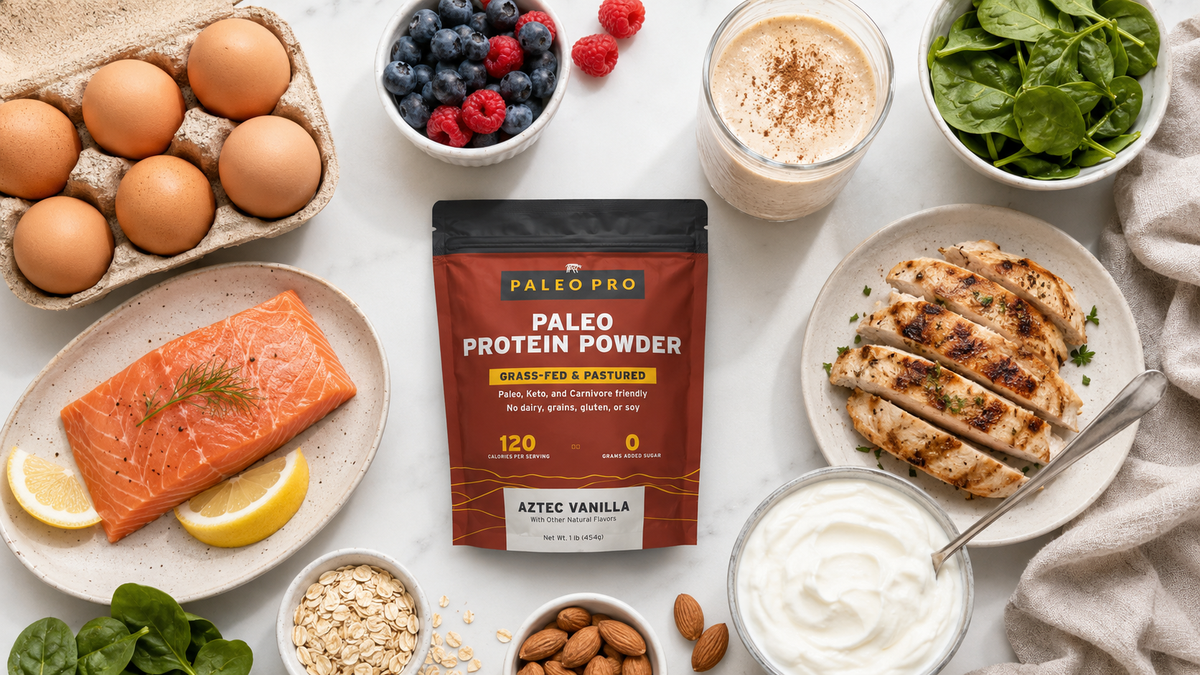
One scoop closes about 26g of your daily protein gap — complete, dairy-free, and ~120 calories, no cooking required.
What are women's protein needs by body weight and goal?
This is the table to bookmark. Find your weight down the side and your goal across the top; the cell is your daily protein target in grams.
| Body weight | Minimum (0.8 g/kg) | General health / active (1.2–1.6 g/kg) | Build muscle (1.6–2.0 g/kg) | Weight loss, preserve muscle (1.6–2.4 g/kg) |
|---|---|---|---|---|
| 120 lb (54 kg) | ~44 g | ~65–87 g | ~87–109 g | ~87–131 g |
| 140 lb (64 kg) | ~51 g | ~76–102 g | ~102–127 g | ~102–153 g |
| 150 lb (68 kg) | ~55 g | ~82–109 g | ~109–136 g | ~109–163 g |
| 160 lb (73 kg) | ~58 g | ~87–116 g | ~116–145 g | ~116–174 g |
| 180 lb (82 kg) | ~65 g | ~98–131 g | ~131–163 g | ~131–196 g |
A quick way to estimate without a calculator: your goal in grams is roughly your body weight in pounds times 0.5 to 0.7 for general health, or times 0.7 to 1.0 if you're building muscle or losing weight. A 150-pound woman aiming to preserve muscle in a diet, then, wants somewhere around 105–150 grams a day.
How much protein for a 150-lb or 170-lb woman?
Two of the most-searched specifics, worked out:
-
A 150-lb (68 kg) woman:
55 g at the RDA minimum; **82–109 g** for general health and muscle maintenance; up to ~136 g if actively building muscle, or ~110–163 g to preserve muscle while losing weight. -
A 170-lb (77 kg) woman:
62 g minimum; **93–124 g** for general health; up to ~154 g building muscle, or ~124–185 g in a muscle-preserving weight-loss phase.
If those upper numbers look daunting, that's the point — they're hard to reach from three meals of normal portions, which is why so many women fall short without realizing it.
Does a woman's protein need change with age?
Yes — it goes up, which is the opposite of what most people assume. Two shifts drive it:
Anabolic resistance. As you age, your muscles become less responsive to protein, so you need a larger dose per meal to trigger the same muscle-building response. Studies show older adults need roughly 0.4 g/kg per meal to maximize muscle protein synthesis, versus less for younger adults [4]. That's why per-meal distribution matters more with age.
Menopause. As estrogen falls, women lose muscle faster, so protein becomes a more important lever for holding onto it [5]. Expert guidelines recommend adults over 65 get 1.0–1.2 g/kg (higher with activity or illness), above the 0.8 RDA [6]. In practice, a woman over 50 should aim for the upper end of the general range and make sure she hits 25–35 grams at each meal.
How much protein is too much for a woman?
For healthy women, "too much" is a higher ceiling than most people think — and the common fears don't hold up. The Institute of Medicine set no Tolerable Upper Intake Level for protein, because there wasn't evidence to define a harmful amount [1].
- Kidneys: A meta-analysis of 28 controlled trials found no adverse effect of higher protein intake on kidney function in healthy adults [7]. The "protein harms kidneys" idea comes from guidance for people who already have kidney disease — for whom protein is deliberately restricted under medical supervision [8]. If you have kidney disease, diabetes with kidney involvement, or a single kidney, talk to your provider about your protein target.
- Bones: The old belief that protein "leaches calcium" is outdated; higher protein is actually associated with better bone density, not worse (covered in our women's protein guides).
- A practical ceiling: Staying within the 10–35% of calories range keeps you well inside safe territory. For most women, getting enough protein is a far more realistic concern than getting too much.
How do you actually hit your protein target?
Knowing the number is easy; reaching it is the hard part. Three tactics do most of the work:
- Anchor every meal with protein. Aim for 25–35 grams per meal — a few eggs, a palm-sized portion of meat or fish, or a scoop of protein powder. Spreading protein across meals beats loading it all at dinner.
- Front-load breakfast. Most women eat the least protein at breakfast (toast, fruit, coffee) and the most at dinner. Flipping that — a protein-rich breakfast — is the single biggest fix.
- Use a powder to close the gap. Hitting 100+ grams from whole food alone means a lot of chicken, eggs, and fish. A clean protein powder adds 20–26 grams in one step, without another meal to cook — the practical reason so many women keep one on hand.
How do you know if you're getting enough protein?
Your body sends signals when protein runs short, though they're easy to miss or blame on something else. Common signs of chronically under-eating protein include:
- Hair thinning or shedding more than usual. Because hair is protein, the body deprioritizes it when protein is scarce — inadequate intake is a documented cause of hair shedding [9].
- Brittle, slow-growing nails and skin that seems to heal slowly.
- Constant hunger and snacking, since protein is the most satiating macronutrient.
- Losing strength or muscle tone, or struggling to recover from workouts.
- Frequent illness, since the antibodies your immune system uses are built from protein.
None of these proves a deficiency on its own — but if several ring true and your diet is light on protein, track your intake for a few days against the targets above. Most women who do are surprised how far short they fall.
Frequently asked questions
How many grams of protein does a woman need per day? Most women need about 0.8 g per kg of body weight at minimum, but 1.2–1.6 g/kg for muscle maintenance and weight management — roughly 55 grams at the floor and 80–110 grams for optimal health for a 150-pound woman [1][2]. Active women and those over 50 should aim for the higher end.
How much protein do I need to lose weight as a woman? For fat loss with muscle preservation, research supports about 1.6–2.4 g/kg of body weight per day — roughly 110–160 grams for a 150-lb woman — spread across meals [2][3]. Higher protein keeps you full and protects lean muscle in a calorie deficit.
Is 100 grams of protein a day enough for a woman? For most women, yes — 100 grams meets the 1.2–1.6 g/kg range for a woman up to about 175 pounds, supporting muscle, metabolism, and healthy aging. Very active women or those building muscle may want more; smaller or sedentary women may need slightly less.
How much protein does a woman over 50 need? Women over 50 should aim for the higher end of the range — about 1.0–1.2 g/kg at minimum, and often 1.2–1.6 g/kg — because aging muscle is less responsive to protein and menopause accelerates muscle loss [4][6]. Getting 25–35 grams per meal matters as much as the daily total.
Can a woman eat too much protein? For healthy women, there's no established upper limit, and higher protein hasn't been shown to harm the kidneys or bones [1][7]. Staying within 10–35% of your daily calories from protein keeps you in safe territory. Women with existing kidney disease should follow their provider's guidance.
How much protein should a woman eat to build muscle? About 1.6–2.0 g/kg of body weight per day, paired with resistance training — roughly 110–135 grams for a 150-lb woman [2]. Women won't "bulk up" from this; without the testosterone men have, protein plus training builds strength and tone, not size.
Your protein target isn't a single magic number — it's a range set by your body weight and your goals, and for most women it's higher than they've been told. Find your row in the table, aim for a solid dose at each meal, and treat the daily total as the goal you build toward.
Struggling to hit your number from food alone? Paleo Protein Powder adds 26g of complete protein in one scoop — dairy-free, no soy, ~120 calories, and backed by a 60-day money-back guarantee.
Sources
- Institute of Medicine (2005). Dietary Reference Intakes for Energy, Carbohydrate, Fiber, Fat, Fatty Acids, Cholesterol, Protein, and Amino Acids. Washington, DC: The National Academies Press. DOI: 10.17226/10490
- Jäger, R., et al. (2017). "International Society of Sports Nutrition Position Stand: protein and exercise." Journal of the International Society of Sports Nutrition, 14, 20. PMID: 28642676
- Leidy, H.J., et al. (2015). "The role of protein in weight loss and maintenance." American Journal of Clinical Nutrition, 101(6), 1320S–1329S. PMID: 25926512
- Moore, D.R., et al. (2015). "Protein ingestion to stimulate myofibrillar protein synthesis requires greater relative protein intakes in healthy older versus younger men." Journals of Gerontology Series A, 70(1), 57–62. PMID: 25056502
- Sipilä, S., et al. (2020). "Muscle and bone mass in middle-aged women: role of menopausal status and physical activity." Journal of Cachexia, Sarcopenia and Muscle, 11(3), 698–709. PMID: 32017473
- Bauer, J., et al. (2013). "Evidence-based recommendations for optimal dietary protein intake in older people: PROT-AGE Study Group." JAMDA, 14(8), 542–559. PMID: 23867520
- Devries, M.C., et al. (2018). "Changes in Kidney Function Do Not Differ between Healthy Adults Consuming Higher- Compared with Lower- or Normal-Protein Diets: A Systematic Review and Meta-Analysis." Journal of Nutrition, 148(11), 1760–1775. PMID: 30383278
- Ikizler, T.A., et al. (2020). "KDOQI Clinical Practice Guideline for Nutrition in CKD: 2020 Update." American Journal of Kidney Diseases, 76(3 Suppl 1), S1–S107. PMID: 32829751
- Guo, E.L., & Katta, R. (2017). "Diet and hair loss: effects of nutrient deficiency and supplement use." Dermatology Practical & Conceptual, 7(1), 1–10. PMID: 28243487
