Protein on a GLP-1 (Ozempic & Wegovy): How to Protect Muscle While You Lose Weight
If you're taking a GLP-1 medication like Ozempic or Wegovy, aim for roughly 1.2–1.6 grams of protein per kilogram of body weight a day, spread across your meals, and add resistance training — because these drugs cause you to lose muscle along with fat. Prioritizing protein helps preserve lean muscle while you lose weight. And because appetite is suppressed, a high-protein, low-volume food like a shake makes that daily target far easier to hit.
GLP-1 medications — semaglutide (Ozempic, Wegovy) and tirzepatide (Mounjaro, Zepbound) — are the most effective weight-loss tools most people have ever had access to. But there's a well-documented catch that the prescriptions don't come with a plan for: a meaningful share of the weight you lose isn't fat — it's muscle. This guide covers the physiology behind that, exactly how much protein the research points to, and the practical part almost no one explains — how to actually get that much protein down when the whole point of the drug is that you're not hungry. It's general nutrition information, not medical advice; your dose, your targets, and your plan are conversations for you and your provider.

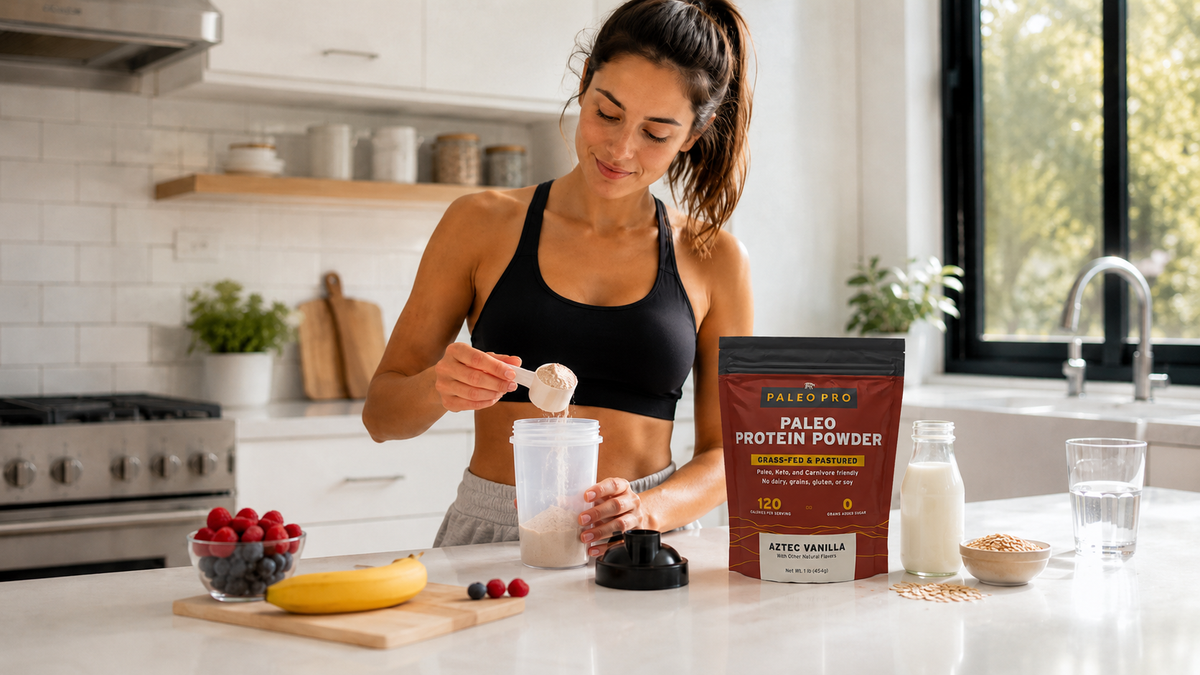
26g of complete protein in a low-volume shake — an easy way to reach your protein target when your appetite is low.
Why do GLP-1 medications cause muscle loss?
Two reasons, working together. First, any rapid weight loss takes muscle along with fat — that's true of dieting, surgery, or medication. Your body doesn't only burn fat in a calorie deficit; it breaks down some lean tissue too. Second, and specific to these drugs: GLP-1s work by powerfully suppressing appetite, so you eat far less of everything — including the protein your body needs to hold onto muscle. Less protein coming in, plus rapid weight loss, is exactly the combination that accelerates muscle loss.
How much? It varies by study, so treat any single number with caution. In the SURMOUNT-1 trial of tirzepatide, about 25% of the total weight participants lost was lean mass, and about 75% was fat [1]. Across the range of GLP-1 trials, the fraction of weight lost as lean tissue runs from roughly a quarter to as high as 40%, depending on the study and how it's measured [2]. Either way, it's a lot of muscle — enough that leading obesity researchers now warn it shouldn't be ignored.
Why does it matter if you're losing weight anyway? Because muscle isn't just for looks. It's your largest site for burning glucose, a major driver of your resting metabolism, and what keeps you strong and mobile as you age. Lose too much of it and your metabolism slows, which makes weight regain more likely if you ever stop the medication — and it can leave you weaker even at a lower body weight [2]. For women, who start with less muscle than men and lose it faster after menopause, protecting muscle during weight loss matters even more.
That makes the goal on a GLP-1 clear: get enough protein even when you don't feel like eating — which means finding protein that's easy to get down when a full plate feels like too much.

26g of complete protein in a low-volume shake — an easy way to reach your protein target when your appetite is low.
How much protein should you eat on a GLP-1?
More than you're probably eating now, especially since the drug is shrinking your appetite. The research on preserving lean mass during weight loss points to about 1.2–1.6 grams of protein per kilogram of body weight per day — well above the 0.8 g/kg RDA, which is only a floor to prevent deficiency [3]. Some obesity-medicine guidance goes higher still during active, rapid weight loss.
Here's what that looks like in real grams:
| Your body weight | Target range (1.2–1.6 g/kg) | Daily protein |
|---|---|---|
| 140 lb (64 kg) | 1.2–1.6 g/kg | ~76–102 g |
| 160 lb (73 kg) | 1.2–1.6 g/kg | ~87–116 g |
| 180 lb (82 kg) | 1.2–1.6 g/kg | ~98–131 g |
| 200 lb (91 kg) | 1.2–1.6 g/kg | ~109–145 g |
One nuance matters as much as the daily total: spread it across your meals. Your body can only use so much protein at once to build and maintain muscle, and that per-meal threshold rises with age — older adults need roughly 0.4 g/kg per meal to fully switch on muscle protein synthesis, versus less for younger people [4]. Aiming for 25–35 grams of protein at each meal or shake beats saving it all for dinner (which is hard to eat anyway on a GLP-1). A useful rule of thumb: eat your protein first, before the vegetables and carbs, because you may fill up fast.
How do you hit a protein target when your appetite is gone?
This is the real challenge on a GLP-1, and it's where most people struggle. When a few bites fills you up, choking down 100+ grams of protein a day from whole food alone can feel impossible. The tactics that work:
- Lead every meal with protein. Eat the eggs, fish, chicken, or yogurt first, while you have the most appetite. If you fill up, you've filled up on what matters most.
- Go for protein density, not volume. You want the most protein in the smallest, easiest-to-eat package. A big salad is filling but low in protein; a few ounces of fish or a scoop of protein powder delivers far more protein per bite.
- Drink some of your protein. When solid food is unappealing, a shake often goes down when a meal won't. This is the single most practical tool on a GLP-1 — a high-protein, low-volume liquid slips past a suppressed appetite in a way a plate of food doesn't.
- Add protein to what you're already eating. Stir unflavored or lightly flavored protein powder into coffee, oatmeal, soup, or yogurt to boost a small portion without adding much volume.
- Time it for your appetite. Many people find appetite is highest in the morning and lowest as the medication peaks. Front-load protein when you can actually eat.
The through-line is simple: on a GLP-1, the best protein is the one that's easiest to get in — complete, high per serving, and low enough in volume that a shrunken appetite can handle it.
Protein plus resistance training: the muscle-protection protocol
Protein gives your body the raw material to maintain muscle; resistance training gives it the reason to. Neither works as well alone. In a randomized trial of older adults losing weight, those who did resistance training lost significantly less muscle and bone than those who only did cardio — the strength work protected lean mass even as the weight came off [5]. That's the same protection a GLP-1 user wants.
You don't need a gym or heavy barbells to start. Two to three short sessions a week of resistance work — bodyweight squats, push-ups, resistance bands, or dumbbells — is enough to signal your body to keep the muscle it would otherwise shed. Paired with adequate protein, it's the closest thing there is to a muscle-protection protocol during medical weight loss. Every credible expert review on GLP-1 weight loss lands on the same two-part answer: more protein, and resistance training [2].
What should you look for in a protein for GLP-1 users?
Not every protein powder suits an appetite-suppressed body. The priorities shift a little from a typical protein shopper's:
- Complete protein. Only a complete protein — all nine essential amino acids — actually maintains muscle. That means an animal protein (beef, egg white, whey) or a well-blended plant protein. Plain collagen won't do it; it's missing tryptophan and low in the muscle-building aminos.
- High protein, low calorie. You want a big dose of protein — 20–26 grams — without a lot of calories crowding out the little food you can manage.
- Low volume, easy to digest. A protein that mixes thin and sits easily matters more when your stomach empties slowly (a known GLP-1 effect) and nausea can flare. Dairy-based powders bother some people here; a dairy-free option removes lactose as a possible trigger.
- No added sugar, clean ingredients. There's no room for a sugary "meal replacement" when you're eating little — every calorie should carry protein, not filler.
A complete, dairy-free protein — such as beef isolate blended with egg white — checks these boxes: about 26 grams of protein for 120 calories, no dairy, no added sugar, and low enough in volume to get down on a rough appetite day.
A sample high-protein day on a GLP-1
You don't need to eat a lot — you need to make what you eat count. Here's a day that reaches roughly 100 grams of protein without much volume:
- Morning (best appetite): two or three eggs, or Greek yogurt, plus a protein shake if breakfast is small (~35–40 g)
- Midday: a few ounces of chicken, fish, or a protein shake — protein first, then a little veg (~30 g)
- Evening: a palm-sized portion of beef, salmon, or eggs; stop when full (~25–30 g)
- Anytime you're short: stir protein powder into coffee, broth, or yogurt to top up (~15–25 g)
Notice how often a shake appears. That's not a coincidence — on a GLP-1, liquid protein is often the difference between hitting your target and falling far short. It asks the least of an appetite that's working against you.
Frequently asked questions
How much protein should I eat on Ozempic or Wegovy? Research on preserving lean mass during weight loss supports about 1.2–1.6 grams of protein per kilogram of body weight per day — roughly 75–130 grams for most adults, well above the 0.8 g/kg RDA minimum [3]. Spread it across meals (aim for 25–35 g each) and eat protein first, since your appetite is limited. Talk to your provider about the right target for you.
Do GLP-1 medications really cause muscle loss? Yes. Body-composition studies show a meaningful share of the weight lost on these drugs is lean mass, not just fat — about 25% in one tirzepatide trial [1], and roughly a quarter to 40% across trials depending on the study [2]. Adequate protein and resistance training are the recommended countermeasures.
Can protein powder help me keep muscle on a GLP-1? Protein powder doesn't preserve muscle by itself, but it makes it far easier to reach a muscle-protecting protein target when your appetite is suppressed — a high-protein, low-volume shake goes down when a full meal won't. Combined with resistance training, adequate protein supports lean-mass preservation during weight loss [2][5]. It's a food tool, not a treatment.
What is the best protein for people on a GLP-1? The most useful protein on a GLP-1 is complete (all nine essential amino acids), high in protein per serving, low in calories and added sugar, and easy to digest and low in volume — since these drugs slow stomach emptying. A dairy-free complete protein like beef and egg white fits, and removes lactose as a possible nausea trigger.
Should I take protein before or after my GLP-1 dose? There's no established timing rule tying protein to your injection. What matters more is spreading protein across the day and eating it when your appetite is highest — often the morning. For any questions about your medication and how to take it, ask your prescriber.
Is it safe to eat high protein on a GLP-1? For people with healthy kidneys, higher protein intake within normal dietary ranges is considered safe. But GLP-1 users often have other health conditions, so protein targets and any dietary changes should be reviewed with your provider — especially if you have kidney disease or diabetes with kidney involvement.
Losing weight is the easy part on a GLP-1; keeping it as fat loss, not muscle loss, is the part that takes a plan. That plan is simple to say and harder to do: enough protein, spread across the day, plus a little resistance training — even when you're not hungry.
Trying to hit your protein target when your appetite is low? Paleo Protein Powder delivers 26g of complete protein for about 120 calories — dairy-free, no added sugar, easy to digest, and low-volume enough to get down on a rough appetite day. Backed by a 60-day money-back guarantee.
Sources
- Look, M., et al. (2025). "Body composition changes during weight reduction with tirzepatide in the SURMOUNT-1 study of adults with obesity or overweight." Diabetes, Obesity and Metabolism, 27(5), 2720–2729. PMID: 39996356
- Prado, C.M., et al. (2024). "Muscle matters: the effects of medically induced weight loss on skeletal muscle." The Lancet Diabetes & Endocrinology, 12(11), 785–787. PMID: 39265590
- Leidy, H.J., et al. (2015). "The role of protein in weight loss and maintenance." American Journal of Clinical Nutrition, 101(6), 1320S–1329S. PMID: 25926512
- Moore, D.R., et al. (2015). "Protein ingestion to stimulate myofibrillar protein synthesis requires greater relative protein intakes in healthy older versus younger men." Journals of Gerontology Series A, 70(1), 57–62. PMID: 25056502
- Villareal, D.T., et al. (2017). "Aerobic or Resistance Exercise, or Both, in Dieting Obese Older Adults." New England Journal of Medicine, 376(20), 1943–1955. PMID: 28514618
