Beef Liver Supplement Side Effects: What's Real and What Isn't (2026)
Beef liver supplements are safe for most healthy adults at the labeled serving. Their side effects come almost entirely from two nutrients liver concentrates — preformed vitamin A and copper — which can accumulate with very high daily doses over time. Pregnant women should avoid them because of the vitamin A.
"Isn't liver full of toxins?" "Won't the vitamin A hurt me?" Search beef liver supplement side effects and you get equal parts genuine caution and internet myth. The truth is narrower, and more useful, than either. Liver is one of the most nutrient-dense foods on earth, and that same density is the source of its short list of real risks. Learn the two that actually matter — vitamin A and copper — and you can use a liver supplement sensibly, or decide it isn't for you. This guide covers what's real, what's overblown, and who should steer clear.

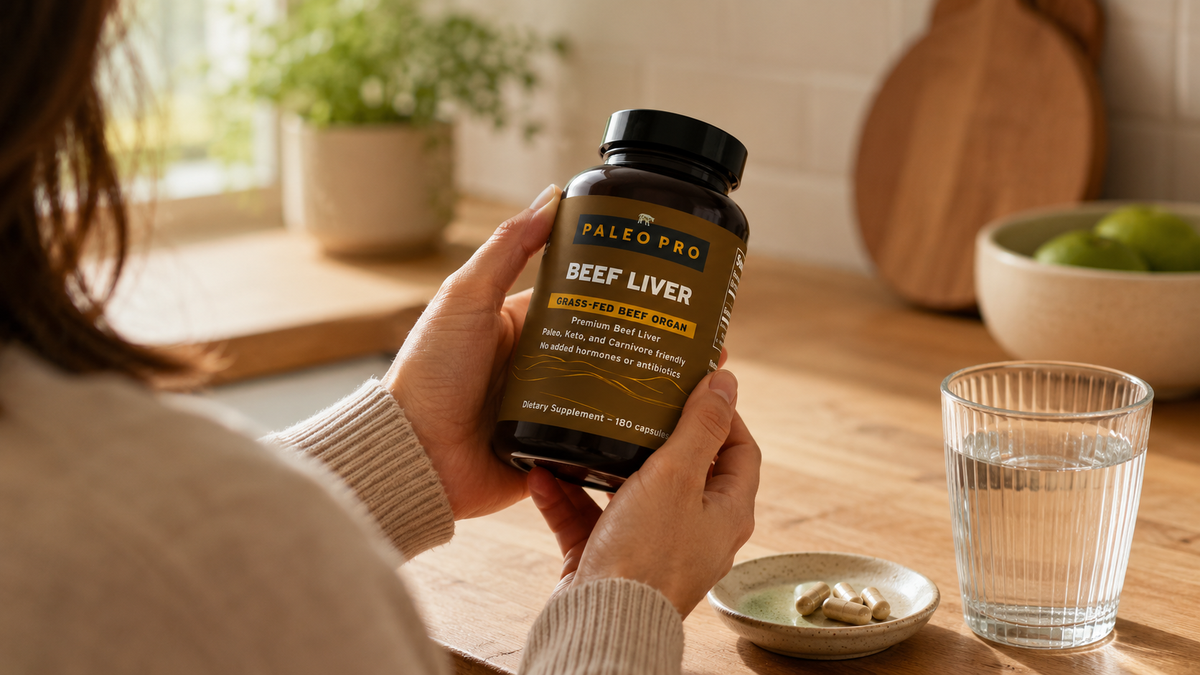
Grass-fed desiccated liver at a measured 3,000mg serving — the nutrients on a label you can actually control, third-party tested for purity.
What are the side effects of beef liver supplements?
At a normal labeled serving, most healthy adults tolerate desiccated liver well. The genuine side effects almost all trace back to over-supplementing the two nutrients liver is richest in:
- Preformed vitamin A (retinol). Liver is the single richest food source of retinol. Taken in very high amounts over months to years, it can cause headache, dry skin, joint and muscle pain, fatigue, and — in extreme chronic cases — abnormal liver function [1][2].
- Copper. Liver is also the richest common food source of copper. Chronically high copper intake can stress the liver, and it's a hard stop for people with the copper-storage disorder Wilson's disease [3].
- Mild digestive upset when starting. Some people notice temporary queasiness or loose stools in the first week. Taking the capsules with food and at the labeled dose usually settles it.
Here's the part most scare-articles skip: dose is everything, and a supplement is the lower-dose option. A single 3 oz plate of fresh liver carries roughly 22,000 IU of vitamin A — already more than twice the daily upper limit for adults [1][4]. A measured desiccated-liver serving is a small fraction of that fresh portion, so its vitamin A is correspondingly lower. And because more than half of bovine liver supplements have been found to misstate something on their label [5], third-party testing is how you know the vitamin A printed on the label is the vitamin A in the capsule. Always read the Supplement Facts for the exact amount per serving.
That's the whole case for a measured supplement over guesswork with a frying pan: you get liver's nutrients at a dose you can actually see on a label and control.

Grass-fed desiccated liver at a measured 3,000mg serving — the nutrients on a label you can actually control, third-party tested for purity.
Beef liver and vitamin A: how much is too much?
The number to know is the Tolerable Upper Intake Level: 3,000 mcg RAE (10,000 IU) of preformed vitamin A per day for adults [4]. That's a chronic daily ceiling, not a single-meal cliff. One serving over it does nothing; the concern is a high intake sustained over time.
How much is genuinely too much? Documented chronic vitamin A toxicity generally requires sustained intakes well above the upper limit — on the order of more than 25,000 IU/day for years, or more than 100,000 IU/day for months [2]. Early signs include dry skin, cracked lips, headache, joint pain, and fatigue, which reverse when intake drops.
Bone health is the one area where the science is honestly unsettled. A meta-analysis of cohort studies found mixed results: very high retinol intake may modestly raise hip-fracture risk in some analyses, yet low retinol was also linked to higher fracture risk — with no firm causal link established either way [6]. The sensible reading isn't "vitamin A is dangerous," it's "more isn't better." Keep your total preformed vitamin A in view, and don't stack a liver supplement on top of a high-dose vitamin A multivitamin. If you want liver's nutrients daily without pushing vitamin A, a multi-organ blend keeps retinol more moderate per serving than straight liver.
Who should not take beef liver supplements?
For most healthy adults, a labeled serving is fine. A few groups should be cautious or abstain:
- Pregnant women, or anyone trying to conceive. This is the important one. High preformed vitamin A in early pregnancy is linked to birth defects: in a large study of nearly 23,000 pregnancies, supplemental intake above 10,000 IU/day was associated with a markedly higher risk of malformation, concentrated in the first seven weeks [7]. Standard guidance is to avoid liver and liver supplements during pregnancy, especially the first trimester. Talk to your doctor.
- People with Wilson's disease. This inherited copper-accumulation disorder makes copper-rich foods a real hazard — liver should be avoided entirely [3].
- Anyone on retinoid or high-dose vitamin A medication. Prescription retinoids already load the body with vitamin A; adding a concentrated food source stacks the total. Check with your prescriber first.
- People managing liver disease, or on anticoagulants like warfarin. Liver is actually low in vitamin K, so the classic "leafy greens vs. warfarin" interaction barely applies here — but any concentrated nutrient source is worth clearing with your clinician, and warfarin patients should keep their diet consistent.
None of this is a reason for a healthy adult to fear liver. It's a reason to know which box, if any, you're in.
Is beef liver bad for you? The heavy-metal and cholesterol questions
Two fears drive most of the "is beef liver bad for you" searches, and both are more nuanced than the headlines.
"The liver is a filter, so it's full of toxins." The liver metabolizes and excretes toxins — it doesn't hoard them. It can carry more cadmium and lead than muscle meat, and those levels track with how the animal was raised, which is exactly why pasture-raised sourcing from clean environments matters [8]. In a healthy, well-raised animal, contaminant loads are low. This is an argument for choosing quality-sourced liver, not for avoiding liver.
Cholesterol. Liver does contain dietary cholesterol. For most people, dietary cholesterol from whole foods moves blood cholesterol far less than once assumed — but if you're actively managing a cholesterol or heart condition, factor it in and talk to your doctor rather than guessing.
The through-line: liver's risks are specific, dose-dependent, and largely solved by two things — a sensible serving and a clean source.
Frequently asked questions
What are the main side effects of beef liver supplements? The real ones come from over-supplementing two nutrients liver concentrates: preformed vitamin A and copper, which can accumulate with very high daily doses over months to years [1][3]. Some people also notice mild digestive upset when they start. At the labeled serving, most healthy adults tolerate desiccated liver well.
Can you take too much beef liver? Yes — over time. The limits to respect are cumulative preformed vitamin A above 3,000 mcg RAE (10,000 IU) per day and copper above 10 mg per day [3][4]. A single serving is not a problem; chronic megadosing is. Symptoms of excess build over months, not from one capsule.
Can I take a beef liver supplement every day? For most healthy adults, a labeled daily serving of desiccated liver stays well below the vitamin A in a single 3 oz portion of fresh liver [1][4]. Read the Supplement Facts, don't pair it with a high-vitamin-A multivitamin, and if you're taking it long-term, a multi-organ blend keeps vitamin A more moderate.
Are beef liver supplements safe during pregnancy? No. High preformed vitamin A is linked to birth defects [7], so pregnant women are advised to avoid liver and liver supplements, particularly in the first trimester. Speak with your doctor about prenatal nutrition instead.
Does desiccated liver have as much vitamin A as fresh liver? Per serving, usually far less — a supplement serving is a small fraction of a 3 oz fresh portion, so the vitamin A is proportionally lower. Amounts vary by product, so check the label for the exact figure [4].
Do beef liver supplements cause digestive issues? Some people feel mild queasiness or looser stools in the first week. Taking the capsules with food and sticking to the labeled dose usually resolves it.
Who should avoid beef liver supplements? Pregnant women, people with Wilson's disease, anyone on retinoid or high-dose vitamin A medication, and those managing liver disease should avoid them or check with a clinician first [3][7].
Beef liver's side effects are real but specific — and they're a dosing story, not a reason to avoid one of the most nutrient-dense foods there is. Used at a sensible serving, from a clean source, a desiccated liver supplement delivers liver's iron, B12, and vitamin A without the guesswork of the frying pan.
Want the measured way to eat liver? Grass-fed Beef Liver is 3,000mg a serving, third-party tested for purity, and backed by a 60-day money-back guarantee. For the full nutrient breakdown, see Beef Liver Supplement Benefits; to keep vitamin A more moderate day to day, a multi-organ blend spreads the load.
Sources
- NIH Office of Dietary Supplements (2024). "Vitamin A and Carotenoids — Health Professional Fact Sheet." ods.od.nih.gov
- StatPearls (2024). "Vitamin A Toxicity." StatPearls Publishing. NCBI Bookshelf NBK532916
- Linus Pauling Institute (2024). "Copper." Micronutrient Information Center, Oregon State University. lpi.oregonstate.edu (UL 10 mg/day); NIH Office of Dietary Supplements (2024). "Copper — Health Professional Fact Sheet." ods.od.nih.gov
- NIH Office of Dietary Supplements (2024). "Vitamin A and Carotenoids." Tolerable Upper Intake Level 3,000 mcg RAE (10,000 IU)/day for adults; USDA FoodData Central — Beef liver, braised (FDC ID 168626),
6,582 mcg RAE (22,175 IU) per 3 oz. fdc.nal.usda.gov - Silva, C.S., Dahm, M.M., & Hellberg, R.S. (2022). "Bovine Liver Supplement Labeling Practices and Compliance With U.S. Regulations." Journal of Dietary Supplements, 19(1), 4–19. PMID: 33148079
- Zhang, X., et al. (2017). "The Effect of Vitamin A on Fracture Risk: A Meta-Analysis of Cohort Studies." International Journal of Environmental Research and Public Health, 14(9), 1043. PMID: 28891953
- Rothman, K.J., et al. (1995). "Teratogenicity of high vitamin A intake." New England Journal of Medicine, 333(21), 1369–1373. PMID: 7477116
- European Food Safety Authority (2009–2024). "Metals as contaminants in food" (cadmium and lead in liver and kidney vs. muscle meat). efsa.europa.eu
