Do Beef Organ Supplements Actually Work? An Honest Look (2026)
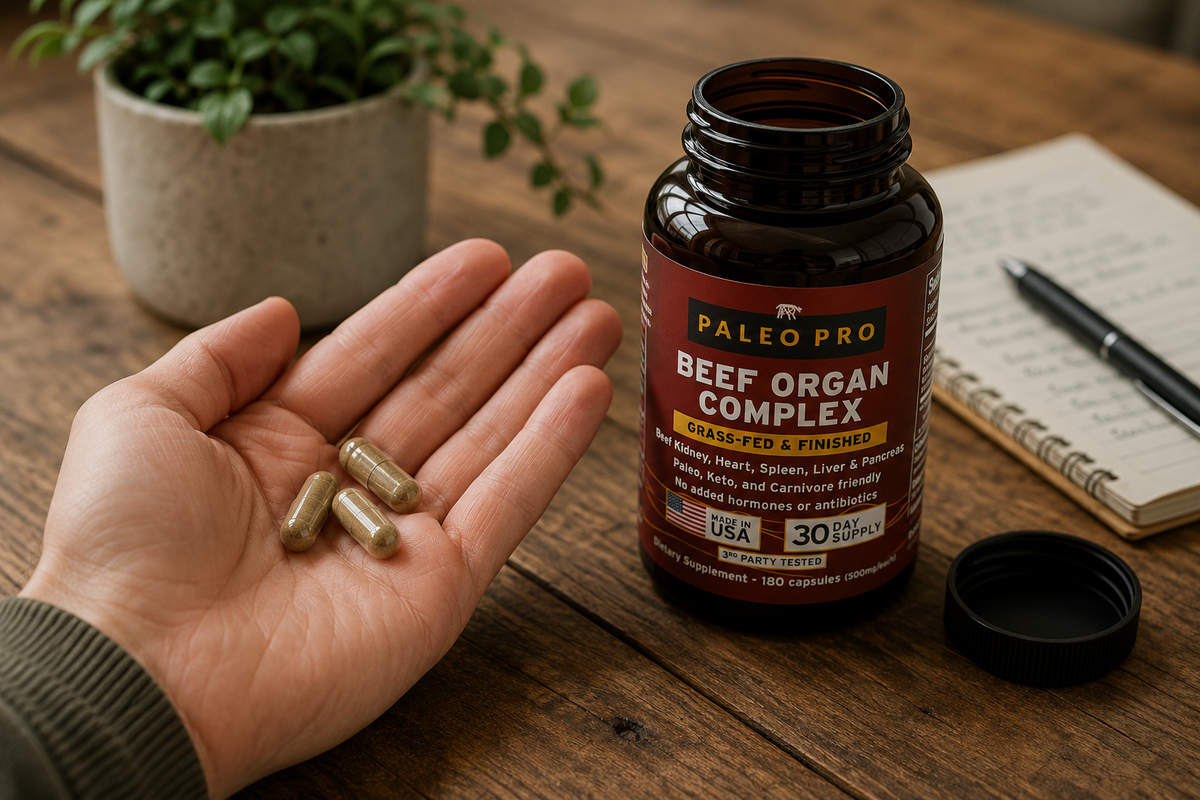
Beef organ supplements work as a concentrated whole-food source of nutrients that are otherwise hard to get — B12, preformed vitamin A, heme iron, copper, and choline — in the form your body absorbs best. What they don't do is act like a drug or fix a poor diet. Whether they're worth it comes down to sourcing, honest dosing, and whether you'd eat organ meat otherwise.
"Do these actually do anything, or am I paying for expensive ground-up filler?" It's the right question. Organ supplements are marketed with a lot of ancestral mystique and not much straight talk. So here's the straight talk: they aren't magic, and they aren't a scam. They're food — a very nutrient-dense food, packed into a capsule — and whether they "work" depends entirely on what you expect them to do. Let's separate the real mechanism from the marketing.

Prefer the single most nutrient-dense organ? Grass-fed desiccated liver, 3,000mg a serving.
Do beef organ supplements actually work? What "work" means
Organ supplements don't work the way a stimulant or a medication works. There's no drug effect. What they do is deliver a dense payload of specific nutrients in whole-food form — and for several of those nutrients, that form genuinely matters:
- Heme iron. Your body absorbs the heme iron in organ meat at roughly 15–35%, versus as little as 2–20% for the non-heme iron in plants and most iron pills — with fewer of the digestive side effects [1]. That's meaningful, because iron deficiency is the most common nutritional deficiency in the world [2].
- Preformed vitamin A (retinol). Liver delivers vitamin A as retinol, which needs no conversion — unlike the beta-carotene in vegetables, which a sizable share of people convert to active vitamin A poorly [3].
- Choline. Only about 10% of people meet the recommended intake for choline, and most multivitamins leave it out entirely [4]. Liver is one of the richest food sources.
- Natural folate. Organ meat provides folate in a form that doesn't depend on the MTHFR enzyme the way synthetic folic acid does — relevant for the roughly 40% of people who carry an MTHFR variant [5].
- CoQ10 and more. Beef heart is the richest dietary source of CoQ10 [6]; kidney concentrates selenium and spleen is one of the densest sources of heme iron of any food [7].
So "do they work?" Yes — as a way to get these nutrients without cooking organ meat you'd probably rather not cook. That's the honest claim. They support nutrient intake and the energy and function those nutrients underpin; they don't cure anything, and they can't out-run a bad diet.
If that's the job you're hiring them for, the thing that decides whether a given product delivers is whether the organs inside are real, clean, and honestly dosed.

Prefer the single most nutrient-dense organ? Grass-fed desiccated liver, 3,000mg a serving.
Organ supplements vs. a multivitamin — which actually works better?
This is the comparison most people are really making, and the honest answer is: they're good at different things. A multivitamin is a precise, consistent set of isolated nutrients. An organ blend is whole food — nutrients in their natural matrix, with cofactors, but in amounts nature decided, not a lab.
| Nutrient / factor | Beef organ blend | Standard multivitamin |
|---|---|---|
| Vitamin B12 | Very high, whole-food form | Present, synthetic |
| Vitamin A | Preformed retinol, no conversion needed [3] | Often as beta-carotene |
| Iron | Heme iron, 15–35% absorbed [1] | Non-heme, 2–20% absorbed |
| Copper | Rich, food-form | Small or absent |
| Choline | Present (liver) [4] | Usually absent |
| Folate | Natural food folate [5] | Folic acid (needs conversion) |
| Vitamin D | Low | Reliable, standardized |
| Vitamin E, calcium | Low | Reliable, standardized |
| Dose consistency | Varies by product [8] | Precise, predictable |
Read the table honestly and the verdict is a split decision. Organs win on B12, vitamin A, iron form, copper, and choline — the nutrients that are hard to get elsewhere or poorly absorbed from pills. Multivitamins win on vitamin D, vitamin E, calcium, and dosing precision — the things organs are genuinely low in. They're not really competitors so much as different tools. If your goal is whole-food B vitamins, absorbable iron, and choline, an organ blend does something a multivitamin can't. If you want guaranteed vitamin D and calcium every day, that's the multivitamin's lane.
Are beef organ supplements worth it?
"Worth it" depends on two things: the quality of the product, and whether you'd otherwise eat organ meat.
On quality, the category has a real problem. A regulatory analysis of bovine liver supplements found 59% had at least one labeling-compliance issue, and 85% of nutrient-content claims were noncompliant [8]. In a market where more than half of products misstate something on the label, a cheap, unverified supplement genuinely can be closer to "ground-up filler" than nutrition. That's the honest risk. It's also exactly why third-party testing, grass-fed sourcing, and transparent dosing are the difference between a product that's worth it and one that isn't — the full checklist is in our guide to the best beef organ supplements.
On the second question: almost nobody eats liver, heart, and kidney regularly anymore. Taste, prep, and availability are the barriers. If you value those nutrients but won't cook organ meat — which is most people — a quality supplement is a reasonable, convenient way to get them. If you happily eat fresh grass-fed liver every week, you may not need one. Worth it isn't a property of the category; it's a property of the product and your habits.
How long do beef organ supplements take to work?
Set expectations like food, not medicine. Because organ supplements work by supplying nutrients rather than triggering an effect, any change tends to be gradual and depends on where you started. Someone genuinely low in iron or B12 may notice a difference in energy over a few weeks as levels rebuild; someone already well-nourished may notice little day to day and is really taking them as nutritional insurance. There's no overnight switch, and there shouldn't be — a supplement promising an instant hit is describing a stimulant, not organ meat. Consistency over weeks is how whole-food nutrition shows up.
Frequently asked questions
Do beef organ supplements really work? Yes, in the specific sense that they deliver hard-to-get nutrients — B12, heme iron, preformed vitamin A, copper, choline — in absorbable whole-food form [1][3][4]. They support nutrient intake and the functions those nutrients drive. They don't act like a drug, cure conditions, or replace a balanced diet.
Are beef organ supplements worth the money? If the product is genuinely grass-fed and third-party tested, they're a convenient way to get nutrients you'd otherwise have to source and cook fresh organ meat for. If it's cheaply sourced or unverified — and most of the category has labeling problems [8] — you may be paying for filler. Quality is what makes them worth it.
Are organ supplements better than a multivitamin? Neither is universally better. Organ blends win on whole-food B12, absorbable heme iron, copper, and choline; multivitamins win on vitamin D, vitamin E, calcium, and precise, consistent dosing [1][4]. Many people use them for different reasons rather than choosing one.
How long until beef organ supplements work? There's no instant effect. If you were low in a nutrient like iron or B12, changes in energy can show up over a few weeks as levels rebuild; if you're already well-nourished, they act more as insurance. Consistency over weeks matters more than any single dose.
Do beef organ supplements give you energy? Not as a stimulant. They supply nutrients — B12, iron, riboflavin — that are involved in normal energy metabolism, so people who were short on them often report steadier energy once levels are restored [1][2]. This is nutritional support, not a caffeine-like boost.
Who shouldn't take beef organ supplements? Pregnant women should be cautious with liver-heavy products because of vitamin A, and people with Wilson's disease should avoid organ meat's copper. See our guide to beef liver side effects for the full safety picture.
Do beef organ supplements work? As whole-food nutrition, yes — with the honest asterisk that the product has to be real, clean, and well-dosed to be worth it. Get that right and you're getting some of the most nutrient-dense food there is, in a form you'll actually take.
Want an organ supplement that clears the quality bar? Beef Organ Complex is a grass-fed, five-organ blend — liver, heart, kidney, spleen, and pancreas — third-party tested, filler-free, and backed by a 60-day money-back guarantee. Prefer to focus on the single most nutrient-dense organ? Our grass-fed Beef Liver delivers 3,000mg a serving. Compare the lineup in the organ supplements collection.
Sources
- Gallo Ruelas, M., et al. (2024). "A comparative analysis of heme vs non-heme iron administration: a systematic review and meta-analysis of randomized controlled trials." European Journal of Nutrition, 64(1), 30. PMID: 39708071
- GBD 2021 Anaemia Collaborators (2023). "Prevalence, years lived with disability, and trends in anaemia burden by severity and cause, 1990–2021." The Lancet Haematology, 10(9), e713–e734. PMID: 37536353
- Tang, G. (2010). "Bioconversion of dietary provitamin A carotenoids to vitamin A in humans." American Journal of Clinical Nutrition, 91(5), 1468S–1473S. PMID: 20200262
- Zeisel, S.H., & da Costa, K.A. (2009). "Choline: an essential nutrient for public health." Nutrition Reviews, 67(11), 615–623. PMID: 19906248; NIH Office of Dietary Supplements (2024). "Choline — Health Professional Fact Sheet" (only ~10% of Americans meet the AI). ods.od.nih.gov
- Carboni, L. (2022). "Active Folate Versus Folic Acid: The Role of 5-MTHF (Methylfolate) in Human Health." Integrative Medicine (Encinitas), 21(3), 36–40. PMID: 35999905
- Mattila, P., & Kumpulainen, J. (2001). "Coenzymes Q9 and Q10: Contents in Foods and Dietary Intake." Journal of Food Composition and Analysis, 14(4), 409–417. PMID: 11257723
- USDA FoodData Central — Beef liver, braised (FDC ID 168626); nutrient density reference for organ meats. fdc.nal.usda.gov
- Silva, C.S., Dahm, M.M., & Hellberg, R.S. (2022). "Bovine Liver Supplement Labeling Practices and Compliance With U.S. Regulations." Journal of Dietary Supplements, 19(1), 4–19. PMID: 33148079
