Beef Organ Supplements for Hair and Skin: What Actually Helps
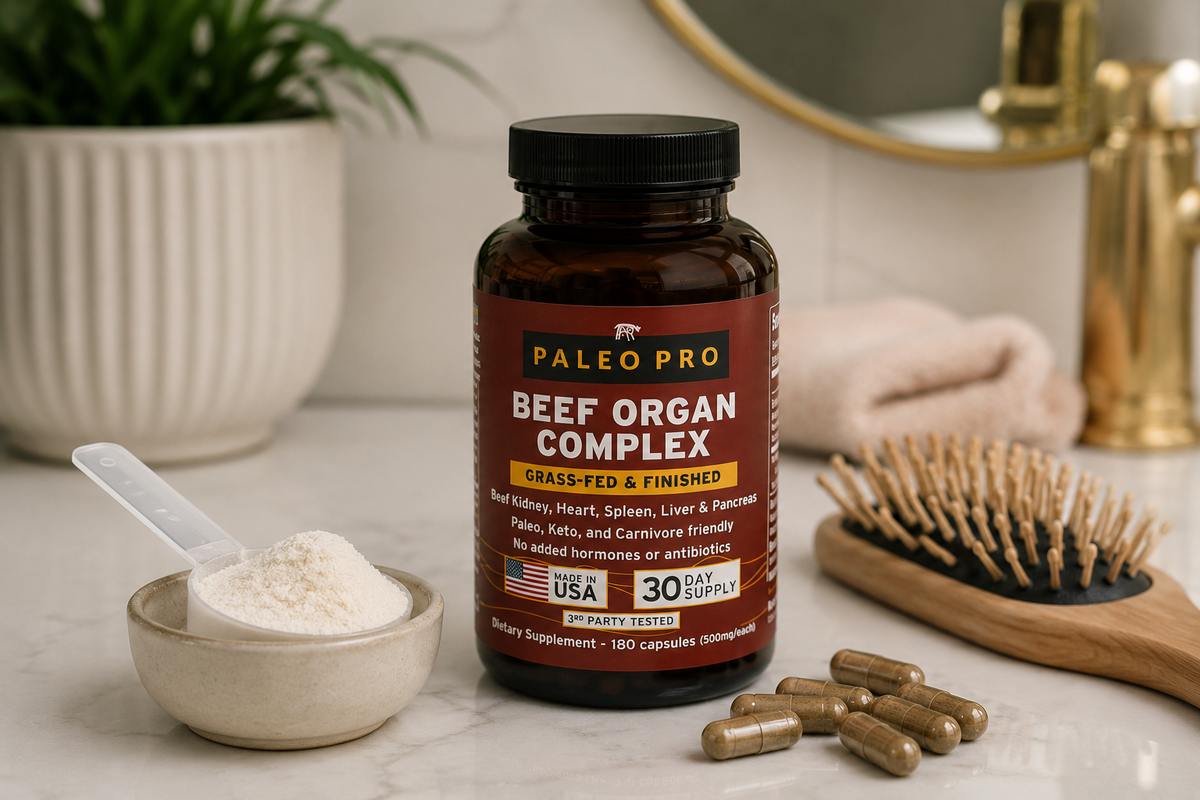
Beef organ supplements support hair and skin indirectly — by supplying nutrients these tissues depend on, including vitamin A, iron, zinc, copper, and B vitamins. They aren't a topical treatment and won't regrow hair or erase wrinkles. Collagen (a separate supplement) has some clinical support for skin elasticity, though the evidence is debated. The honest approach is nutrient sufficiency first, collagen as an add-on.
Hair and skin are where nutrient status shows up first — and where the supplement industry makes its boldest promises. Beef organs and collagen both get marketed for "hair, skin, and nails," and the truth is more useful than the hype: organs feed the tissues, collagen is a separate and genuinely debated player, and neither works like a cream. Here's what actually helps, what's oversold, and how to think about it honestly.
How organ nutrition supports hair and skin
Hair and skin are built and maintained from nutrients, so a shortfall in the wrong one shows up as dullness, thinning, or slow growth. Organ meats are dense in several of the nutrients these tissues rely on:
- Vitamin A (retinol). Liver is the richest food source of preformed vitamin A, which is essential for normal skin-cell turnover and repair [1]. (Topical retinoids — vitamin A derivatives — are among the best-evidenced skincare ingredients, which tells you the nutrient genuinely matters for skin.)
- Copper. Copper drives lysyl oxidase, the enzyme that cross-links collagen and elastin — the fibers that give skin its firmness and stretch [2]. Liver is the richest common food source of it.
- Iron. Low iron is one of the nutritional factors associated with hair shedding, and iron deficiency is extremely common, especially in women [3]. Organ meats supply iron in the well-absorbed heme form.
- Zinc and B vitamins. Zinc supports skin repair, and liver is a leading whole-food source of B vitamins including biotin — the "hair and nails" B vitamin [4]. Worth an honest caveat: biotin supplements help hair only if you were actually deficient, which is uncommon.
The honest mechanism here is sufficiency, not super-dosing. If a nutrient shortfall was holding your hair or skin back, restoring it from a nutrient-dense food can help. If you were already well-nourished, adding more won't push past normal. Organs are a way to cover those bases with whole food — not a growth serum.

A grass-fed, five-organ blend rich in the vitamin A, iron, and copper skin and hair are built from — third-party tested and filler-free.
What about collagen? The skin angle
Organs feed skin its raw-material nutrients, but the ingredient most people associate with skin is collagen — and it's a different supplement with a different story. Collagen is the protein that forms the firm, springy mesh of the skin's dermis, and the body makes less of it with age [5]. That's why collagen peptides are marketed for skin, and why they pair naturally with organ nutrition rather than duplicating it.
The clinical picture is genuinely mixed, and honesty matters here:
- Several randomized trials report benefits. In one, 2.5–5g of collagen peptides for eight weeks significantly improved skin elasticity, most in women over 50 [6]. In another, 2.5g daily reduced eye-wrinkle volume and raised the skin's own collagen production [7].
- But most of those positive trials were funded by collagen manufacturers — and that matters. The most rigorous recent analysis, which separated industry-funded studies from independent ones, found that the non-industry studies showed no significant effect on skin hydration, elasticity, or wrinkles, and concluded there's currently insufficient clinical evidence to recommend collagen for skin aging [8].
So the honest read on collagen for skin: there's real, repeated evidence of benefit, and there's real reason to be skeptical of how much of it is industry-shaped. It's a reasonable thing to try — not a guaranteed result.
The honest truth about collagen for skin
Because this is exactly where beauty supplements oversell, it's worth stating plainly:
- Collagen may modestly support skin elasticity and hydration over 8–12 weeks, especially as you age past 50 [6][7] — but the independent evidence is weaker than the ads suggest [8].
- It is not a wrinkle cure, and it works slowly if at all.
- For skin aging specifically, the best-evidenced steps are still sun protection and topical retinoids — a supplement is a supporting player, not the lead.
That honesty is the point: collagen is worth trying if you have realistic expectations, and it's a fair complement to whole-food nutrient support — not a replacement for the basics.
Organs, collagen, or both — what actually works for hair and skin?
Putting it together, here's the sensible hierarchy:
- Cover your nutrients first. Iron, vitamin A, zinc, copper, and B vitamins are the foundation — a deficiency will undermine anything else you try. A nutrient-dense organ supplement is an efficient way to shore these up [1][2][3].
- Add collagen if skin is your goal. If elasticity and hydration are what you're after, a collagen supplement is the more targeted add-on, with the honest caveats above [6][8].
- Give it time, and mind the basics. Hair grows slowly; skin turns over on its own schedule. Sleep, protein, sun protection, and patience do more than any capsule.
For the fuller women's take on this — protein's role in skin, hair, and nails alongside collagen — see our guide to protein for skin, hair, and nails.
Frequently asked questions
Do beef organ supplements help hair growth? Indirectly. They supply nutrients hair depends on — iron, zinc, biotin and other B vitamins, and vitamin A — so they can help if a shortfall was contributing to thinning [1][3][4]. They don't force new growth, and if you're already well-nourished the effect is limited. Persistent hair loss is worth discussing with a doctor.
Are beef organ supplements good for skin? They provide nutrients skin uses to renew and stay firm — vitamin A for cell turnover, copper for collagen cross-linking [1][2]. That supports skin health from the inside, but it's nutrient support, not a topical treatment. For elasticity specifically, collagen is the more targeted (if debated) option.
Should I take organ supplements or collagen for skin? They do different jobs. Organs supply the nutrients skin is built from; collagen peptides target skin elasticity and hydration directly, with mixed evidence [6][8]. Many people who prioritize skin use both — organs for nutrient sufficiency, collagen as the skin-specific add-on.
Does collagen actually work for skin? Some randomized trials show improved elasticity and hydration, but many were industry-funded, and the most rigorous independent analysis found no significant effect [6][8]. It's reasonable to try with realistic expectations; it is not a proven wrinkle treatment.
Which nutrient is most important for hair and skin? There's no single one — hair and skin need iron, zinc, vitamin A, copper, and B vitamins together, and a shortfall in any can show. That's the argument for a nutrient-dense whole-food source over a single isolated pill [1][2][3].
How long until I see results for hair and skin? Slowly — think months, not weeks. Skin may show hydration or elasticity changes over 8–12 weeks with collagen [6]; hair grows only about half an inch a month, so nutrient improvements take a full growth cycle to show. Patience is part of the plan.
The honest bottom line: beef organs support hair and skin by feeding them the nutrients they're made from, and collagen adds a targeted — if debated — skin benefit. Neither is magic, both are reasonable, and expectations set the difference between satisfied and disappointed.
Want to cover the nutrient basics for hair and skin? Beef Organ Complex is a grass-fed, five-organ blend rich in vitamin A, iron, and copper — third-party tested and filler-free, with a 60-day money-back guarantee. For targeted skin support, our Premium Multi-Collagen pairs naturally with it.
Sources
- Tang, G. (2010). "Bioconversion of dietary provitamin A carotenoids to vitamin A in humans." American Journal of Clinical Nutrition, 91(5), 1468S–1473S. PMID: 20200262
- Linus Pauling Institute (2024). "Copper." Micronutrient Information Center, Oregon State University (lysyl oxidase; collagen and elastin cross-linking). lpi.oregonstate.edu
- GBD 2021 Anaemia Collaborators (2023). "Prevalence, years lived with disability, and trends in anaemia burden by severity and cause, 1990–2021." The Lancet Haematology, 10(9), e713–e734. PMID: 37536353
- USDA FoodData Central — Beef liver, braised (FDC ID 168626); B vitamins including biotin, zinc. fdc.nal.usda.gov
- Varani, J., et al. (2006). "Decreased collagen production in chronologically aged skin." American Journal of Pathology, 168(6), 1861–1868. PMID: 16723701
- Proksch, E., et al. (2014). "Oral supplementation of specific collagen peptides has beneficial effects on human skin physiology." Skin Pharmacology and Physiology, 27(1), 47–55. PMID: 23949208 [industry-funded]
- Proksch, E., et al. (2014). "Oral intake of specific bioactive collagen peptides reduces skin wrinkles and increases dermal matrix synthesis." Skin Pharmacology and Physiology, 27(3), 113–119. PMID: 24401291 [industry-funded]
- Myung, C.H., & Park, C.H. (2025). "Effects of Collagen Supplements on Skin Aging: A Systematic Review and Meta-Analysis of Randomized Controlled Trials." American Journal of Medicine, 138(9). PMID: 40324552
