Beef Testicle Supplement: Benefits, Research, and What to Expect
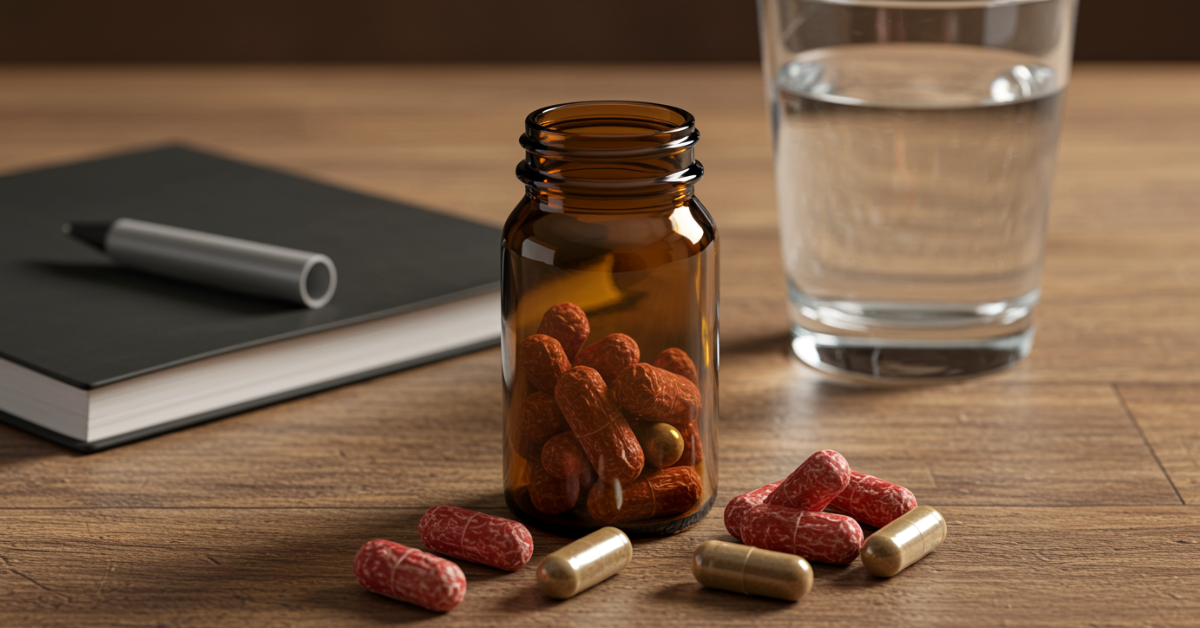
Beef testicle supplements — also called orchic extract or bovine orchic substance — are freeze-dried capsules of desiccated bull testicle. They provide zinc, selenium, B12, protein, and cholesterol (the precursor to all steroid hormones), plus peptides unique to testicular tissue. The ancestral logic is simple: eat the organ to support the organ. The modern evidence is more complicated. Some claims hold up. Others don't. And the most popular claim — that eating testicles boosts testosterone — deserves a harder look than most supplement companies are willing to give it.
Let's be straight about something: this is the PaleoPro product with the thinnest clinical evidence behind it. That doesn't mean it's worthless. It means we owe you an honest breakdown rather than a marketing pitch.
The Testosterone Question: Does Eating Testicles Boost Testosterone?
This is why most people land on this page, so let's address it first.
The short answer: probably not in the way you're hoping.
Bovine testicles contain only trace testosterone — on the order of tens of nanograms per gram of tissue. That sounds like something until you do the math. A typical daily serving of desiccated testicle powder (3,000-6,000 mg) works out to at most a few hundred nanograms of testosterone, against the roughly 6-7 milligrams your body makes every day. The supplement dose is a tiny fraction of one percent of your daily production.
Even if you could absorb all of it — which you can't — oral testosterone is very poorly absorbed, because the liver metabolizes most of it on first pass. You'd need to consume roughly a kilogram of raw bull testicles to get 6-8 mg of testosterone, and after gut absorption losses and liver metabolism, you'd retain a fraction of a fraction.
Third-party lab analyses of desiccated testicle supplements have detected testosterone, androstenediol, and other naturally occurring hormones — but at levels measured in nanograms per gram. These are trace amounts, present because the tissue is real testicular tissue, not because they're in physiologically meaningful quantities.
What about indirect effects? There's a more nuanced argument: that testicular tissue provides building blocks and signaling molecules that support your body's own testosterone production, rather than delivering testosterone directly. This is plausible but unproven. No human clinical trial has measured testosterone levels before and after bovine testicle supplementation.

Grass-fed bull testicle in a capsule — traditional nose-to-tail nutrition, no raw organs to source.
What Beef Testicle Supplements Actually Contain
While the testosterone angle is overstated, the nutritional profile has real substance:
| Nutrient | Approximate per 100g | Why It Matters |
|---|---|---|
| Protein | ~26g | Complete protein with full amino acid profile |
| Zinc | ~1.6 mg | Essential for testosterone synthesis, immune function |
| Selenium | ~Trace amounts | Thyroid function, antioxidant defense, sperm quality |
| Vitamin B12 | Present | Energy metabolism, nervous system function |
| Cholesterol | ~375 mg | Raw material the body uses for steroid hormones in general; dietary cholesterol doesn't raise testosterone (see below) |
| Unique peptides | Unquantified | Tissue-specific bioactive compounds (see below) |
The nutritional profile is modest compared to liver (which delivers several thousand percent of the DV for B12 and many times the DV for vitamin A in a single serving). Testicle supplements aren't nutrient bombs the way liver is. Their appeal lies more in the tissue-specific compounds — peptides and growth factors unique to reproductive tissue — than in raw vitamin content.
The "Like Supports Like" Principle: History and Science
The idea that eating an animal organ supports the corresponding human organ goes back thousands of years:
Paracelsus (1493-1541) formalized this as the "Doctrine of Signatures" — the principle that nature marks each growth according to its curative benefit. Kidney heals kidney. Liver heals liver.
Traditional Chinese Medicine has prescribed animal organ consumption for corresponding organ support for over 2,000 years. Testicles and reproductive organs specifically were used to address fertility and vitality.
19th-century organotherapy gave this principle scientific teeth. In 1889, physician Charles-Édouard Brown-Séquard injected himself with extracts from guinea pig and dog testicles and reported increased vigor and energy. When modern researchers replicated his method, they found the extract's testosterone was orders of magnitude too low to have any biological effect — his reported benefits were a placebo (Cussons et al., 2002). Still, his work launched the field of endocrinology and eventually led to the isolation and synthesis of actual hormones.
The modern validation: Thyroid organotherapy actually works. Desiccated thyroid (Armour Thyroid) is still prescribed today as a legitimate treatment for hypothyroidism. The thyroid gland contains the actual hormones (T3 and T4) in therapeutic quantities, and they survive oral digestion. This established that glandular therapy can work — when the active compounds are present in sufficient quantities and survive digestion.
The key question for testicle supplements: do the active compounds survive digestion in meaningful amounts?
What Does the Research Actually Show?
Let's separate what we know from what we're guessing.
What We Know
Zinc is essential for testosterone production. This is well-established. Zinc deficiency directly reduces testosterone levels, and supplementation restores them. A classic study found that marginal zinc deficiency in elderly men (serum zinc: normal-low) was associated with reduced testosterone, and supplementation for six months increased serum testosterone from 8.3 to 16.0 nmol/L (Prasad et al., 1996).
But zinc supplementation in zinc-sufficient men does not boost testosterone. A study of healthy, regularly exercising men with adequate zinc levels found that ZMA supplementation (which includes zinc) had no significant effect on serum testosterone. A 2023 systematic review by Te et al. confirmed: zinc's effect on testosterone depends entirely on baseline zinc status (Te et al., 2023).
More broadly, a systematic analysis of 50 "testosterone boosting" supplements found no published data supporting orchic (testicle) extract for testosterone, and that most such products contained no ingredient with a plausible mechanism to raise it (Clemesha et al., 2020). If you want the deeper honest breakdown of organs and men's health, see our guide to beef organ supplements for men.
Cholesterol is the biochemical precursor to testosterone. All steroid hormones — testosterone, estrogen, cortisol, DHEA — are synthesized from cholesterol. Testicle tissue provides dietary cholesterol. However, dietary cholesterol has minimal effect on serum cholesterol in most people, and the rate-limiting step in testosterone synthesis is enzyme activity (StAR protein, CYP enzymes), not cholesterol availability.
What We Don't Know (Honest Gaps)
No human trials exist on bovine testicle supplementation and testosterone levels. Zero. Not one. Every testosterone claim made by testicle supplement companies is based on theoretical reasoning, not measured outcomes.
Bioactive peptide survival is questionable. Larger peptides from organ supplements face substantial barriers to surviving digestion. Single amino acids and small di/tripeptides are absorbed, but most larger bioactive molecules are broken down by digestive enzymes before reaching the bloodstream. The oral tolerance mechanism that makes UC-II collagen work for joints (see our guide to collagen types explained) is a specific exception, not a general rule.
We don't know what "tissue-specific factors" actually do in supplement form. The ancestral logic is compelling. The historical precedent (thyroid extract) proves the concept can work. But testicle tissue ≠ thyroid tissue, and the absence of evidence isn't evidence of effect.
Who Might Benefit from Beef Testicle Supplements?
Given the evidence gaps, who's the best candidate?
Men interested in nose-to-tail nutrition. If you're already eating ancestrally and want to incorporate all parts of the animal, testicle supplements are a practical way to include reproductive organ tissue in your diet. The nutritional contribution — zinc, selenium, B12, cholesterol, protein — is real, even if the testosterone claim is unproven.
Carnivore dieters. Testicle is a traditional part of nose-to-tail carnivore eating. PaleoPro Beef Testicle is 100% carnivore-compatible. For the complete supplement guide, see our article on carnivore diet supplements. New to the diet? Start with our complete carnivore diet guide.
Men who are zinc-deficient. If you're not getting adequate zinc from your diet (common in men over 40, heavy exercisers, and those on restricted diets), the zinc in testicle supplements may have a meaningful impact. But you'd get more zinc from a dedicated zinc supplement or from beef liver.
People drawn to the ancestral philosophy. The "like supports like" principle has ancient roots and partial modern validation. If that framework resonates with you and you understand the evidence limitations, testicle supplements fit within an ancestral nutrition approach.
What Not to Expect
Let's be specific about what beef testicle supplements won't do:
- They won't dramatically raise your testosterone. The trace hormone content is orders of magnitude below therapeutic doses.
- They won't replace TRT. If you have clinically low testosterone, that's a medical issue requiring medical treatment.
- They won't match liver's nutrient density. For raw nutritional firepower, beef liver and beef organs deliver far more per capsule.
- They won't work overnight. Even if the ancestral "support the organ" concept holds, nutritional support is a long-term game.
How Beef Testicle Compares to Other PaleoPro Organ Supplements
| Factor | Beef Testicle | Beef Liver | Beef Organs (Blend) |
|---|---|---|---|
| Clinical evidence | Very limited | Strong (nutrients well-studied) | Moderate (individual nutrients studied) |
| Primary nutrients | Zinc, selenium, B12, cholesterol | B12, vitamin A, copper, choline, folate, iron | Broad spectrum (all organs combined) |
| Unique compounds | Testicular peptides, trace hormones | Retinol, heme iron | CoQ10 (heart), selenium (kidney), heme iron (spleen) |
| Best for | Ancestral nutrition, nose-to-tail | Nutrient density, B12/iron support | Broad-spectrum organ nutrition |
| Price per benefit | Lower nutrient density per capsule | Highest nutrient density per capsule | Best value for breadth |
For most people, PaleoPro Beef Organs or Beef Liver provides more documented nutritional benefit per capsule. Beef Testicle is best understood as a targeted supplement within a broader nose-to-tail approach — not as a standalone nutrition strategy.
Frequently Asked Questions
Do beef testicle supplements increase testosterone?
No clinical evidence supports this claim. Bovine testicles contain only trace testosterone (a few tens of nanograms per gram), but the amount in a supplement serving is a tiny fraction of one percent of your body's daily production. After digestion and liver metabolism, the delivered hormone dose is negligible. The zinc content may support testosterone production if you're zinc-deficient, but that effect comes from zinc, not from the testicular tissue specifically.
What is orchic extract?
Orchic extract is another name for desiccated (dried) bovine testicle tissue. "Orchic" comes from the Greek word for testicle. It contains the same nutrients and compounds as whole desiccated testicle supplements. The terms are interchangeable.
Are beef testicle supplements safe?
At recommended supplement doses (3,000-6,000 mg/day), beef testicle supplements have no documented safety concerns in the published literature. They do contain trace naturally occurring hormones (testosterone, androstenediol), which could theoretically be a concern for competitive athletes subject to anti-doping testing — one third-party lab analysis found these compounds above the level of reporting. If you compete in tested sports, check with your sport's governing body before use.
How long does it take to see results from beef testicle supplements?
Given the lack of clinical trials, there's no evidence-based timeline. Anecdotal reports from users suggest 4-8 weeks for subjective effects (energy, libido), but these reports are not controlled for placebo effect. Nutritional support from the zinc, selenium, and B12 content would follow standard nutrient repletion timelines.
Can women take beef testicle supplements?
There's no specific reason women can't, though the product is primarily marketed to men. The zinc, selenium, and B12 content is relevant regardless of sex. Women with PCOS or other conditions affecting androgen levels should consult a healthcare provider first.
What's better — beef testicle or zinc supplements?
If your goal is specifically zinc for testosterone support, a dedicated zinc supplement (15-30 mg zinc as glycinate or picolinate) provides a more precise and studied dose. Beef testicle provides zinc plus the full tissue matrix — including peptides and compounds that may have value beyond isolated minerals, but this added value is unproven. PaleoPro Beef Testicle gives you the whole tissue approach; a zinc supplement gives you the isolated nutrient approach.
Here's the honest version: beef testicle supplements won't turn you into a hormonal powerhouse. What they will do is give you a whole-food source of zinc, selenium, B12, and tissue-specific compounds from an organ your ancestors valued for centuries. The ancestral logic is real. The nutritional content is real. The testosterone claims are overstated industry-wide. We'd rather tell you that than sell you a fantasy. PaleoPro Beef Testicle is grass-fed, freeze-dried, and exactly what it says it is. For broader organ nutrition, check out Beef Organs or Carnivore Complete. Browse the full supplement collection.
Sources:
- Prasad, A.S., et al. (1996). "Zinc status and serum testosterone levels of healthy adults." Nutrition, 12(5), 344-348. PubMed
- Te, L., Liu, J., Ma, J., & Wang, S. (2023). "Correlation between serum zinc and testosterone: A systematic review." Journal of Trace Elements in Medicine and Biology, 76, 127124. PubMed
- Fuerniss, H.F., et al. (2024). "Nutrient Analysis of Raw United States Beef Offal Items." Nutrients, 16(18), 3104. PubMed
- Clemesha, C.G., Thaker, H., & Samplaski, M.K. (2020). "'Testosterone Boosting' Supplements Composition and Claims Are not Supported by the Academic Literature." World Journal of Men's Health, 38(1), 115-122. PubMed
- Cussons, A.J., Bhagat, C.I., Fletcher, S.J., & Walsh, J.P. (2002). "Brown-Séquard revisited: a lesson from history on the placebo effect of androgen treatment." Medical Journal of Australia, 177(11-12), 678-679. PubMed
- Molecules (2020). "Current Evidence on the Bioavailability of Food Bioactive Peptides." Molecules, 25(19), 4479. PMC
- Price, W.A. (1939). Nutrition and Physical Degeneration. Paul B. Hoeber/Harper & Brothers.
