Collagen Types Explained: What Types I, II, and III Mean
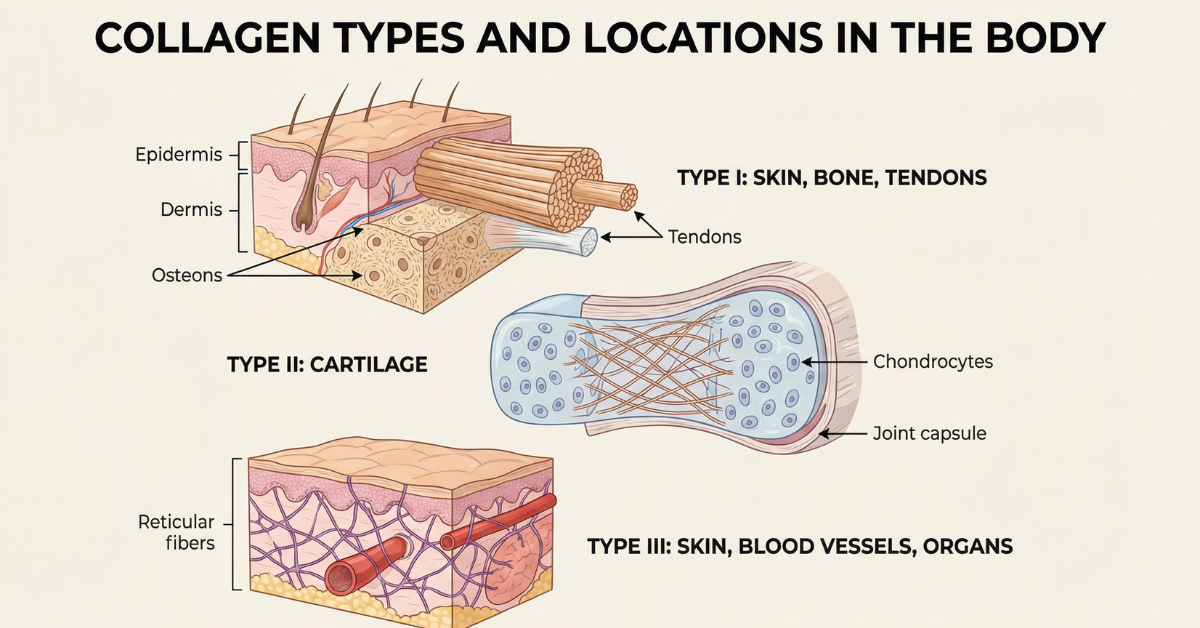
Scientists have identified 28 collagen types. Types I, II, and III account for much of the supplement conversation because they are common in skin, bone, cartilage, and other connective tissues. A type number describes a protein in the body. It does not, by itself, tell you the source, processing, dose, or proven benefit of a supplement.
That last distinction clears up most of the confusion on a collagen label.
What do the main collagen types do in the body?
Collagens are a family of structural proteins in the extracellular matrix. Different types assemble in different tissues and perform different jobs [1]. The familiar supplement numbers are biological classifications, not a ranking from best to worst.
| Type | Common locations in the body | Main structural role | Common source clue on supplements |
|---|---|---|---|
| I | Skin, bone, tendon, ligament | Tensile strength and structural framework | Bovine hide, fish skin, bone-derived materials |
| II | Cartilage and vitreous humor | Cartilage framework | Chicken cartilage |
| III | Skin, blood vessels, hollow organs | Flexible reticular support, often beside Type I | Bovine tissues |
| V | Cornea, skin, hair, placenta | Helps regulate formation of Type I fibers | Eggshell membrane or multi-source blends |
| X | Growth-plate cartilage | Involved in bone development | Chicken cartilage or multi-source blends |
These locations explain why marketers connect Type I with skin, Type II with joints, and Type III with flexible tissues. They do not prove that swallowing a named type sends it to that same tissue. Digestion breaks dietary proteins into amino acids and peptides, and the body decides where those materials are used.
Use the type number as one label detail, then check the ingredient form, source, dose, and evidence for your actual goal.

20g of total protein with four disclosed collagen sources in one protein-and-collagen blend.
Is a collagen type the same as a collagen source?
No. Type describes molecular structure. Source describes the animal tissue used to make the ingredient.
Bovine, marine, chicken, and eggshell membrane are sources. Hydrolyzed, gelatin, and undenatured describe processing or physical form. A label can combine these ideas, such as “hydrolyzed bovine collagen peptides,” without stating an exact amount of each collagen type.
Source can offer clues. Bovine hide is rich in Types I and III. Fish skin is mainly associated with Type I. Cartilage is associated with Type II. But starting tissue and finished powder are not identical. Manufacturing, blending, and hydrolysis change the material, and many labels do not quantify individual types.
This matters with a five-type claim. The formula may contain ingredients sourced from tissues associated with Types I, II, III, V, and X. That does not mean each type appears in an equal or clinically studied dose.
What does hydrolyzed collagen mean?
Hydrolyzed collagen has been broken into smaller protein fragments called peptides. The process generally makes the ingredient easier to disperse and changes it so it no longer behaves like gelling gelatin.
A human study detected several hydroxyproline-containing peptides in blood after participants consumed gelatin hydrolysates [2]. That is useful mechanism evidence. It shows that some dietary collagen peptides can survive digestion long enough to circulate. It does not prove that every source or type produces the same health outcome.
Most scoopable collagen products use hydrolyzed material in gram quantities. Clinical trials on hydrolyzed collagen also tend to use grams per day, but the studied dose varies with the ingredient and outcome. “Hydrolyzed” is a processing fact, not a promise of superior absorption or guaranteed results.
How is undenatured Type II different?
Undenatured Type II collagen is a separate category from ordinary hydrolyzed peptides. It keeps a more intact native structure and is usually supplied from chicken cartilage in milligram amounts.
In a 180-day randomized trial, 191 people with knee osteoarthritis received 40 milligrams of a branded undenatured Type II ingredient, glucosamine plus chondroitin, or placebo. The Type II group improved more on the study's symptom score than the comparison groups [3]. Two study authors worked for the ingredient company, and the result applies to that undenatured material and population.
Do not transfer that study to a hydrolyzed “Type II” blend. Hydrolyzed collagen is processed differently and used at a very different dose. A product that merely lists chicken collagen or a Type II source has not established that it supplies the studied undenatured ingredient.
This is the most important type distinction on the shelf. Form can matter more than the Roman numeral.
Does the collagen type determine the benefit?
Not reliably. Human studies usually test a specific ingredient, dose, population, outcome, and duration. The type name may be part of the intervention, but it is not the whole intervention.
For joint symptoms, a 2024 meta-analysis covering 35 randomized trials found small-to-moderate improvements in pain and function across collagen derivatives [4]. The pooled category included varied products. That supports a possible role for certain collagen interventions in osteoarthritis, not a claim that every Type II or multi-type powder works.
For skin aging, a 2025 meta-analysis reached a more skeptical conclusion. Although pooled results across 23 trials favored collagen, higher-quality studies and studies without pharmaceutical-company funding did not show significant improvements in hydration, elasticity, or wrinkles [5]. A “Type I” label does not solve those study-quality problems.
The bone broth collagen benefits guide grades the evidence for joints, skin, bone, digestion, and general protein use separately.
The honest hierarchy is simple:
- Exact studied ingredient
- Dose and duration
- Population and outcome
- Study quality and funding
- Source and collagen-type claims on the label
The type number belongs on the list. It just should not sit at the top.
Which collagen type should you choose?
Choose around the use and evidence, not the largest number of types.
For a general hydrolyzed collagen serving
Look for protein grams, a clearly named source, allergens, and a formula you can use consistently. A single-source product can be easier to evaluate than a proprietary blend.
For joint-specific research
Determine whether the evidence concerns hydrolyzed collagen in grams or undenatured Type II in milligrams. Those are not interchangeable. Joint pain also deserves medical evaluation rather than self-diagnosis from a supplement aisle.
For skin goals
Treat the evidence as uncertain. Positive trials exist, but the strongest 2025 analysis found that study quality and funding materially changed the result [5]. Avoid products that promise to erase wrinkles or rebuild skin.
For dietary restrictions
Source may matter more than type. Marine collagen is a fish-derived ingredient. Chicken materials and eggshell membrane can matter to people managing allergies or food preferences. Read the allergen statement as well as the front label.
For complete protein needs
Collagen is not a substitute for a balanced complete protein. Its amino-acid pattern is rich in glycine, proline, and hydroxyproline but lacks tryptophan and is low in several indispensable amino acids. Count the grams on the label while keeping the nutritional role separate.
Are multi-collagen products better?
A multi-collagen formula can be convenient when you want several source materials in one product. It is not automatically more effective than a single-source collagen.
If you want that collagen alongside a full serving of protein, see how to choose a protein powder with collagen.
Ask three questions:
- Does the label name each source?
- Does it disclose the total protein or collagen amount?
- Is there human evidence for the finished blend, or only for separate ingredients?
Paleo Pro's Protein+ Multi-Collagen currently lists beef protein isolate plus hydrolyzed beef collagen, marine collagen, chicken bone-broth collagen, and eggshell membrane. It provides 20 grams of total protein per serving [6]. Those facts describe the formula. They do not establish an equal dose of every collagen type or prove that the blend reproduces trials on the individual materials.
Shoppers who want a collagen-only comparison can browse the collagen collection. For the difference between a broth food and hydrolyzed powder, read bone broth vs collagen peptides.
How do you read a collagen supplement label?
Read it in this order:
- Protein grams: the measured amount in the serving.
- Ingredient form: hydrolyzed collagen, gelatin, bone broth, or undenatured Type II.
- Source: bovine, marine, chicken, eggshell membrane, or a blend.
- Blend disclosure: whether amounts are listed for each component.
- Allergens: especially fish and egg-derived materials.
- Other ingredients: flavors, sweeteners, cocoa, lecithin, or botanicals.
- Evidence match: exact ingredient, dose, population, duration, and outcome.
A front label can carry five Roman numerals and still leave the useful questions unanswered. Turn the package around.
Frequently asked questions
How many types of collagen are there?
The collagen family includes 28 types [1]. Types I, II, and III dominate supplement marketing because they are abundant in common connective tissues.
What is the difference between Type I and Type II collagen?
Type I is common in skin, bone, tendon, and ligament. Type II is a central component of cartilage. In supplements, source and processing still determine what material you are taking.
What is Type III collagen used for in the body?
Type III forms flexible reticular fibers in tissues including skin, blood vessels, and hollow organs. Its biological location does not prove a Type III supplement targets those tissues.
Are Types V and X necessary in a supplement?
Human evidence has not established that adding Types V and X makes a general collagen supplement superior. Their presence may describe the source blend more than a proven outcome.
Is hydrolyzed Type II the same as undenatured Type II?
No. Hydrolyzed collagen is broken into peptides and usually dosed in grams. Undenatured Type II retains a more intact structure and has been studied in milligram doses.
Is marine collagen better absorbed than bovine collagen?
A marine source does not guarantee superior absorption. Peptide size and processing affect a hydrolyzed ingredient, and direct clinical comparisons are limited.
Can a multi-collagen replace complete protein?
Collagen protein contributes grams but does not supply a balanced indispensable amino-acid profile. Use complete protein foods or a verified complete formula for primary protein needs.
Collagen types are biology, not a shopping score. Once you separate type, source, form, and evidence, the label gets much easier to read.
Sources
- Ricard-Blum S. “The Collagen Family.” Cold Spring Harbor Perspectives in Biology. 2011;3(1):a004978. doi:10.1101/cshperspect.a004978
- Iwai K, et al. “Identification of Food-Derived Collagen Peptides in Human Blood After Oral Ingestion of Gelatin Hydrolysates.” Journal of Agricultural and Food Chemistry. 2005;53(16):6531-6536. doi:10.1021/jf050206p
- Lugo JP, Saiyed ZM, Lane NE. “Efficacy and Tolerability of an Undenatured Type II Collagen Supplement in Modulating Knee Osteoarthritis Symptoms.” Nutrition Journal. 2016;15:14. PMID: 26822714
- Liang CW, et al. “Efficacy and Safety of Collagen Derivatives for Osteoarthritis: A Trial Sequential Meta-Analysis.” Osteoarthritis and Cartilage. 2024;32(5):574-584. PMID: 38218227
- Myung SK, Park Y. “Effects of Collagen Supplements on Skin Aging: A Systematic Review and Meta-Analysis of Randomized Controlled Trials.” The American Journal of Medicine. 2025;138(9):1264-1277. doi:10.1016/j.amjmed.2025.04.034
- Paleo Pro. “Protein+ Multi-Collagen.” Product page and current product data, accessed 2026-09-17. Product details
