Best Beef Organ Supplements for Women (2026): How to Choose
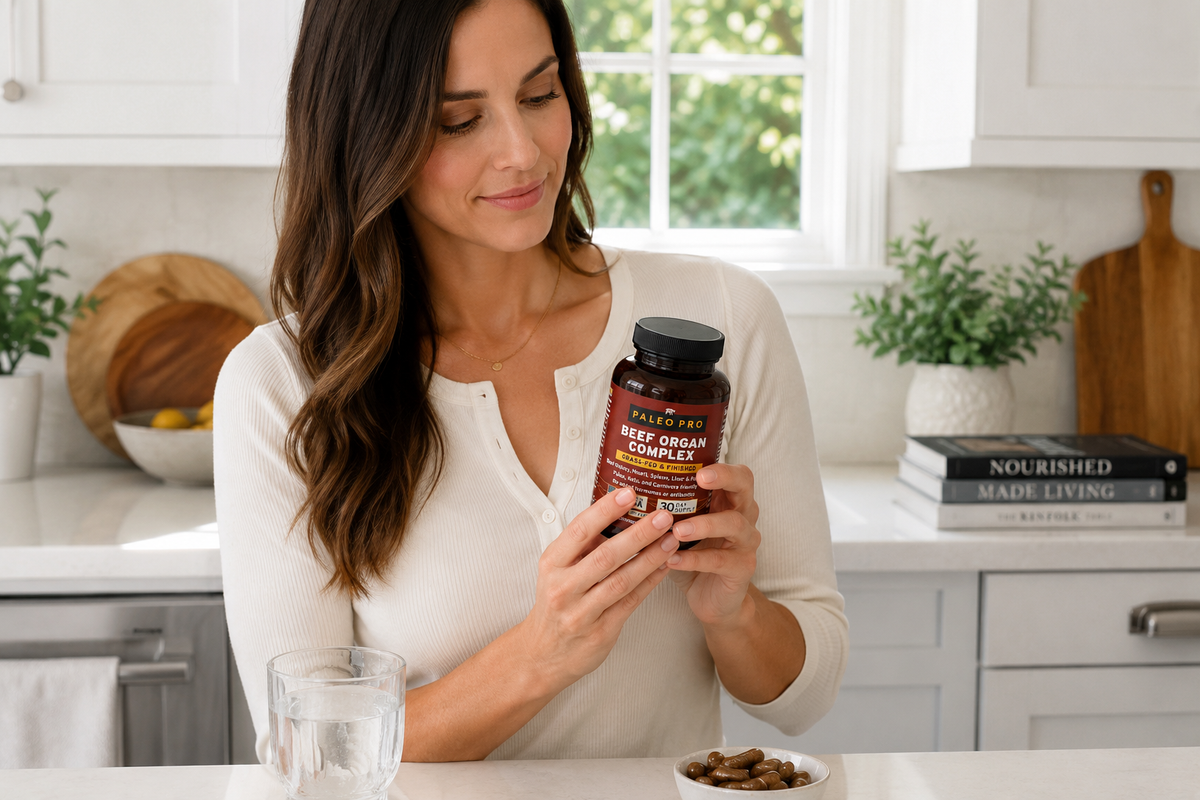
The best beef organ supplements for women are genuinely grass-fed and pasture-raised, third-party tested for purity, free of fillers, and built around the nutrients women most often run short on — heme iron, B12, folate, vitamin A, and choline. A multi-organ blend covers the widest range in one capsule, and the vitamin A dose should be sensible, which matters most during pregnancy.
Search "best beef organ supplements for women" and you'll hit a wall of ranked lists — most of them affiliate rankings dressed up as advice, sorted by commission rather than by what's actually in the capsule. This guide does it the honest way: it sets the criteria first, explains why each one matters for a woman specifically, and is candid about where the science is thin. There's no separate "female" version of an organ — a cow's liver is a cow's liver. What's different is context: the iron women lose monthly, the folate their genetics may not convert well, and the vitamin A dose that's fine most of the time but not in early pregnancy. A good organ supplement answers that context.

Add the protein, collagen, and hair-and-nails piece the organs do not cover.
How to choose a beef organ supplement for women
There's no magic ranking. There's a set of criteria, applied consistently. Here are the six that separate a genuinely good women's organ supplement from a nicely branded jar of powder:
- Genuinely grass-fed and pasture-raised. Organs concentrate whatever the animal was exposed to, so sourcing is the whole ballgame. Grass-fed, pasture-raised cattle from clean environments carry a lower contaminant load than conventionally raised animals — this is a reason to buy quality, not a reason to fear organs.
- Third-party tested — because the label often lies. This isn't a slogan. When researchers analyzed 49 bovine liver supplements, 59% had at least one labeling-compliance failure and 85% of the nutrient-content claims were noncompliant [1]. Third-party testing is the only way to know the capsule matches the panel.
- A multi-organ blend, not just liver. Liver is the most nutrient-dense single organ, but it's also where vitamin A and copper pile up fastest. A blend that adds heart, kidney, and spleen widens the nutrient range while keeping any one nutrient from dominating.
- Built around the nutrients women actually run short on. Heme iron, B12, folate, and choline — the ones women are statistically most likely to be low in. More on each below.
- A sensible vitamin A dose. Preformed vitamin A (retinol) from liver is a feature, not a bug — but it accumulates, and there's a real pregnancy caution (covered below). The best supplements dose it within a reasonable range and label it clearly.
- A clean capsule. No fillers, no flow agents, no grains or soy — just organs in a simple capsule. If a label buries the organs in a "proprietary blend," you can't tell how much of anything you're getting.
Score every product against those six and one thing becomes obvious: the best beef organ supplement for a woman isn't the one with the flashiest label — it's the one that's genuinely grass-fed, third-party tested, and built around the nutrients women actually run short on.

Add the protein, collagen, and hair-and-nails piece the organs do not cover.
Which nutrients matter most in a women's organ supplement?
Organ meats are a whole-food multivitamin [2], but a handful of their nutrients matter more for women than the rest. Here's what to prioritize and where it comes from:
| Nutrient | Why it matters for women | Best organ source |
|---|---|---|
| Heme iron | Reproductive-age women lose iron every month; iron deficiency is the most common nutritional deficiency in the world, and women of childbearing age are among the most affected [3]. Heme iron (the animal form) absorbs far better than the non-heme iron in plants and pills — with fewer of the GI side effects [4]. | Spleen, liver, kidney |
| Vitamin B12 | Central to energy metabolism and the nervous system; harder to get on plant-forward diets and less well absorbed with age. | Liver, kidney |
| Folate (natural) | About 40% of people carry an MTHFR gene variant that reduces how well they convert synthetic folic acid; natural food folate largely bypasses that step [5]. Relevant for any woman who might become pregnant. | Liver |
| Choline | Most women fall short of the recommended intake, and it's essential for brain and liver function — yet it's absent from most multivitamins [6]. | Liver |
| Vitamin A (retinol) | Supports skin, vision, and immune function in the readily absorbed preformed form — but the dose matters, especially in pregnancy [7]. | Liver |
| CoQ10 | Involved in cellular energy production; the body's own output declines after about age 40. | Heart |
The pattern is clear: no single organ covers all of it. Liver leads on B12, folate, choline, and vitamin A; spleen is the iron champion; kidney brings selenium and B12; heart brings CoQ10. That's the case for a blend — which is exactly what a well-built grass-fed beef organ complex delivers.
Organ blend or single organ — which is better for women?
For most women, a multi-organ blend is the smarter default. It spreads the nutrition across several organs, so you get iron, B12, folate, choline, CoQ10, and selenium in one capsule instead of stacking several bottles. It also moderates the two nutrients that make daily liver-only intake tricky — vitamin A and copper — by diluting them with organs that are lower in both.
A single-organ liver supplement still has a place: if your one goal is maximum vitamin A, B12, and preformed retinol, liver alone is the most concentrated option. But concentrated cuts both ways. The more liver-heavy the product, the more carefully you need to watch total vitamin A — particularly if you're pregnant, trying to conceive, or already taking a retinol-based skincare or supplement.
If you're choosing your first organ supplement and want the widest coverage with the least to think about, start with a blend. You can browse vetted options in the organ supplements collection, and go deeper on the specific benefits in our guide to beef organ supplements for women.
What about pregnancy and breastfeeding?
This is the one place to slow down. Liver is extraordinarily rich in preformed vitamin A, and high intakes of preformed vitamin A in early pregnancy have been linked to birth defects — a large study found increased malformation risk above roughly 10,000 IU/day of supplemental preformed vitamin A, concentrated in the first trimester [7]. A single serving of concentrated liver can approach or exceed that.
That doesn't make organ supplements "bad" — for a non-pregnant woman, the vitamin A in a sensibly dosed blend is a benefit. But if you are pregnant, trying to conceive, or breastfeeding, talk to your doctor before adding any liver or organ supplement, and factor in the vitamin A from your prenatal. Prenatal vitamins are formulated to cover pregnancy needs safely; layering concentrated liver on top is where the risk creeps in. This is a dosing-and-timing caution, not a reason to fear organ meats the rest of your life.
What to look for on the label (and what to skip)
The panel tells you almost everything if you know the red flags:
- "Proprietary blend" with one total number. If you can't see the milligrams of each organ, you can't judge the product. Transparency is a baseline.
- No third-party testing. With more than half of liver supplements failing basic labeling compliance [1], "trust us" isn't good enough.
- Vague sourcing. "Grass-fed" should come with a country and a pasture story, not just a badge.
- Fillers and flow agents. Magnesium stearate, maltodextrin, rice flour — a clean organ capsule doesn't need them.
- Unlabeled vitamin A. A quality product tells you how much preformed vitamin A is in a serving so you can dose responsibly.
Frequently asked questions
What is the best beef organ supplement for women? The best one is grass-fed and pasture-raised, third-party tested, filler-free, and built as a multi-organ blend so it covers the nutrients women run short on — heme iron, B12, folate, and choline — while keeping vitamin A in a sensible range. Sourcing and testing matter more than branding.
Are beef organ supplements good for women? Yes. Organ meats are a whole-food source of heme iron, B12, folate, choline, and vitamin A — nutrients that support energy, hair, skin, and overall nutrient status, and that women commonly fall short on [3][6]. They're an easy way to get organ nutrition without cooking liver.
Which organ supplement is best for iron and energy? For iron, look for a blend that includes spleen and liver — spleen is one of the richest heme-iron foods, and heme iron absorbs better than the iron in most supplements with fewer GI side effects [4]. B12 from liver and kidney supports energy metabolism alongside it.
Can I take beef organ supplements while pregnant? Check with your doctor first. Liver is very high in preformed vitamin A, and high intakes in early pregnancy carry a birth-defect risk [7]. If you're pregnant or trying to conceive, don't add a liver or organ supplement on top of a prenatal without medical guidance.
Do beef organ supplements help with hair and nails? They supply nutrients that support healthy hair and nails — notably iron, B12, and biotin-family B vitamins — so correcting a shortfall can help. They're not a topical treatment, and results depend on whether you were low to begin with.
How many organ capsules should a woman take a day? Follow the product's serving size — a common dose is six capsules once daily. Don't exceed the label, mainly because of vitamin A, and account for any vitamin A in your other supplements.
Are beef organ supplements safe? For most non-pregnant adults, a sensibly dosed, third-party-tested organ supplement from grass-fed cattle is safe taken as directed. The two things to watch are vitamin A and copper (which is why blends and label transparency matter), and pregnancy, where liver's vitamin A calls for medical guidance.
You now know the six criteria, the nutrients that matter most, and the one real pregnancy caution. If you want the short version — a grass-fed, third-party-tested, five-organ blend built around the nutrients women actually need — here's the one that checks every box.
Ready to cover your bases with real food? Beef Organ Complex is a grass-fed blend of liver, heart, kidney, spleen, and pancreas — third-party tested, no fillers, and backed by a 60-day money-back guarantee.
Sources
- Silva, S.A., Dahm, M.M., & Hellberg, R.S. (2022). "Bovine Liver Supplement Labeling Practices and Compliance With U.S. Regulations." Journal of Dietary Supplements, 19(1), 4–19. PMID: 33148079
- U.S. Department of Agriculture, FoodData Central. "Beef, variety meats and by-products, liver, cooked, braised" (FDC ID 168626). USDA FoodData Central
- GBD 2021 Anaemia Collaborators (2023). "Prevalence, years lived with disability, and trends in anaemia burden by severity and cause, 1990–2021." The Lancet Haematology, 10(9), e713–e734. PMID: 37536353
- Gallo Ruelas, M., et al. (2024). "A comparative analysis of heme vs non-heme iron administration: a systematic review and meta-analysis of randomized controlled trials." European Journal of Nutrition, 64(1), 30. PMID: 39708071
- Carboni, L. (2022). "Active Folate Versus Folic Acid: The Role of 5-MTHF (Methylfolate) in Human Health." Integrative Medicine (Encinitas), 21(3), 36–40. PMID: 35999905
- Zeisel, S.H., & da Costa, K.A. (2009). "Choline: an essential nutrient for public health." Nutrition Reviews, 67(11), 615–623. PMID: 19906248
- Rothman, K.J., et al. (1995). "Teratogenicity of high vitamin A intake." New England Journal of Medicine, 333(21), 1369–1373. PMID: 7477116
