Best Protein Powder for Women's Weight Loss: What Actually Works
The best protein powder for women's weight loss is high in protein, low in sugar and calories, and complete — so it keeps you full and protects lean muscle while you're in a calorie deficit. Look for at least 20–25 grams of complete protein per serving, under about 150 calories, and no added sugar. Protein doesn't burn fat; it makes eating less feel easier and keeps the weight you lose from coming off as muscle.
That last point is the one the "slim" and "diet" shakes leave out. Losing weight is easy to do badly — cut calories hard enough and the scale moves, but a chunk of what you lose is muscle, your metabolism slows, and the weight comes back. Protein is the single most useful lever against that. It's not a fat-burner and it's not magic; it's the nutrient that makes a lower-calorie diet livable and keeps your results made of fat, not muscle. Here's how it actually works, how much you need, and what separates a real weight-loss protein from a sugary shake with a woman on the label.
How does protein help women lose weight?
Protein helps in three concrete, well-studied ways — none of which is "melting fat."
It keeps you full. Of the three macronutrients, protein is the most satiating. Higher-protein diets improve weight management largely by increasing fullness and reducing overall calorie intake, without you having to white-knuckle it [1]. A protein-rich breakfast or afternoon shake blunts the mid-afternoon hunger that sends most diets off the rails.
It costs more energy to digest. Your body burns roughly 20–30% of protein's calories just processing it — its "thermic effect" — versus about 5–10% for carbs and fat [2]. Swap some of your daily calories from refined carbs to protein and you spend a little more energy digesting the same number of calories. It's a modest effect, but it's real and it's free.
It protects the muscle you'd otherwise lose. This is the big one. In a calorie deficit, your body will strip both fat and muscle for fuel — and lost muscle is what slows your metabolism and makes weight regain so easy. Eating more protein tilts that balance toward fat. In one randomized trial, women and men in a steep calorie deficit who ate a high-protein diet (2.4 g/kg) plus training gained more lean mass and lost more fat than a lower-protein group (1.2 g/kg) [3]. Same deficit, better body composition — because of protein.
So the best weight-loss protein isn't a "fat burner." It's simply the one with the most protein and the fewest empty calories — high protein, low sugar, no bloat — that you'll actually drink every single day.

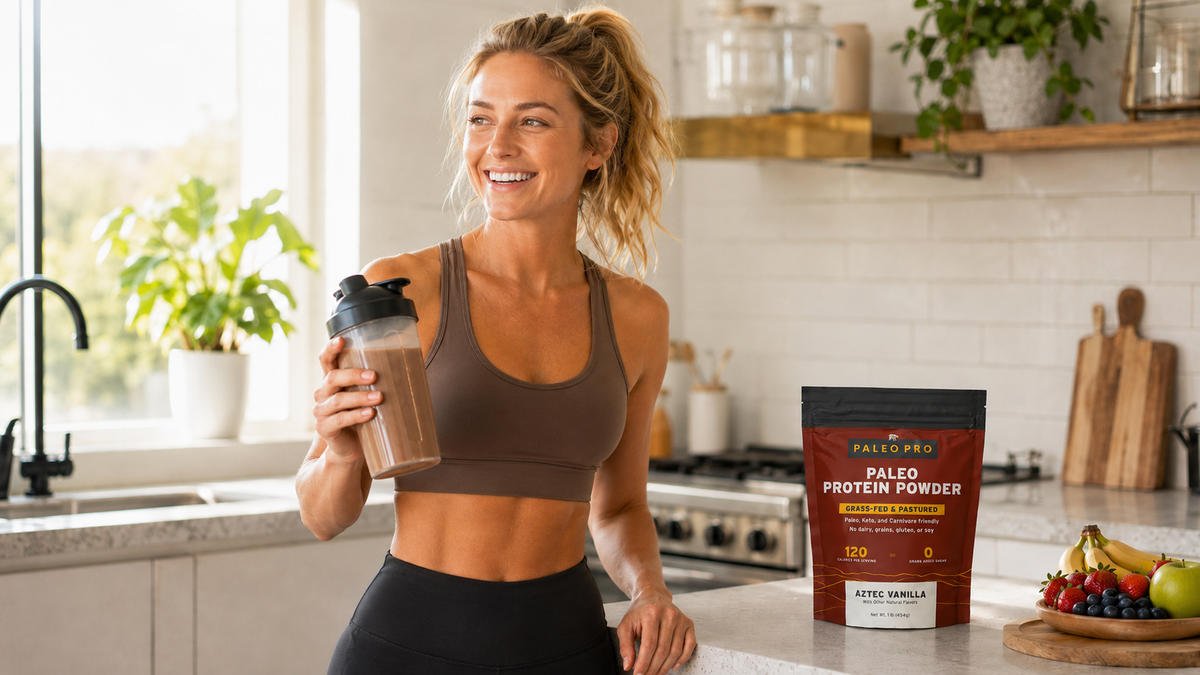
26g of complete protein for about 120 calories — dairy-free, no added sugar, and filling enough to carry you between meals.
How much protein should a woman eat to lose weight?
More than you think, and more than the government minimum. The RDA of 0.8 grams per kilogram of body weight is the floor to prevent deficiency, not the target for losing fat while keeping muscle [4]. For weight loss specifically, research points higher: the International Society of Sports Nutrition notes that 1.4–2.0 g/kg supports muscle, and that up to 2.3–3.1 g/kg can help preserve lean mass in an aggressive calorie deficit [5].
Here's what that looks like in real grams for a 150-lb (about 68 kg) woman:
| Your situation | Daily protein target | ~150-lb (68 kg) woman |
|---|---|---|
| Gentle deficit, mostly sedentary | 1.2–1.6 g/kg | ~80–110 g/day |
| Active + calorie deficit | 1.6–2.0 g/kg | ~110–135 g/day |
| Steep deficit + training (max muscle protection) | 2.0–2.4 g/kg | ~135–160 g/day |
Two practical notes. First, spread it across the day — aim for 25–35 grams per meal rather than saving it all for dinner, because your body can only use so much at once to build and hold muscle. Second, hitting 110+ grams a day while eating fewer calories is genuinely hard from whole food alone — it's a lot of chicken and eggs for not many calories. That's the honest case for a powder: it delivers a big dose of protein for a small number of calories, which is exactly the ratio weight loss needs.
What to look for in a weight-loss protein powder
Not all protein powders are built for weight loss. Many "women's" and "meal replacement" shakes are the opposite — protein wrapped around a surprising amount of sugar. Screen for these five things:
- High protein-per-calorie. This is the whole game. You want the most protein for the fewest calories — roughly 20–26 grams of protein for 100–130 calories. A powder that's 15 grams of protein and 200 calories is a snack, not a weight-loss tool.
- No added sugar. "Slim," "skinny," and "diet" shakes are frequent offenders, hiding 8–15 grams of added sugar per serving. That's not a weight-loss food; it's a milkshake with a health halo.
- A complete protein. Only a complete protein — all nine essential amino acids — actually preserves muscle. That means an animal protein (beef, egg white, whey) or a smartly blended plant protein. Straight collagen won't do it; it's missing tryptophan and low in the muscle-building aminos.
- Something filling. Protein per calorie does most of the satiety work, but a clean, low-sugar formula you can blend with fiber (berries, greens) keeps you fuller longer than a thin, sweet shake.
- A clean sweetener, not a sugar bomb. Monk fruit and stevia sweeten without the sugar or the calories. Be wary of "diet" shakes leaning on cheap artificial sweeteners — some, like sucralose and saccharin, have human data suggesting effects on gut bacteria and glucose response [6].
If you want the short version, a dairy-free beef and egg white protein with about 26 grams of protein for 120 calories and no added sugar hits every one of these — high protein, low calorie, complete, and clean.
Does protein help with menopause weight gain?
For a lot of women, the weight that won't budge shows up in their 40s and 50s — and protein matters even more here, for a specific reason. As estrogen falls through the menopause transition, body composition shifts: women lose muscle faster and tend to store more fat around the middle. Postmenopausal women measurably carry less muscle and more of it turns over to fat than in their premenopausal years [7], and estrogen's decline is directly linked to that muscle loss [8].
Less muscle means a lower resting metabolism, which means the same meals that maintained your weight at 35 now nudge it up at 52. Crash-dieting makes it worse — it accelerates the muscle loss that's already happening. The better play is to protect muscle: enough protein (toward the higher end of the ranges above), spread across the day, paired with resistance training. The goal after 50 isn't to bulk up — it's to hold onto the muscle and metabolism you have, so the fat you lose stays lost. (We go deeper on this in our guide to protein for women over 40.)
What about losing weight on a GLP-1 (Ozempic or Wegovy)?
GLP-1 medications — semaglutide (Ozempic, Wegovy) and tirzepatide (Mounjaro, Zepbound) — cut appetite and produce large, real weight loss. But a meaningful share of that weight comes off as muscle, not just fat. In the tirzepatide SURMOUNT-1 trial, about 25% of the weight participants lost was lean mass [9], and across GLP-1 studies the lean-mass fraction runs from roughly a quarter to as high as 40%, depending on the trial [10]. That's worth heading off: losing muscle lowers your resting metabolism and makes weight regain more likely if you come off the medication [10].
Protein is the main defense. When your appetite is switched off, you eat less of everything — protein included — at exactly the moment you most need it to hold onto muscle. The guidance emerging for people on these medications is straightforward: prioritize protein (research supports roughly 1.2–1.6 g/kg a day to preserve lean mass in a deficit) [1], spread it across your smaller meals, and add resistance training, which independently protects muscle during weight loss [11]. A low-volume, high-protein shake is a practical way to hit a protein target when a full meal feels like too much — which is why the same clean, complete protein that suits any weight-loss plan suits a GLP-1 plan especially well.
This is general nutrition information, not medical advice. If you're on a GLP-1, talk to your provider about your protein target and any changes to your routine. (We go deeper in our dedicated guide to protein on a GLP-1.)
A simple high-protein day for weight loss
You don't need a complicated plan — you need to hit your protein target while keeping calories in check. Here's a straightforward day that lands around 120 grams of protein:
- Breakfast: a protein shake blended with unsweetened almond milk, a handful of frozen berries, and a spoon of nut butter (~30 g protein)
- Lunch: a big salad with grilled chicken or salmon (~35 g)
- Afternoon: a second small shake or a hard-boiled egg or two when the 3 p.m. hunger hits (~15–25 g)
- Dinner: a palm-sized portion of beef, fish, or eggs with vegetables (~35 g)
Notice the shake does two jobs: it front-loads protein at breakfast (the meal most women under-eat protein at) and it covers the afternoon gap where cravings usually win. That's the practical value of a powder in weight loss — it's the easiest, lowest-calorie way to close your daily protein gap. Just make sure it's a clean one: a shake with 12 grams of added sugar quietly undoes the very deficit you're working to create.
Frequently asked questions
What is the best protein powder for women's weight loss? The best protein powder for women's weight loss is high in protein, low in calories and sugar, and complete. Look for at least 20–25 grams of complete protein per serving for under about 150 calories, with no added sugar. Protein supports fat loss by keeping you full and preserving lean muscle in a calorie deficit [1][3] — it doesn't burn fat directly, so avoid "diet" shakes with added sugar.
Do protein shakes help women lose belly fat? No food or shake targets belly fat specifically — spot reduction isn't real. But protein shakes help you lose fat overall by curbing appetite and protecting muscle in a calorie deficit, and higher-protein diets are associated with less abdominal fat over time. A shake replaces a higher-calorie, lower-protein snack or meal — that's where the benefit comes from.
How much protein should a woman eat to lose weight? Research supports about 1.2–2.0 grams of protein per kilogram of body weight per day for fat loss with muscle preservation, and up to ~2.4 g/kg in a steep deficit with training [5]. For a 150-lb woman, that's roughly 80–160 grams a day depending on activity — well above the 0.8 g/kg RDA minimum [4].
When should I drink a protein shake to lose weight? Two windows help most: at breakfast, to front-load protein and reduce hunger later in the day, and in the mid-afternoon, to blunt the cravings that derail dinner. A shake works best as a replacement for a higher-calorie snack or meal, not as an extra on top of your usual eating.
Will protein powder make me gain weight? Only if it pushes your total calories over your needs. Protein powder is food, and calories still count — but because protein is filling and low-calorie per gram, a clean powder usually helps you eat less overall, not more. The risk is sugary "meal replacement" shakes with 200+ calories and added sugar.
Is a protein shake or a meal better for weight loss? Whole-food meals are the foundation — they're more filling and more nutritious. A shake is a tool for the moments whole food is hard: a rushed breakfast, an afternoon slump, or hitting a high protein target on low calories. Use shakes to fill gaps, not to replace real meals entirely.
You now know the mechanism, the numbers, and the label red flags. Weight loss that lasts is really about two things: eating a bit less, and keeping the muscle that keeps your metabolism up. A clean, high-protein, low-sugar powder makes both easier.
Ready to make your deficit easier to stick to? Paleo Protein Powder delivers 26g of complete protein for about 120 calories — dairy-free, no added sugar, monk-fruit sweetened, and backed by a 60-day money-back guarantee.
Sources
- Leidy, H.J., et al. (2015). "The role of protein in weight loss and maintenance." American Journal of Clinical Nutrition, 101(6), 1320S–1329S. PMID: 25926512
- Halton, T.L., & Hu, F.B. (2004). "The effects of high protein diets on thermogenesis, satiety and weight loss: a critical review." Journal of the American College of Nutrition, 23(5), 373–385. PMID: 15466943
- Longland, T.M., et al. (2016). "Higher compared with lower dietary protein during an energy deficit combined with intense exercise promotes greater lean mass gain and fat mass loss: a randomized trial." American Journal of Clinical Nutrition, 103(3), 738–746. PMID: 26817506
- Institute of Medicine (2005). Dietary Reference Intakes for Energy, Carbohydrate, Fiber, Fat, Fatty Acids, Cholesterol, Protein, and Amino Acids. Washington, DC: The National Academies Press. DOI: 10.17226/10490
- Jäger, R., et al. (2017). "International Society of Sports Nutrition Position Stand: protein and exercise." Journal of the International Society of Sports Nutrition, 14, 20. PMID: 28642676
- Suez, J., et al. (2022). "Personalized microbiome-driven effects of non-nutritive sweeteners on human glucose tolerance." Cell, 185(18), 3307–3328. PMID: 35987213
- Sipilä, S., et al. (2020). "Muscle and bone mass in middle-aged women: role of menopausal status and physical activity." Journal of Cachexia, Sarcopenia and Muscle, 11(3), 698–709. PMID: 32017473
- Critchlow, A.J., et al. (2023). "The role of estrogen in female skeletal muscle aging: A systematic review." Maturitas, 178, 107844. PMID: 37716136
- Look, M., et al. (2025). "Body composition changes during weight reduction with tirzepatide in the SURMOUNT-1 study of adults with obesity or overweight." Diabetes, Obesity and Metabolism, 27(5), 2720–2729. PMID: 39996356
- Prado, C.M., et al. (2024). "Muscle matters: the effects of medically induced weight loss on skeletal muscle." The Lancet Diabetes & Endocrinology, 12(11), 785–787. PMID: 39265590
- Villareal, D.T., et al. (2017). "Aerobic or Resistance Exercise, or Both, in Dieting Obese Older Adults." New England Journal of Medicine, 376(20), 1943–1955. PMID: 28514618
