Carnivore Diet Before and After: Real Results and What to Expect

Carnivore diet before-and-after results typically show 10-20 pounds of weight loss in the first 30 days, improved energy by week 3, and significant body composition changes by month 3. The largest survey of carnivore dieters — 2,029 adults — found a median BMI reduction from 27.2 (overweight) to 24.3 (normal), with 95% reporting improved overall health [1]. But the first week is rough, blood markers are a mixed bag, and the research has real limitations. Here's what actually happens, month by month.
We make Carnivore Complete, a product designed for carnivore dieters. That means we hear from hundreds of people at different stages of this diet. The results below aren't cherry-picked success stories — they're what the survey data and clinical observations consistently show, including the parts that aren't flattering.
What the Research Shows: The Largest Carnivore Diet Study
The best data we have on carnivore diet results comes from the 2021 Harvard-affiliated survey by Lennerz et al. — 2,029 adults who had been eating carnivore for a median of 14 months [1].
Weight and Body Composition
| Metric | Before Carnivore | After Carnivore | Change |
|---|---|---|---|
| Median BMI | 27.2 (overweight) | 24.3 (normal) | -2.9 points |
| Weight category shift | Overweight | Normal range | Entire category |
| Satisfaction with weight | Not reported | High satisfaction reported | — |
For context, a BMI drop from 27.2 to 24.3 represents roughly 18-20 pounds for someone 5'10" — consistent with the 10-25 pound range most carnivore dieters report in the first 3-6 months.
Health Markers (Self-Reported)
| Outcome | Percentage Reporting Improvement |
|---|---|
| Overall health | 95% |
| Energy | 66-91% |
| Sleep | Improved (specific % varies by sub-question) |
| Mental clarity | Improved (frequently cited) |
| Diabetes (HbA1c) | Median 0.4% reduction; 84-100% medication reduction |
| Adverse effects | Low: GI (3.1-5.5%), muscular (0.3-4%), skin (0.1-1.9%) |
Blood Lipids (The Complicated Part)
| Marker | Reported Value | Context |
|---|---|---|
| LDL-C | 172 mg/dL | Elevated (standard target: <100-130) |
| HDL-C | 68 mg/dL | Optimal (target: >40 men, >50 women) |
| Triglycerides | 68 mg/dL | Optimal (target: <150) |
| TG/HDL ratio | 1.0 | Excellent (target: <2.0) |
The LDL elevation is real and consistent across carnivore studies. A smaller German study of 24 carnivore adults found even more dramatic increases — LDL rising from 157 to 256 mg/dL [2]. We cover this honestly in our dedicated carnivore diet and cholesterol article. The short version: triglycerides and HDL improve significantly, but LDL goes up. Whether this specific pattern carries the same cardiovascular risk as standard elevated LDL is still being studied.
Important caveat: The Lennerz survey recruited through social media carnivore communities. People who stuck with the diet and had positive experiences were more likely to respond. The data is self-reported, not clinically verified. This is the best data available, but it's not the same as a controlled trial.
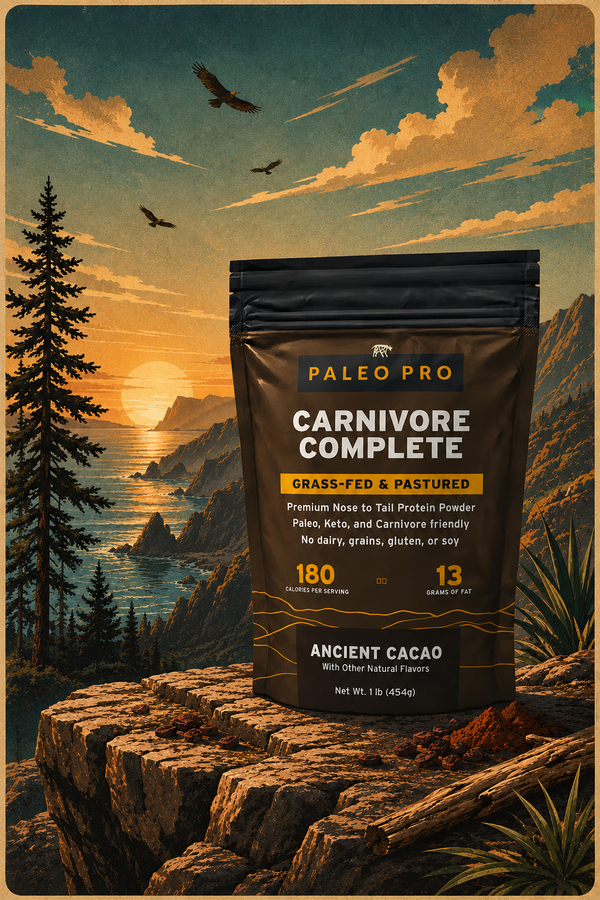
Grass-fed protein plus organ nutrients — fuel the transformation without the guesswork.
Month-by-Month Timeline: What to Expect
Week 1: The Hard Part
What happens: Your body is burning through glycogen stores and transitioning to fat as its primary fuel source. Expect the "carnivore flu" — headaches, fatigue, brain fog, irritability, possible digestive changes.
Weight change: 3-7 pounds lost. Most of this is water. Each gram of glycogen holds roughly 3 grams of water, and depleting your glycogen stores releases that water quickly. Don't mistake this for fat loss — it's a necessary metabolic shift.
What to do: Salt everything generously (5-7g sodium/day), supplement magnesium (200-400mg glycinate), drink bone broth, and eat until full. This is not the week to restrict calories.
Weeks 2-3: Adaptation
What happens: Energy begins to stabilize. Digestive system adjusts to higher fat intake — bile acid production upregulates. Hunger patterns shift; you may naturally start eating fewer meals. Cravings for sugar and carbs typically peak and then diminish.
Weight change: Another 2-5 pounds lost. This is a mix of water and early fat loss. Body composition is starting to shift even if the scale isn't moving dramatically.
What most people report: "I stopped being hungry between meals." The satiety effect of high-protein eating kicks in — protein is the most satiating macronutrient, and at 150-200g/day, your appetite hormones are fully engaged [3].
Month 1 (30-Day Results)
What happens: Most adaptation symptoms are behind you. Energy and mental clarity improve noticeably. Sleep often improves (the glycine in bone broth and collagen helps here). Skin changes — some people report clearer skin, others experience temporary breakouts during the transition.
Weight change: 8-15 pounds total for most people. The rate varies significantly based on starting weight, activity level, and whether you're naturally eating at a caloric deficit.
What the survey data shows: By one month, most carnivore dieters report the cognitive benefits (mental clarity, stable energy) more consistently than weight loss. Weight loss is variable; the metabolic improvements are more uniform.
Months 2-3: Visible Changes
What happens: This is when body composition changes become visible. Fat loss accelerates as metabolic adaptation completes. Clothes fit differently. If you're exercising, strength and recovery often improve.
Weight change: 15-25 pounds total for people starting in the overweight range. Rate typically slows from the initial burst but becomes more consistent.
Key mechanisms at work:
- Protein leverage — your body prioritizes protein intake; once protein needs are met, calorie intake naturally decreases [4]
- Food variety restriction — fewer food options means sensory-specific satiety kicks in faster, reducing overall intake [5]
- Thermic effect — protein requires ~30% of its calories just to digest, compared to ~3% for fat and ~8% for carbs [3]
Months 3-6: The New Baseline
What happens: Weight stabilizes at a new set point. Meal patterns are established (most settle into 1-2 meals/day). Blood markers stabilize — the lipid changes noted above are typically established by this point.
Common reports at this stage:
- Reduced joint pain and stiffness
- Improved or resolved digestive issues
- Stable, predictable energy throughout the day
- Reduced or eliminated cravings
- Improved body composition beyond what the scale shows
What the research shows: In the Lennerz survey, participants who had been carnivore for 6+ months showed the strongest self-reported improvements across all health markers. Duration of the diet correlated with satisfaction [1].
6+ Months: Long-Term
The data gets thin here. No controlled study has followed carnivore dieters beyond 2 years with clinical endpoints. The Lennerz survey included participants up to several years, but again — self-selected, self-reported.
Long-term reports are generally positive among people who stick with it, but survivor bias is real. We don't have good data on the people who tried carnivore and quit.
Who Gets the Best Results?
Based on survey data and clinical observations, the strongest carnivore diet results appear in:
People with significant weight to lose. The protein leverage and food variety effects are most powerful when starting from a high body weight. Someone at BMI 32 will see more dramatic changes than someone at BMI 24.
People with inflammatory or autoimmune conditions. A case series of 10 IBD patients on a carnivore-ketogenic diet showed all 10 achieving remission and discontinuing medications [6]. This is dramatic, but it's 10 people — not a controlled trial.
People with pre-diabetes or insulin resistance. The Lennerz survey showed a median HbA1c reduction of 0.4% and 84-100% reduction in diabetes medication use among participants with diabetes [1]. Removing all carbohydrates from the diet directly addresses blood sugar regulation.
People who've tried and failed other approaches. The extreme simplicity of carnivore — no counting, no measuring, just eat meat until full — works well for people exhausted by conventional diet complexity.
Who Should Be Cautious
People with familial hypercholesterolemia or existing cardiovascular disease. The consistent LDL elevation on carnivore is a legitimate concern if you're already at elevated cardiovascular risk. Monitor blood work closely. See our cholesterol guide for the full research breakdown.
People on medications for diabetes or blood pressure. The metabolic changes can be dramatic enough to require medication adjustments — sometimes quickly. Work with a doctor who can monitor and adjust dosages.
Pregnant or breastfeeding women. No clinical data exists on carnivore diet during pregnancy.
Maximizing Your Results
A few things separate the people who get great results from the ones who quit after two weeks:
Eat enough fat. The most common mistake is eating too lean. If you feel terrible, exhausted, and constantly hungry — you probably need more fat. Target fatty cuts (ribeye, 80/20 ground beef, pork belly) and cook with animal fats generously.
Don't restrict calories early. The first 4-6 weeks are about adaptation, not weight loss. Eat until satisfied. The caloric deficit happens naturally over time as satiety kicks in.
Handle electrolytes. Salt your food heavily. Supplement magnesium. Drink bone broth. Most "carnivore flu" symptoms are electrolyte deficiencies, not inevitable adaptation effects.
Include organ meats. The nutrient density difference between muscle-meat-only and nose-to-tail is massive. A 2025 modeling study showed that carnivore plans including organs had significantly better nutrient profiles [7]. If you won't eat organs directly, Carnivore Complete provides liver, heart, kidney, and spleen alongside beef protein isolate — the nose-to-tail nutrition most people skip.
Give it 30 days minimum. The adaptation period is real. Judging the diet by week 1 is like judging a movie by the opening credits.
FAQ
How much weight can you lose on the carnivore diet in 30 days? Most people lose 8-15 pounds in the first 30 days, though 3-7 pounds of that is water weight from glycogen depletion. Results vary significantly based on starting weight, caloric intake, and activity level. The Lennerz survey showed a median BMI drop from 27.2 to 24.3 over time — roughly 18-20 pounds for an average-height person.
What does carnivore diet before and after look like at 90 days? By month 3, most people report 15-25 pounds of total weight loss (if starting overweight), visible body composition changes, stable energy, improved mental clarity, reduced cravings, and often improved skin and joint comfort. Blood work typically shows improved triglycerides and HDL but elevated LDL.
Is the carnivore diet weight loss just water? The first 3-7 pounds are primarily water from glycogen depletion. After week 1-2, weight loss shifts to actual fat loss, driven by the protein leverage effect and spontaneous caloric reduction from high satiety. The sustained BMI changes in the Lennerz survey (median 14 months on diet) confirm this isn't just water.
Does the carnivore diet actually work for weight loss? The survey data consistently shows significant weight loss. The mechanisms are well-understood: protein leverage reduces total calorie intake, food variety restriction accelerates satiety, and high thermic effect of protein burns more calories during digestion. Whether it's superior to other well-designed diets is less clear — the simplicity and satiety may be the biggest advantages.
What are the side effects of the carnivore diet? Short-term: headaches, fatigue, brain fog, digestive changes, muscle cramps (weeks 1-3, driven by electrolyte shifts). Long-term: elevated LDL cholesterol is the most consistent finding. The Lennerz survey found adverse effects were reported by only 1-5.5% of participants, though this is self-reported from people who chose to stay on the diet.
How long does it take to see carnivore diet results? Energy and mental clarity typically improve by weeks 2-3. Noticeable weight loss by month 1. Visible body composition changes by months 2-3. The full metabolic adaptation — including stable blood markers and settled appetite patterns — usually takes 3-6 months.
Sources
- Lennerz, B.S., et al. (2021). "Behavioral Characteristics and Self-Reported Health Status among 2029 Adults Consuming a 'Carnivore Diet'." Current Developments in Nutrition, 5(12), nzab133. PMID: 34934897
- Klement, R.J. & Matzat, J.S. (2025). "Subjective Experiences and Blood Parameter Changes in Individuals From Germany Following a Self-Conceived 'Carnivore Diet'." Cureus, 17(4), e82521. PMID: 40385902
- Paddon-Jones, D., et al. (2008). "Protein, weight management, and satiety." American Journal of Clinical Nutrition, 87(5), 1558S-1561S. PMID: 18469287
- Simpson, S.J. & Raubenheimer, D. (2005). "Obesity: the protein leverage hypothesis." Obesity Reviews, 6(2), 133-142. PMID: 15836464
- Raynor, H.A. & Epstein, L.H. (2001). "Dietary variety, energy regulation, and obesity." Psychological Bulletin, 127(3), 325-341. PMID: 11393299
- Norwitz, N.G. & Soto-Mota, A. (2024). "Case report: Carnivore-ketogenic diet for the treatment of inflammatory bowel disease." Frontiers in Nutrition, 11, 1467475. PMID: 39296504
- Goedeke, S., et al. (2025). "Assessing the Nutrient Composition of a Carnivore Diet: A Case Study Model." Nutrients, 17(1), 140. PMID: 39796574
Just getting started? Read the Carnivore Diet for Beginners step-by-step guide or the complete carnivore diet guide. For the full food list with meal plans, see our Carnivore Diet Food List. And if you want nose-to-tail nutrition from day one, Carnivore Complete combines beef protein isolate with organ nutrients — liver, heart, kidney, and spleen — in one scoop.
