Bone Broth Collagen Benefits: What Human Studies Support
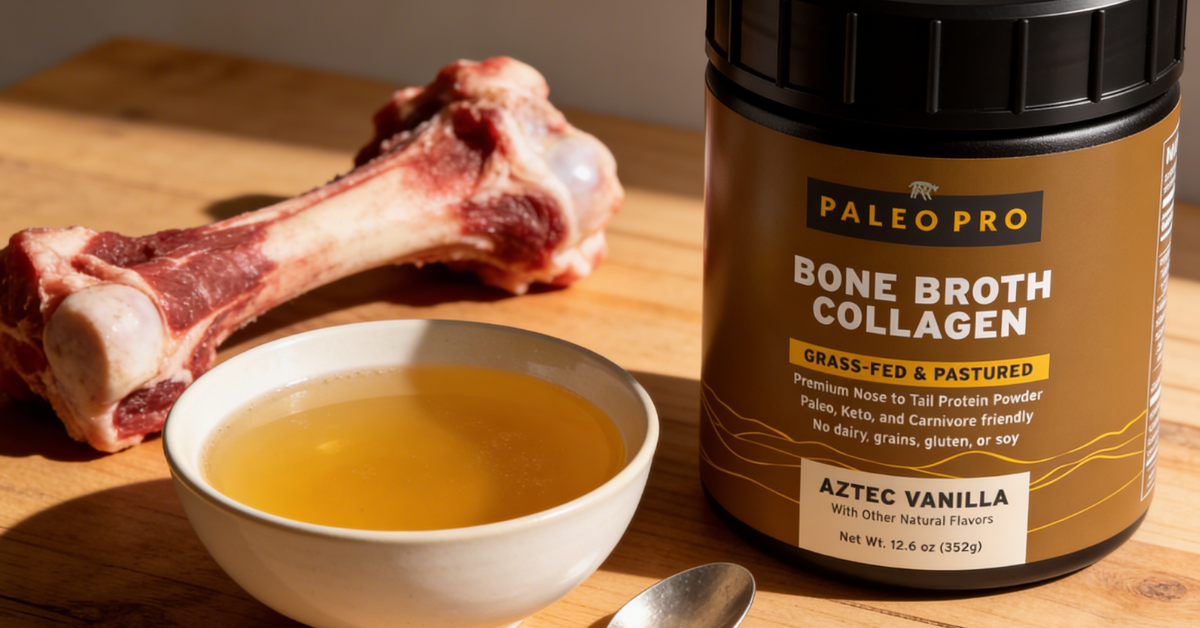
The strongest human evidence for collagen concerns osteoarthritis symptoms, where meta-analyses report modest improvements across varied collagen derivatives. Evidence for skin is disputed, bone findings come from specific peptide trials, and digestive evidence is insufficient. Bone broth collagen can supply measured collagen protein, but finished-product benefits depend on the exact ingredient, dose, population, and outcome studied.
“Collagen has research” is the start of the evaluation. It is not the conclusion.
What counts as evidence for a bone broth collagen benefit?
A useful claim should match five details:
- Ingredient: hydrolyzed peptides, gelatin, undenatured Type II, broth, or a blend
- Dose: milligrams or grams per day
- Population: healthy adults, athletes, or people with a diagnosed condition
- Outcome: pain score, skin hydration, bone density, or another measured endpoint
- Duration: days, weeks, or months
Funding and risk of bias matter too. A study on a branded collagen peptide cannot establish the same result for every bovine collagen, homemade broth, or flavored powder. A study on isolated glycine cannot be treated as a trial of a product unless the product supplies the studied glycine dose.
That ingredient-dose-outcome match is the standard used below.
If the label terminology is the confusing part, start with collagen types explained. The type number, ingredient source, and processing method answer different questions.
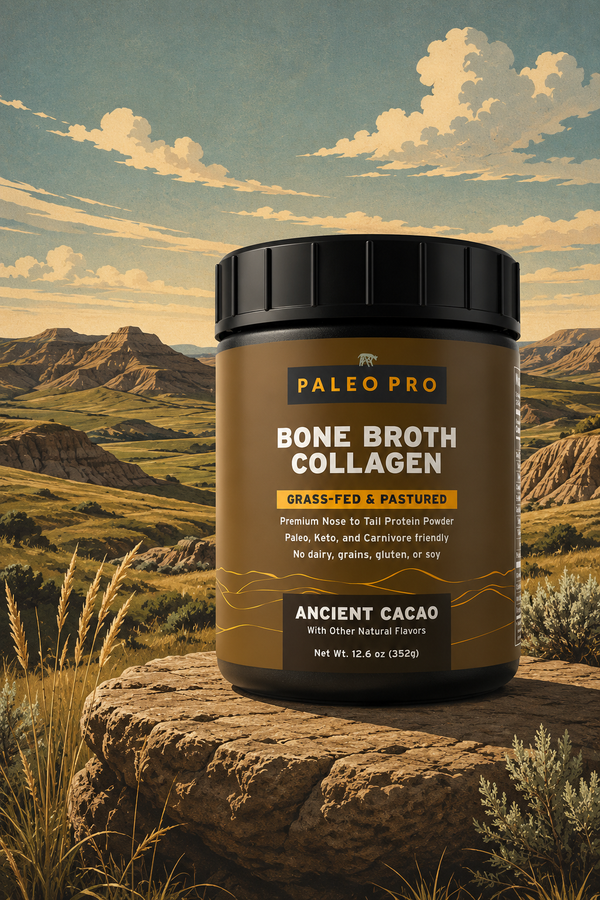
16g of protein from grass-fed beef collagen, with turmeric root in a measured serving.
How strong is the evidence for joints?
Evidence grade: Moderate for osteoarthritis symptoms across collagen derivatives.
A 2024 trial sequential meta-analysis included 35 randomized controlled trials and 3,165 participants with osteoarthritis. Collagen derivatives produced small-to-moderate improvements in pain and function, with moderate certainty for pain and high certainty for function [1].
A separate 2023 meta-analysis focused on collagen peptides and knee osteoarthritis. It found improved pain versus placebo across four trials with 507 participants, but all four trials had high risk of bias [2].
Those findings justify cautious language: certain collagen derivatives may modestly improve pain or function for some people with osteoarthritis. They do not prove that a retail bone-broth collagen powder prevents cartilage loss, rebuilds joints, or works for an undiagnosed ache.
The form matters. Undenatured Type II collagen has been studied at about 40 milligrams daily, while hydrolyzed collagen trials often use grams. Those products are not dose-equivalent, even when both use the word collagen.
Does collagen improve skin?
Evidence grade: Uncertain.
The broad literature includes many favorable trials and earlier meta-analyses. A 2025 meta-analysis examined 23 randomized trials with 1,474 participants and found better hydration, elasticity, and wrinkles in the overall pooled analysis [3].
Then the result changed when study quality and funding were considered. Higher-quality trials did not show significant benefits. Trials without pharmaceutical-company funding also did not show significant improvements in hydration, elasticity, or wrinkles [3]. The authors concluded that current clinical evidence does not support collagen supplements to prevent or treat skin aging.
That does not prove collagen can never affect skin. It means a finished product should not promise firmer skin, fewer wrinkles, or a younger appearance based on the present evidence. A customer may still choose collagen, but the expectation should remain modest.
What does research say about bone density?
Evidence grade: Preliminary and ingredient-specific.
A 12-month randomized, placebo-controlled trial studied 5 grams per day of specific collagen peptides in 131 postmenopausal women with age-related reductions in bone mineral density. The collagen group improved spine and femoral-neck bone mineral density relative to placebo [4].
That is a meaningful human result with several limits. It tested a particular peptide ingredient, a specific dose, postmenopausal women with reduced bone density, and a 12-month protocol. The ingredient manufacturer partly funded the study. It did not test generic bone broth collagen. It also measured bone density and biomarkers, not fracture prevention.
People with osteopenia or osteoporosis need clinical care. Collagen is not a substitute for adequate nutrition, resistance and weight-bearing exercise, or prescribed treatment.
Does bone broth collagen heal the gut?
Evidence grade: Insufficient.
No strong human evidence shows that bone broth collagen heals intestinal permeability or treats a digestive disorder.
One 2022 study gave 20 grams per day of a specific collagen peptide to healthy women with a body mass index over 25. It used an open-label, single-arm design. Fourteen of 40 enrolled participants completed the intervention, and some reported reduced digestive symptoms [5]. The ingredient supplier funded the study; one author worked for the supplier and another received consulting funding. Without a placebo group, the study cannot separate the supplement effect from expectation, time, diet changes, or selective completion.
A randomized crossover trial tested 10 grams per day of collagen peptides for seven days before a strenuous running protocol. Collagen did not improve the study's measures of gastrointestinal integrity or subjective symptoms versus control [6]. The ingredient supplier funded the trial, supplied the supplements, and employed two coauthors.
Mechanistic arguments about glycine, glutamine, or connective tissue are not the same as clinical proof. It is reasonable to describe collagen as a protein rich in particular amino acids. It is not reasonable to promise a repaired gut lining.
Does collagen support sleep or recovery?
Evidence grade: Not established for finished bone broth collagen products.
Glycine has been studied separately for sleep, and collagen is generally rich in glycine. That does not reveal how much glycine a particular serving provides. Without a product-specific amino-acid analysis, you cannot assume one scoop matches an isolated glycine protocol.
Recovery claims have a similar problem. Some trials combine collagen peptides with training, vitamin C, calcium, vitamin D, or other interventions. Improvements in a combined protocol do not establish that collagen alone caused the result. A claim should name the studied intervention rather than borrowing the strongest part of a multi-part program.
Collagen also differs from a complete protein. It lacks tryptophan and provides relatively little of several indispensable amino acids. It can contribute protein grams, but it should not be the only protein source used for muscle maintenance or general protein adequacy.
What about turmeric in a bone broth collagen formula?
Evidence grade: Product composition fact, not a proven finished-product outcome.
Turmeric root and concentrated curcumin extracts are not interchangeable. Clinical trials commonly specify extract composition and dose. A label that lists turmeric root without quantifying curcuminoids does not establish equivalence to those trials.
Paleo Pro's Grass-Fed Bone Broth Collagen + Turmeric currently lists beef collagen, natural flavors, monk fruit, and turmeric root, with 16 grams of protein per serving [7]. The label supports those composition facts. It does not establish that the finished formula treats inflammation or produces a joint, skin, gut, or sleep outcome. Compare that format with hydrolyzed powders in bone broth vs collagen peptides, or review the current collagen collection.
How should you decide whether to try collagen?
First decide what job you expect it to do.
| Goal | What the human evidence suggests | What to check |
|---|---|---|
| Osteoarthritis symptoms | Modest benefit is plausible across varied collagen derivatives | Exact form, dose, diagnosis, and clinician guidance |
| Skin aging | Overall pooled studies look positive, but higher-quality and non-industry subsets do not | Avoid guaranteed cosmetic claims |
| Bone density | A few specific-peptide studies are encouraging | Ingredient identity, long duration, and medical care |
| Digestive symptoms | Evidence is weak and conflicting | Do not use “gut healing” as a purchase criterion |
| General protein | Collagen contributes grams but is incomplete | Keep complete protein foods in the diet |
| Convenience | A measured powder is consistent | Protein grams, ingredients, allergens, flavor, and availability |
Then read the label. Look for protein grams, ingredient source, hydrolyzed versus undenatured form, allergens, serving size, and any undisclosed proprietary blend. Compare that material with the study you are relying on.
If the product does not disclose the detail that makes the claim plausible, keep the expectation conservative.
For the serving-size question specific to broth, see does bone broth have collagen?.
How much collagen did the studies use?
There is no single evidence-based dose for every goal.
- Osteoarthritis trials used different collagen derivatives and protocols [1].
- The bone-density trial above used 5 grams of a specific peptide daily for 12 months [4].
- The open-label digestive study used 20 grams daily for eight weeks [5].
- The exercise-related GI trial used 10 grams daily for seven days [6].
- Undenatured Type II studies use milligrams rather than the gram amounts common with hydrolyzed collagen.
Copying a number while changing the ingredient and outcome is not evidence matching. Follow the product directions, and speak with a qualified clinician when the goal involves osteoarthritis, osteoporosis, persistent digestive symptoms, pregnancy, medication interactions, or another medical condition.
Frequently asked questions
What are the best-supported bone broth collagen benefits?
The best human evidence concerns modest improvements in osteoarthritis pain and function across varied collagen derivatives. That evidence does not prove the same result for every bone broth product.
Does bone broth collagen rebuild cartilage?
Clinical studies may measure pain and function, but symptom changes do not prove that cartilage regrew. Avoid products that turn a symptom result into a tissue-rebuilding promise.
Does bone broth collagen improve skin?
Evidence is disputed. Overall pooled studies report benefits, while higher-quality and non-industry-funded subgroups in a 2025 meta-analysis did not show significant improvement [3].
Can bone broth collagen heal leaky gut?
No strong human evidence supports that claim. A small uncontrolled symptom study was encouraging, while a randomized exercise trial found no improvement in GI integrity or symptoms [5,6].
Is collagen a complete protein?
No. Collagen contributes protein grams but lacks tryptophan and has an amino-acid pattern that differs from complete dietary proteins. Use it alongside complete protein sources.
How long does collagen take to work?
Study durations vary by ingredient and outcome, from days to 12 months. There is no universal timeline, and a study duration does not guarantee an individual result.
Is more collagen better?
Not necessarily. Use the serving directed on the label and match the dose to evidence for the same material and goal. Larger servings add protein and calories without guaranteeing more benefit.
Bone broth collagen is a measurable protein ingredient, not a list of guaranteed outcomes. The research is useful when we keep the details attached.
Sources
- Liang CW, et al. “Efficacy and Safety of Collagen Derivatives for Osteoarthritis: A Trial Sequential Meta-Analysis.” Osteoarthritis and Cartilage. 2024;32(5):574-584. PMID: 38218227
- Lin CR, et al. “Analgesic Efficacy of Collagen Peptide in Knee Osteoarthritis: A Meta-Analysis of Randomized Controlled Trials.” Journal of Orthopaedic Surgery and Research. 2023;18:694. doi:10.1186/s13018-023-04182-w
- Myung SK, Park Y. “Effects of Collagen Supplements on Skin Aging: A Systematic Review and Meta-Analysis of Randomized Controlled Trials.” The American Journal of Medicine. 2025;138(9):1264-1277. doi:10.1016/j.amjmed.2025.04.034
- König D, et al. “Specific Collagen Peptides Improve Bone Mineral Density and Bone Markers in Postmenopausal Women.” Nutrients. 2018;10(1):97. PMID: 29337906
- Abrahams M, O'Grady R, Prawitt J. “Effect of a Daily Collagen Peptide Supplement on Digestive Symptoms in Healthy Women.” JMIR Formative Research. 2022;6(5):e36339. doi:10.2196/36339
- Taylor G, et al. “The Effects of Collagen Peptides on Exercise-Induced Gastrointestinal Stress.” European Journal of Nutrition. 2023;62(2):1027-1039. doi:10.1007/s00394-022-03051-2
- Paleo Pro. “Grass-Fed Bone Broth Collagen + Turmeric.” Product page and current product data, accessed 2026-09-17. Product details
