Egg White Albumen Protein Powder: What "Albumen" Means on the Label
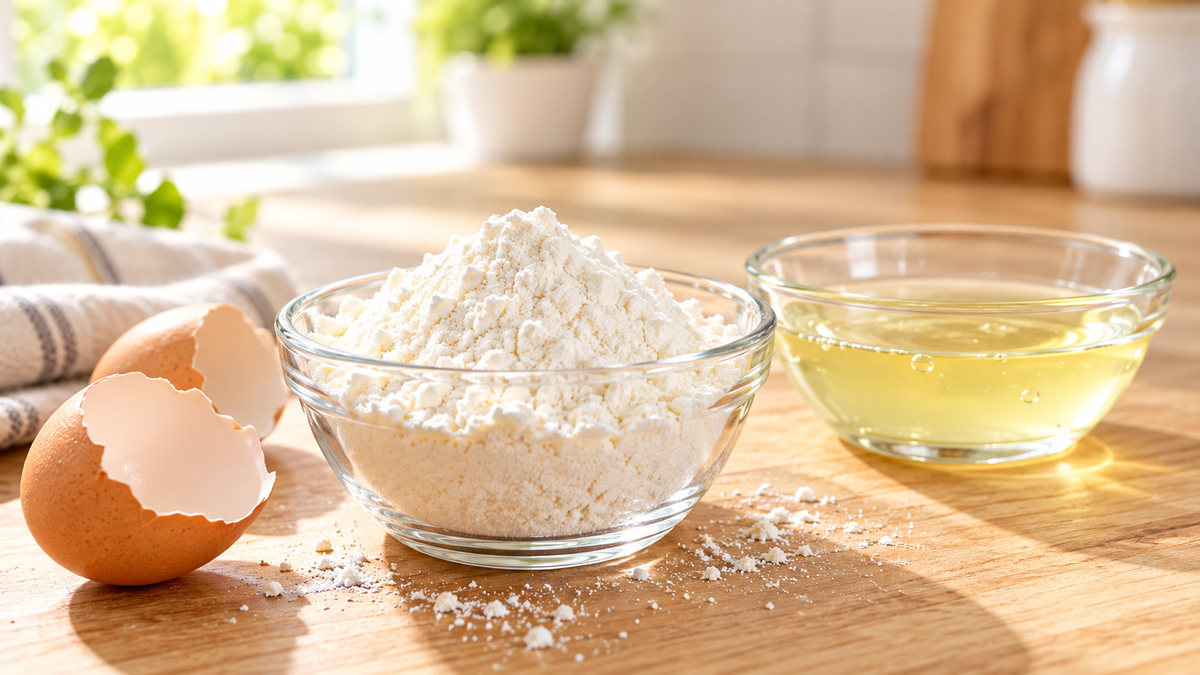
Egg white albumen protein powder is dried egg white. Albumen is the old word for the white of an egg, so it names the source and says nothing about quality. US rules require dried egg whites to be free of Salmonella. Compare powders on protein and calories per scoop, ingredient count, sweetener, egg source and sodium.
Albumen comes from albus, Latin for white. Brands like the word because it sounds like something a lab invented. It's the same stuff you've separated over a mixing bowl a thousand times, minus the water.

Eggs from pastured hens and sunflower lecithin. That's the whole label: 20 g of protein, no sweetener.
What is egg white albumen protein powder?
It's egg whites with the water taken out. Raw egg white is mostly water, with about 10.9 g of protein per 100 g [7]. Dry it and USDA's figure for dried, stabilized egg white jumps to 84.1 g of protein per 100 g [6].
What is egg white powder? The same ingredient: dried egg white powder, sold to bakers by the drum and to everyone else in a bag with a scoop. Whether a product called "egg white protein powder" adds anything to it is a label question, and the egg white powder vs egg white protein powder comparison lives in our main egg white guide.
Federal rules treat the names as synonyms. FDA's standard for dried egg whites lets one food go by four names: dried egg whites, egg white solids, dried egg albumen and egg albumen solids [3]. A bag that leads with "pure albumen" is telling you it contains egg white, which the picture of the egg on the front had already covered.
So skip the word on the front and read the back: how many ingredients, what sweetens it, and where the eggs came from.

Eggs from pastured hens and sunflower lecithin. That's the whole label: 20 g of protein, no sweetener.
Is albumen the same as albumin?
Close, but no. Albumen is the white of an egg; the word has been in English since the 1590s and traces to the Latin for white [1]. Albumin is a family of simple, water-soluble proteins that set when heated, found in egg white, milk and blood [2]. The egg white is albumen. Its main protein, ovalbumin, is an albumin, and it makes up about 54% of egg white protein [8].
Plenty of labels use the two spellings interchangeably. If a bag says "egg albumin," check the ingredient list. It should name egg white.
| Term | What it means | Where you'll see it |
|---|---|---|
| Albumen | The white of an egg [1] | "Egg white albumen" or "dried egg albumen" on the front of a bag |
| Albumin | A family of water-soluble proteins that set when heated [2] | Science writing, and swapped in for "albumen" on some labels |
| Ovalbumin | The main albumin in egg white, about 54% of its protein [8] | Allergy information, where it's listed as allergen Gal d 2 [8] |
| Egg white solids | FDA's other legal name for dried egg white [3] | Ingredient lists, especially on baking products |
How is egg white protein powder made?
The whites are separated, treated for Salmonella, stripped of their natural glucose and dried. Federal rules cover most of those steps.

- Pasteurizing. Liquid egg whites sold as food must be "pasteurized or otherwise treated" to destroy all viable Salmonella [4].
- Taking out the glucose. Before drying, FDA's standard requires the glucose in the whites to be reduced, either with an enzyme treatment or a controlled fermentation using baker's yeast or approved bacterial cultures [3]. That step is why USDA's entry for the powder carries the name "dried, stabilized, glucose reduced" [6].
- Drying. The whites are spray-dried or pan-dried into powder [5], and the finished powder has to be free of viable Salmonella [3].
- Heat after drying. From 1971 until 2022, USDA spelled out a "hot room" step: spray-dried albumen held at no less than 130°F for at least 7 days and until it came back Salmonella-negative [5]. That fixed recipe came off the books on October 31, 2022. The rule that replaced it is a performance standard: pasteurized egg products have to be safe to eat without further cooking [5].
Heat does more than handle food safety. In a tracer study in people, cooked egg protein was 90.9% digestible by the end of the small intestine, against 51.3% for raw egg protein [9]. Raw egg white also contains avidin, a protein that binds the B vitamin biotin. Some manufacturers go further and pull avidin and lysozyme out with an ion-exchange resin, and FDA then requires the name on the label to include "lysozyme and avidin reduced" [3].
What should you check on an egg white powder label?
Five things, all on the back panel, and the word albumen isn't one of them.
- Protein against calories. Nutrition Facts panels count protein at 4 calories per gram [13]. Multiply the grams of protein by 4, divide by the calories, and you have the share of calories that comes from protein. USDA's dried egg white works out to about 94% [6]. A plain egg white powder should land near that, so a big gap means something besides egg white is in the scoop. Compare grams of protein and calories per scoop, since scoop sizes vary.
- Ingredient count. Plain dried egg white can be a single ingredient, and a bag sold as pure egg white protein powder should come close. Some powders add an emulsifier such as sunflower lecithin so they stir in without clumping; flavored ones add sweetener and flavoring. Each addition should be doing a job you want done. If whipping aids went into the whites, FDA wants them named on the front panel [3].
- Sweetener. "Unflavored" and "unsweetened" are separate claims. Read the ingredient list for stevia, monk fruit, sucralose or sugar alcohols, and check added sugars on the panel.
- Egg source. Words like pastured or free-range describe how the hens lived. The FDA standard for dried egg whites doesn't address that [3], so the claim is only there if the brand chose to make it.
- Sodium. Egg whites carry sodium naturally, and drying concentrates it. Check the milligrams per scoop. Salt in the ingredient list means some was added.
| What to check | What to look for | Dried egg white, USDA reference (per 100 g) | Paleo Pro Egg White Protein (per scoop) |
|---|---|---|---|
| Protein against calories | Close to USDA's 94% for plain egg white | 84.1 g protein, 357 calories, about 94% from protein [6] | 20 g protein, 90 calories, about 89% from protein [14] |
| Ingredient count | Only what the job needs; whipping aids named on the front [3] | Egg white only | Two: egg white protein, sunflower lecithin [14] |
| Sweetener | None, if the bag says unsweetened | None | None [14] |
| Egg source | A stated claim, if it matters to you | Not specified | Pastured chickens [14] |
| Sodium | Milligrams per scoop; salt on the ingredient list means added salt | Not shown here | 300 mg (13% DV), no salt in the ingredients [14] |
Our unflavored egg white protein powder is the last column, for comparison. You can read its entire ingredient list in one breath.
Why do egg white powders list sodium?
Because egg whites have sodium in them before anyone processes them. Take the water out and the sodium stays behind, so a scoop of powder can show more than you'd guess. Our bag lists 300 mg per scoop, 13% of the daily value, and its ingredient list is egg white protein and sunflower lecithin, with no salt [14].
If you track sodium, count those 300 mg the way you'd count them from any other food. And if you find salt in a powder's ingredients, that part was put there on purpose.
How does albumen powder score on protein quality?
Very well, with one catch worth knowing. Egg white scored the maximum PDCAAS of 1.00 in the 1991 FAO/WHO report [10], and it carries all nine essential amino acids [6].
The catch is leucine, the amino acid most tied to switching on muscle protein synthesis. Egg protein runs about 7 to 9% leucine depending on the sample: Gorissen's lab measured 7.0%, and USDA's dried egg white works out to 8.75% [11][6]. Whey sits near 11% [11]. By Gorissen's math, it takes about 39 g of egg protein to supply 2.7 g of leucine, the amount in a standard serving of whey [11].
So 20 g of egg white protein carries roughly 1.4 to 1.75 g of leucine, by our arithmetic on those percentages. That clears the International Society of Sports Nutrition's floor of 700 mg per dose [12] and stays under whey. If leucine per scoop is your priority, use a bigger serving or pair egg white with a protein that carries more of it.
Can you use albumen powder for baking as well as shakes?
Yes. Ovalbumin foams when you whip it and sets when you heat it, which is why egg whites turn into meringue and hold a muffin together. Plain dried egg white rehydrates for both jobs. Powders with an added emulsifier can behave differently in a whipped recipe, so we'd test a small batch before betting a pavlova on any of them, ours included.

For shakes, an unflavored powder goes into 12 to 16 oz of liquid [14] and takes on the flavor of whatever you blend with it. The egg white protein shake guide covers how to make unflavored taste like something, and the egg white protein powder recipes post has pancakes, bread and savory ideas. If you're weighing an egg based protein powder against the rest of the shelf, the dairy-free protein powder guide lines it up against beef, plant and collagen options.
Frequently Asked Questions
Is "egg white albumen" on a label different from "egg white protein"?
No. Both mean dried egg white, and FDA lets dried egg white be sold as dried egg albumen or egg albumen solids. Any real difference between two products comes from what else is in the bag, so compare the ingredient list, the sweetener and the protein per scoop.
What's the difference between albumen and albumin?
Albumen is the white of an egg. Albumin is a family of water-soluble proteins that set when heated, found in egg white, milk and blood. Ovalbumin, the main protein in egg white, is an albumin and makes up about 54% of egg white protein.
Is egg white albumen powder raw?
Not in the food-safety sense. FDA requires dried egg whites to be free of viable Salmonella, which means the whites are pasteurized as liquid, heat-treated after drying, or both. Heat matters for digestion too: cooked egg protein was 90.9% digestible in a human tracer study, compared with 51.3% for raw.
Why does egg white protein powder contain sodium?
Egg whites contain sodium naturally, and drying removes the water but leaves the sodium, so it shows up concentrated in the powder. Check the milligrams per scoop on the panel. If salt appears in the ingredient list, some sodium was added on top.
Is egg white albumen protein powder dairy-free?
Egg white is not dairy, so a powder made only from egg white has no milk, lactose, whey or casein as ingredients. Egg is a major allergen in its own right. If you have a serious milk allergy, also read the label's statement about shared facilities.
How much protein should an egg white powder have per scoop?
Compare grams of protein against calories rather than scoop size. Protein counts as 4 calories per gram, and plain dried egg white gets about 94% of its calories from protein by USDA's numbers. A powder that lands far below that is carrying sweetener, flavor or other ingredients.
Does egg white albumen powder have enough leucine?
It clears the common minimum. Egg protein is about 7 to 9% leucine, so 20 g of egg white protein supplies roughly 1.4 to 1.75 g, above the 700 mg per dose the International Society of Sports Nutrition sets as a floor. It carries less leucine than whey, so a larger serving or a pairing closes the gap.
Which egg white powder does Paleo Pro make?
Albumen turns out to be a fancy word for egg white. Once you've translated it, the back panel does the rest: protein against calories, the ingredient count, the sweetener, where the eggs came from and the sodium. Ours is egg white from pastured chickens plus sunflower lecithin, 20 g of protein and 90 calories a scoop, unflavored and unsweetened [14]. It comes with a 60-day money-back guarantee, and subscribe and save takes 15% off every delivery [14].
Read the label, then try it: Paleo Pro Egg White Protein has two ingredients and 20 g of protein in every scoop. Browse the rest of the protein collection.
Sources
- Dictionary.com. "Albumen." dictionary.com/browse/albumen. Accessed 2026-10-26.
- Dictionary.com. "Albumin." dictionary.com/browse/albumin. Accessed 2026-10-26.
- US Food and Drug Administration. 21 CFR 160.145, Dried egg whites. law.cornell.edu/cfr/text/21/160.145. Read 2026-10-26.
- US Food and Drug Administration. 21 CFR 160.140, Egg whites. law.cornell.edu/cfr/text/21/160.140. Read 2026-10-26.
- USDA Food Safety and Inspection Service. 9 CFR 590.575, Heat treatment of dried whites, and 9 CFR 590.570 as revised, Code of Federal Regulations, 2021 edition, including the effective-date note for 85 FR 68680 (2020-10-29), effective 2022-10-31. govinfo.gov.
- USDA FoodData Central. Egg, white, dried, stabilized, glucose reduced (FDC 170895). SR Legacy. fdc.nal.usda.gov. Percent of calories from protein is our arithmetic: 84.1 g x 4 kcal / 357 kcal. Leucine 7.36 g per 100 g, or 8.75% of protein.
- USDA FoodData Central. Egg, white, raw, fresh (FDC 172183). SR Legacy. fdc.nal.usda.gov.
- Caubet, J.C. & Wang, J. (2011). "Current understanding of egg allergy." Pediatric Clinics of North America, 58(2), 427-443. PubMed 21453811.
- Evenepoel, P., et al. (1998). "Digestibility of cooked and raw egg protein in humans as assessed by stable isotope techniques." The Journal of Nutrition, 128(10), 1716-1722. PubMed 9772141.
- FAO/WHO (1991). Protein Quality Evaluation: Report of the Joint FAO/WHO Expert Consultation. FAO Food and Nutrition Paper 51. openknowledge.fao.org.
- Gorissen, S.H.M., et al. (2018). "Protein content and amino acid composition of commercially available plant-based protein isolates." Amino Acids, 50(12), 1685-1695. PubMed 30167963.
- Jäger, R., et al. (2017). "International Society of Sports Nutrition Position Stand: protein and exercise." Journal of the International Society of Sports Nutrition, 14:20. PMC5477153. Leucine per 20 g of egg white protein (1.4 to 1.75 g) is our arithmetic on the 7.0% and 8.75% figures.
- US Food and Drug Administration. 21 CFR 101.9(c)(1), Nutrition labeling of food: calories. law.cornell.edu/cfr/text/21/101.9.
- Paleo Pro. Egg White Protein Powder, Plain Naked: product page, Nutrition Facts and ingredient list. paleopro.com/products/egg-white-protein-powder. Read 2026-10-26. Percent of calories from protein is our arithmetic: 20 g x 4 kcal / 90 kcal.
