Egg White vs Beef Protein Isolate: Two Dairy-Free Proteins, Side by Side
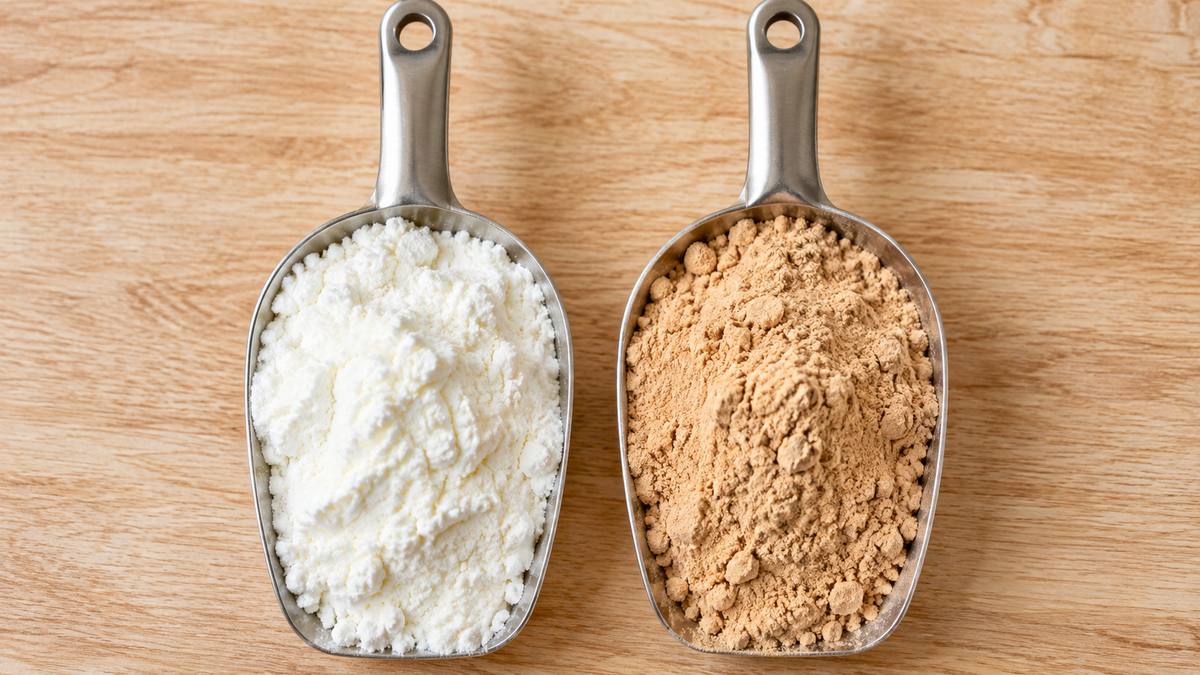
Beef vs egg protein mostly comes down to how you'll use it. Egg white protein and beef protein isolate are both dairy-free animal proteins with almost no fat or carbs. Unflavored egg white disappears into smoothies and baking; flavored beef isolate is the one you shake with plain water. Egg white usually has no sweetener; flavored beef isolate usually does.
We make both of these, and a blend of the two, so we have no reason to pretend one of them always wins. What follows is the side-by-side we'd want if we were the ones buying: the label numbers, the amino acid people argue about most, digestion, taste, and who each one suits.

Unflavored, unsweetened egg white: 20 g of protein and two ingredients, so it disappears into smoothies, pancakes and baking.
What's the difference between egg white protein and beef protein isolate?
Egg white protein is dried egg white, the protein half of the egg with the yolk left out. Beef protein isolate is protein taken from beef with most of the fat and carbohydrate removed [2]. Neither contains dairy, which is usually why people end up comparing the two.
If you're reading this, there's a decent chance you've already crossed whey off your list, and maybe pea and soy as well. (If you're still sorting through every option, our guide to dairy-free protein powder covers the whole field.) That leaves the animal options. Our two bags land at 90 and 100 calories a scoop, both are nearly all protein, and neither has added sugar [1][2]. On paper they're closer than most of the category's marketing would suggest.
The differences that matter day to day are practical ones:
- Flavor. Egg white powder usually comes unflavored. Beef isolate usually comes flavored, because plain beef isolate isn't something most people want to drink on its own.
- Sweetener. An unflavored egg white has none. A flavored beef isolate needs something, and ours uses stevia leaf extract [2].
- Allergens. One contains egg. The other doesn't, though a shared facility matters if your allergy is serious.
So the useful question is what you're about to make, and whether you want your protein to taste like something or like nothing at all.

Unflavored, unsweetened egg white: 20 g of protein and two ingredients, so it disappears into smoothies, pancakes and baking.
Beef vs egg protein: how do the two compare, number for number?
Here are our two bags side by side, straight from the nutrition panels and ingredient lists [1][2]. Beef Protein Isolate comes in two flavors, so where they differ, both numbers are shown.
| Egg White Protein | Beef Protein Isolate | |
|---|---|---|
| Protein per scoop | 20 g | 21 g (Ancient Cacao), 23 g (Aztec Vanilla) |
| Calories | 90 | 100 |
| Fat | 0 g | 1 g (Cacao), 0.5 g (Vanilla) |
| Carbohydrate | 1 g | 2 g (Cacao), 1 g (Vanilla) |
| Sugar | 0 g | 0 g |
| Sodium | 300 mg | 140 mg (Cacao), 150 mg (Vanilla) |
| Iron | 0.1 mg | 2.6 mg (Cacao), 1.2 mg (Vanilla) |
| Potassium | 310 mg | 190 mg (Cacao), 70 mg (Vanilla) |
| Ingredients | 2: egg white protein, sunflower lecithin | 3 or 4: beef protein isolate and stevia leaf extract, plus cacao powder (Cacao) or natural vanilla flavors and vanilla bean powder (Vanilla) |
| Sweetener | None | Stevia leaf extract |
| Flavor | Unflavored | Ancient Cacao, Aztec Vanilla |
| Protein source | Eggs from pastured chickens | Grass-fed, grass-finished beef |
| Allergens on the ingredient list | Egg | No egg, milk or soy ingredients |
| Facility also processes | Milk, soy, tree nuts, wheat | Milk, soy, egg, tree nuts, fish, wheat |
| Bag | 13.2 oz, usually 15 scoops | 13.2 oz, usually 15 scoops |
| Price | $49.99, about $3.33 a scoop | $49.99, about $3.33 a scoop |
| Cost per gram of protein | About 17 cents | About 16 cents (Cacao), 14.5 cents (Vanilla) |
Two rows in that table tend to surprise people. The sodium in egg white is there naturally. Egg whites carry it, and no salt is added, so if you watch your sodium, count 300 mg a scoop, which is 13% of the daily value [1]. And Ancient Cacao has two fewer grams of protein than Aztec Vanilla because the cacao powder takes up part of the scoop [2]. We think that's a fair trade for chocolate. Your scoop, your call.
How do egg white and beef protein isolate compare on leucine?
Nobody has published a leucine figure for our beef isolate, so we can't rank the two. What the data does show is where egg sits: below milk protein, and further below whey. Leucine is the amino acid most closely tied to switching on muscle protein building, which is why people count it [5].
In one lab analysis of protein sources, egg protein measured 7.0% leucine, against 9.0% for milk protein and 11.0% for whey [3]. USDA data for dried egg white works out higher, about 8.75% of its protein [4]. So the honest range for egg white is roughly 7 to 9%, depending on the sample. The same lab work calculated that you'd need about 1.5 times as much egg protein as whey to get the same amount of leucine [3]. Our main guide to egg white protein goes deeper on its amino acids.
That lab work didn't analyze beef or beef protein isolate. It did list human muscle protein at 7.6%, as a reference for what muscle is built from, and that number sometimes gets passed around as a beef figure, which it isn't. You'll see higher beef numbers quoted online; the ones we've traced come from ingredient-maker data, not from a test of this bag, so we're not going to borrow them.
At a single scoop, leucine matters less than the internet suggests. The International Society of Sports Nutrition puts a useful serving at 20 to 40 g of protein carrying 700 to 3,000 mg of leucine [5]. Using the range above, a 20 g scoop of egg white works out to roughly 1.4 to 1.75 g of leucine, which already sits inside that window. If you want more, the simplest fix is a bigger serving of whichever one you prefer.
Which is easier to digest, egg white or beef protein isolate?
For most people, the protein without dairy is the easy one, and both of these qualify. Neither has lactose or milk proteins on its ingredient list [1][2], and that removes the most common reason a protein shake sits badly.
Past that, digestion is personal, and anyone promising you a universal answer is guessing. A few things are known:
- Heat matters for egg. In a human study using labeled egg protein, cooked egg protein was about 91% digested, compared with about 51% for raw [6].
- Egg is on the slower side. One review estimated that cooked egg protein is absorbed at about 2.8 g an hour, against 8 to 10 g an hour for whey [7].
- Egg intolerance exists apart from allergy. It's poorly documented, which means your own gut is the best data you've got.
Beef isolate's main digestive point is what it leaves out: no dairy and no egg on the label. If stevia doesn't bother you, that's the whole list.
Which is better if you're allergic to eggs, or avoiding stevia?
If you're allergic to egg, beef isolate is the obvious pick, with one caveat. Egg allergy affects roughly 0.5 to 2.5% of children and around 0.1% of adults [8]. Our Beef Protein Isolate has no egg on its ingredient list, but it's made in a facility that also handles egg, so we can't promise zero trace for a serious allergy [2]. If yours is severe, ask your allergist before you try any powder made on shared equipment.
If you're avoiding stevia, egg white is the easy answer, since it has no sweetener at all and you can sweeten it however you like [1]. Stevia's sweet compounds also switch on two bitter-taste receptors in lab tests [9]. In a tasting study of 122 people, the bitterness of rebaudioside A, one of the main stevia sweeteners, ranged from barely there to strong depending on the person, and none of the genes the researchers checked explained who tasted what [10]. So if stevia tastes off to you, you're not imagining it, and nobody can tell you in advance whether you'll be one of those people.
Which works better for cooking, and which for a shake with water?

For cooking, baking and smoothies, egg white. For a shake you mix with water and drink, beef isolate.
Unflavored egg white protein has no flavor of its own to argue with whatever you're making, so it goes into a smoothie, pancake batter or a bowl of oatmeal without announcing itself. Egg whites set when they're heated, which is why baking recipes have leaned on them forever. People who buy our beef and egg blend tell us they use it in waffles, smoothies and savory recipes, and unflavored egg white on its own is even more neutral. For ideas, start with our egg white protein shake guide and these egg white protein powder recipes. Mix one scoop into 12 to 16 oz of liquid [1].
A flavored beef isolate is built for the shaker bottle. You can mix beef protein isolate in Aztec Vanilla with plain water and drink it as is, which is the reason vanilla and cacao are in there at all. It tastes like vanilla or cacao, because that's what we put in it, and the beef stays out of the flavor.

Should you use both egg white and beef protein isolate?

A lot of people do, and the reasons are mostly practical. One bag lives by the blender for smoothies and baking. The other is for the mornings you want a shake and nothing else. In plenty of households it's also two people: one who cooks with protein and one who just wants something to drink.
You can also put both in one shake. A scoop of each, with Aztec Vanilla, comes to 43 g of protein and 190 calories [1][2]. That's a big shake, so for most people one scoop of either is a normal serving. And the vanilla or cacao covers the plain taste of the egg white, which helps if unflavored isn't your thing.
What about a beef and egg protein blend in one scoop?
That's a third option, and a good one if you'd rather keep a single bag. Our Beef & Egg Protein blend puts beef protein isolate and egg white protein in the same scoop: 26 g of protein and 120 calories, sweetened with monk fruit in the flavored bags, with an unflavored Plain Naked version too [11].
The trade-off is control. With the blend, the ratio is set for you and there's one bag to reorder. With two separate bags, you decide the mix scoop by scoop, and you can keep the sweetened one out of your pancakes. Pick whichever matches how you eat. You can see all three side by side in our protein collection.
Who should pick egg white, and who should pick beef isolate?
Egg white protein makes sense if you:
- want an unflavored protein for smoothies, oats or baking
- avoid stevia, or prefer to sweeten things yourself
- want a two-ingredient label
- eat egg without trouble and aren't counting every milligram of sodium
Beef protein isolate makes sense if you:
- want a shake you can mix with water and drink as is
- are allergic to egg, and a shared facility is acceptable for your allergy
- want a couple more grams of protein a scoop, or more iron (2.6 mg in Ancient Cacao)
- don't mind stevia
Both, or the blend, make sense if you cook with protein and also drink it.
One honest note on the research. For beef, a 2019 review pooling seven trials and 270 people found beef protein matched whey for lean mass and fat mass [12]; we cover that in more detail in beef protein vs whey. Egg white hasn't had that kind of long-term head-to-head work against whey; in one eight-week trial in female athletes, 15 g a day of egg white protein didn't beat a carbohydrate placebo for strength or body composition [13]. Small doses and short studies are the likelier explanation, and either way, anyone claiming one of these "builds more muscle" is getting ahead of the evidence.
Frequently Asked Questions
Is egg white protein or beef protein isolate better for people who can't have dairy?
Both work, because neither contains lactose or milk proteins. Choose egg white if you want an unflavored powder for cooking and smoothies, and beef isolate if you want a flavored shake you can mix with water. With a serious milk allergy, read each brand's facility statement, since shared equipment is common.
Which has more protein, egg white or beef protein isolate?
Per scoop they're close, and the label number depends on scoop size and flavoring. Paleo Pro's Egg White Protein has 20 g per scoop, and its Beef Protein Isolate has 21 g in Ancient Cacao and 23 g in Aztec Vanilla, because cacao powder takes up part of the scoop.
Does beef protein isolate contain egg?
Beef protein isolate on its own doesn't, but read the label, because some beef protein powders are blends that add egg white. Paleo Pro's Beef Protein Isolate has no egg ingredient, though it's made in a facility that also handles egg, so it isn't a guarantee for a severe allergy.
Is egg white protein lower in leucine than beef?
Nobody can say for sure yet. Egg protein runs about 7 to 9% leucine: one lab analysis measured 7.0%, and USDA data for dried egg white works out to about 8.75%. That lab work didn't test beef or beef protein isolate, so a firm ranking isn't possible. Egg sits below whey, which measured 11.0%.
Can you mix egg white protein and beef protein isolate together?
Yes. They mix fine in one shake or one recipe. A scoop of each adds up the protein of both, and a flavored beef isolate covers the plain taste of unflavored egg white. Use a little more liquid than you would for a single scoop so the shake doesn't turn thick.
Which tastes better in water, egg white or beef protein isolate?
Flavored beef isolate, for most people. Unflavored egg white in plain water tastes like very little, and some people notice a faint eggy note, so it's at its best in a smoothie or a recipe. A beef isolate flavored with cacao or vanilla tastes like cacao or vanilla, with no beef flavor.
Are egg white protein and beef protein isolate keto-friendly?
Both are very low in carbohydrate. Paleo Pro's Egg White Protein has 1 g per scoop, and its Beef Protein Isolate has 2 g in Ancient Cacao and 1 g in Aztec Vanilla, with 0 g of sugar in all three. Whether that fits your plan depends on your daily carbohydrate target.
Ready to pick yours?
If you've read this far, you probably already know which one you'd reach for first. Maybe it's both: unflavored egg white by the blender, and a cacao or vanilla beef isolate for the days you want a shake and nothing else. Either bag comes with our 60-day money-back guarantee, so you can find out in your own kitchen.
Pick your pair below: Egg White Protein for the kitchen, Beef Protein Isolate for the shaker bottle.
Sources
- Paleo Pro. Egg White Protein Powder, Plain Naked: nutrition facts, ingredients, allergen and facility statement, FAQ, price and servings. paleopro.com/products/egg-white-protein-powder, read 2026-10-26. Price per scoop ($49.99 / 15) and cost per gram of protein ($49.99 / 300 g) are our arithmetic.
- Paleo Pro. Beef Protein Isolate (Ancient Cacao, Aztec Vanilla): nutrition facts, ingredients, facility statement, FAQ, price and servings. paleopro.com/products/beef-protein-isolate, read 2026-10-26. Cost per gram of protein ($49.99 / 315 g Cacao, / 345 g Vanilla) and the 43 g, 190-calorie pair total are our arithmetic.
- Gorissen SHM, Crombag JJR, Senden JMG, et al. (2018). "Protein content and amino acid composition of commercially available plant-based protein isolates." Amino Acids, 50(12), 1685-1695. PMID: 30167963. Leucine: egg 7.0%, milk 9.0%, whey 11.0% of protein (the paper's 7.6% "muscle protein" is human vastus lateralis biopsy tissue used as a reference, not beef); Table 2: 39 g of egg protein supplies the leucine of the paper's reference whey serving, about 1.5 times the whey amount (our arithmetic). Beef protein isolate was not analyzed.
- USDA FoodData Central, FDC 170895, Egg, white, dried, stabilized, glucose reduced: protein 84.1 g and leucine 7.36 g per 100 g (8.75% of protein). fdc.nal.usda.gov. The 1.4 to 1.75 g range for a 20 g scoop (20 g x 7.0% to 8.75%) is our arithmetic.
- Jager R, Kerksick CM, Campbell BI, et al. (2017). "International Society of Sports Nutrition Position Stand: protein and exercise." J Int Soc Sports Nutr, 14:20. PMC5477153.
- Evenepoel P, Geypens B, Luypaerts A, et al. (1998). "Digestibility of cooked and raw egg protein in humans as assessed by stable isotope techniques." J Nutr, 128(10), 1716-1722. PMID: 9772141.
- Bilsborough S, Mann N. (2006). "A review of issues of dietary protein intake in humans." Int J Sport Nutr Exerc Metab, 16(2), 129-152. PMID: 16779921.
- Caubet JC, Wang J. (2011). "Current understanding of egg allergy." Pediatr Clin North Am, 58(2), 427-443. PMID: 21453811.
- Hellfritsch C, Brockhoff A, Stahler F, Meyerhof W, Hofmann T. (2012). "Human psychometric and taste receptor responses to steviol glycosides." J Agric Food Chem, 60(27), 6782-6793. DOI: 10.1021/jf301297n. PMID: 22616809.
- Allen AL, McGeary JE, Hayes JE. (2013). "Rebaudioside A and Rebaudioside D bitterness do not covary with Acesulfame K bitterness or polymorphisms in TAS2R9 and TAS2R31." Chemosens Percept, 6(3). DOI: 10.1007/s12078-013-9149-9. PMID: 24187601, PMC3811954.
- Paleo Pro. Beef & Egg Protein (Paleo Protein Powder): protein, calories, sweetener and flavors. paleopro.com/products/paleo-protein-powder, compare table on the Egg White product page, read 2026-10-26.
- Valenzuela PL, Mata F, Morales JS, Castillo-Garcia A, Lucia A. (2019). "Does beef protein supplementation improve body composition and exercise performance? A systematic review and meta-analysis of randomized controlled trials." Nutrients, 11(6), 1429. PMID: 31242624.
- Hida A, Hasegawa Y, Mekata Y, et al. (2012). "Effects of egg white protein supplementation on muscle strength and serum free amino acid concentrations." Nutrients, 4(10), 1504-1517. PMID: 23201768.
