Egg White vs Yolk: Which Part of the Egg Holds the Protein?
Both parts of an egg contain protein, and the white holds more. A large egg white has 3.6 g of protein and the yolk has 2.7 g, so the white carries about 57% of the egg's 6.3 g. Gram for gram the yolk is richer, 15.9 g per 100 g against 10.9 g, because the white is mostly water.
Plenty of us spent the 1990s rinsing yolks down the sink to dodge the fat. That habit threw away about 43% of every egg's protein. It also threw away three quarters of the calories, which is why the habit stuck around.

Dried egg white from pastured hens, yolk left out: 20 g of protein and 0 g of fat in every scoop.
Is the protein in an egg in the yolk or the white?
Both. Protein runs through the whole egg, packaged differently in each part. The white is a gel of protein and water with almost nothing else in it: 87.6% water, 10.9% protein and 0.17% fat in USDA's analysis [1]. The yolk is denser. It's about half water, 15.9% protein and 26.5% fat [2].
Size settles where most of the protein ends up. USDA weighs the white of a large egg at 33 g and the yolk at 17 g [1][2], so the white brings almost twice the volume to the pan:
- Egg white: 3.6 g of protein [1]
- Egg yolk: 2.7 g of protein [2]
- Both together: 6.3 g, about 57% from the white and 43% from the yolk (our arithmetic on the USDA figures)
The two halves also hold their protein in different ways. One review of egg composition describes the yolk as 68% low-density lipoproteins, 16% high-density lipoproteins, 10% livetins and other soluble proteins, and 4% phosvitins [5]. A lipoprotein is protein and fat bound into one particle, so most yolk protein comes with fat attached. The same review describes the white as a gel that lacks lipids [5].
So if what you want from an egg is the protein without the yolk's fat and calories, the white is the half to keep, and drying it takes the water out too.

Dried egg white from pastured hens, yolk left out: 20 g of protein and 0 g of fat in every scoop.
Which has more protein, egg white or egg yolk?
It depends on the yardstick, and the three common ones give different winners.
| Measured by | Egg white | Egg yolk | More protein |
|---|---|---|---|
| Per large egg | 3.6 g [1] | 2.7 g [2] | White |
| Per 100 g | 10.9 g [1] | 15.9 g [2] | Yolk |
| Per 100 calories | about 21 g | about 4.9 g | White, by roughly four times |
| Share of calories from protein | about 84% | about 20% | White |
The per-calorie rows are our arithmetic: grams of protein over USDA's calories, with protein counted at 4 calories per gram, the figure Nutrition Facts panels use [1][2][7].
The white wins per egg because it's twice as heavy. Weigh them gram for gram and the yolk comes out ahead, since the white is mostly water. Per calorie the gap is wide, because the yolk's fat counts 9 calories a gram against 4 for protein [7], and a large yolk carries 4.5 g of it [2].
Which answer matters depends on why you asked. Cooking breakfast, you eat eggs by the egg, so the per-egg numbers are the useful ones. Counting calories against a protein goal, the per-100-calorie row tells you more, and it's the same math we use to compare protein per calorie across powders.
Egg white vs yolk vs whole egg: what's the nutrition per large egg?
This is USDA's data for one large raw egg, split into its parts [1][2][3].
| Per large egg | Egg white (33 g) | Egg yolk (17 g) | Whole egg (50 g) |
|---|---|---|---|
| Calories | 17 | 55 | 72 |
| Protein | 3.6 g | 2.7 g | 6.3 g |
| Total fat | 0.06 g | 4.5 g | 4.8 g |
| Saturated fat | 0 g | 1.6 g | 1.6 g |
| Cholesterol | 0 mg | 184 mg | 186 mg |
| Choline | 0.4 mg | 139 mg | 147 mg |
| Vitamin A (RAE) | 0 µg | 65 µg | 80 µg |
| Vitamin D | 0 µg | 0.9 µg | 1.0 µg |
| Lutein and zeaxanthin | 0 µg | 185 µg | 252 µg |
| Folate | 1 µg | 25 µg | 24 µg |
| Sodium | 55 mg | 8 mg | 71 mg |
| Protein per 100 calories | about 21 g | about 4.9 g | about 8.8 g |
Per-egg values are our arithmetic: USDA's per-100 g figures times USDA's large-egg portion weights. The whole-egg column is USDA's separate whole-egg entry [3], which is why the white and yolk don't add up to it exactly on a few rows.
Read down the columns and the split is lopsided. The white brings protein, water and a little sodium. The yolk brings about 76% of the calories, about 99% of the fat and all of the cholesterol, plus nearly all of the choline, vitamin A, vitamin D, lutein and zeaxanthin in USDA's numbers [1][2].
What does the yolk give you that the white doesn't?
Most of what makes an egg more than a protein source. A large yolk holds 139 mg of choline, against less than half a milligram in the white [1][2]. Vitamins A and D sit in the yolk, along with lutein and zeaxanthin, the yellow pigments that give it color. Folate and vitamin B12 lean heavily yolk-side too: 25 µg of folate in a large yolk against about 1 µg in the white [1][2].
The yolk's fat carries those fat-soluble vitamins, and that's the trade. With the vitamins come 4.5 g of fat and 55 calories per yolk [2].
Cholesterol is the other number people ask about. A large yolk has about 184 mg and the white has none [1][2]. If your doctor has you watching dietary cholesterol, that yolk figure is the one to count, and your doctor is the right person to tell you how many fit your day.
If you're simply eating eggs for breakfast, the yolk is good food and there's little reason to toss it. Separating eggs makes sense when the job is protein and the fat and calories are what you'd rather leave on the counter.
Are whole eggs better than egg whites for muscle?
In one well-run study, yes, at least for the first few hours. Ten resistance-trained young men lifted, then ate either whole eggs or egg whites with the same 18 g of protein. The whole eggs carried 17 g of fat and the whites none. Muscle protein synthesis after the workout ran higher with the whole eggs [6].
Some honest limits. It was ten men in their early twenties, a single workout, and a measure of the hours after eating, not muscle gained over months [6]. The authors read it as a sign that protein eaten inside a nutrient-dense whole food can act differently from protein on its own [6]. Nobody has pinned down which part of the yolk did it.
So we wouldn't tell anyone to quit eating whole eggs. The white earns its place in a different job: adding protein when you've already had your eggs, or when the yolk's 55 calories don't fit.
Why is egg white protein powder made from the white alone?
Because the white is the half that dries down to nearly pure protein. Take the water out of a raw egg white and about 88% of what's left is protein. Do the same to a yolk and it's about 33% protein, with most of the rest fat (our arithmetic on USDA's water and protein figures [1][2]). USDA's entry for dried egg white lists 84.1 g of protein per 100 g [4].
A powder built for protein starts with the white for that reason. You get the white's protein in a form that keeps in the pantry and stirs into a glass, without separating a dozen eggs and finding a use for the yolks.
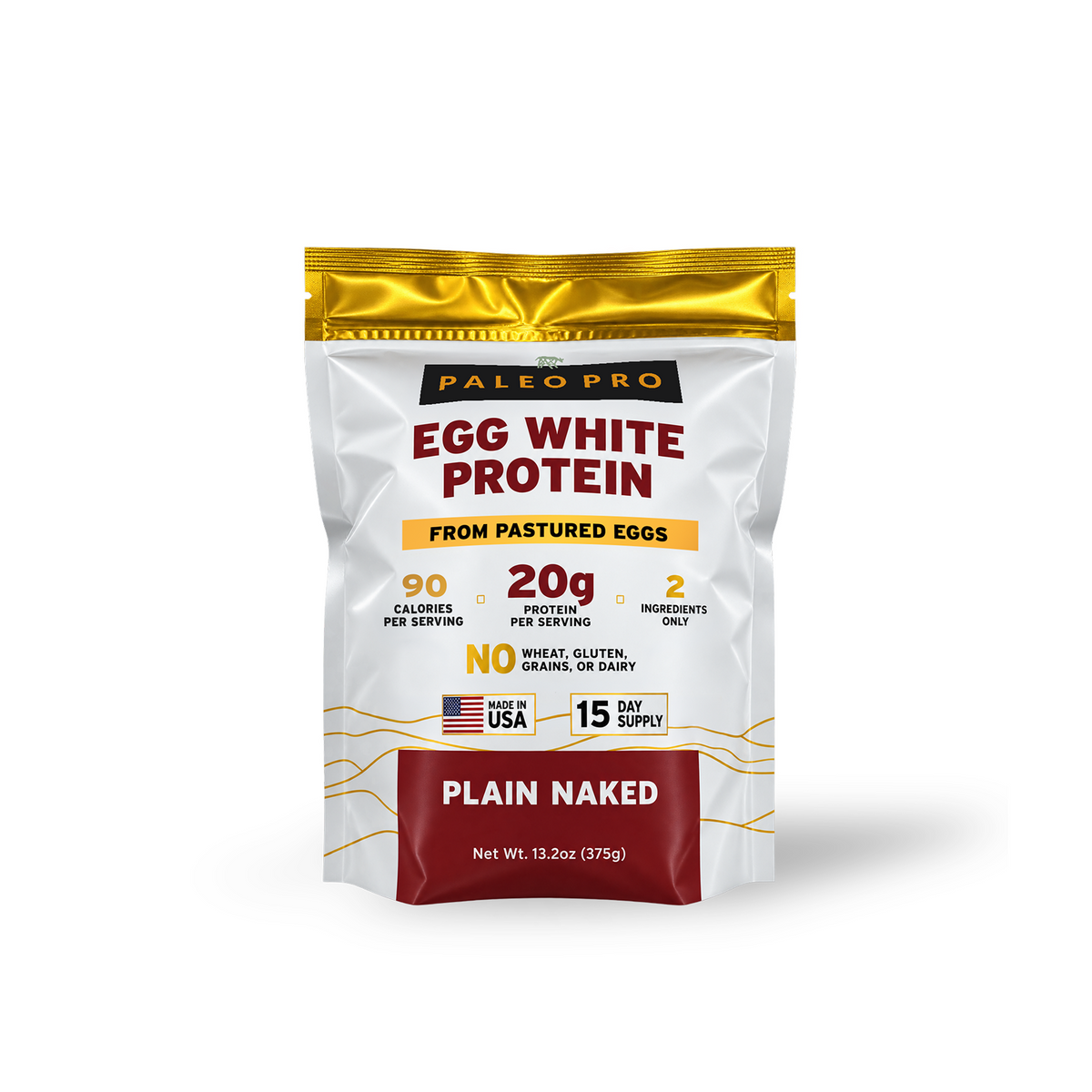
Our Egg White Protein is that idea in a bag: egg white from pastured chickens plus sunflower lecithin, with 20 g of protein, 90 calories and 0 g of fat in a scoop [8]. That works out to about 22 g of protein per 100 calories, close to the 21 g in a white you'd separate yourself (our arithmetic). Egg white isn't dairy either, which is why it turns up in our dairy-free protein powder guide. For how egg white protein compares with other powders and how to pick one, our full guide to egg white protein goes deeper.
Frequently Asked Questions
Does the egg yolk have more protein than the egg white?
Gram for gram, yes. Egg yolk has 15.9 g of protein per 100 g and egg white has 10.9 g, according to USDA. In a whole large egg the white has more, 3.6 g against 2.7 g, because the white weighs about twice as much as the yolk.
How much protein is in an egg yolk?
A large egg yolk has about 2.7 g of protein, based on USDA's 15.9 g per 100 g and a 17 g large yolk. It also carries about 55 calories and 4.5 g of fat, so it's a much less concentrated protein source than the white when you count calories.
What percentage of an egg's protein is in the white?
About 57%. A large egg has roughly 6.3 g of protein in total, with 3.6 g in the white and 2.7 g in the yolk by USDA's figures. The remaining 43% sits in the yolk.
Do egg whites have any fat or cholesterol?
Almost none. USDA lists 0.06 g of fat and 0 mg of cholesterol in a large egg white. Nearly all of an egg's fat, and all of its cholesterol, about 184 mg in a large egg, is in the yolk.
Are whole eggs healthier than egg whites?
They carry more nutrients. The yolk holds nearly all of an egg's choline, vitamin A, vitamin D, lutein and zeaxanthin, along with its fat and cholesterol. Egg whites deliver protein with very few calories. Which suits you depends on your calorie budget and any advice from your doctor about cholesterol.
Why do egg white protein powders leave out the yolk?
The yolk is about a quarter fat by weight and supplies most of an egg's calories, so a yolk powder would be mostly fat. Dried egg white is mostly protein: USDA's dried egg white lists 84.1 g of protein per 100 g. Powders made for protein use the white for that reason.
Which egg white powder does Paleo Pro make?
An egg splits its protein between two very different halves. The yolk is the nutrient-rich one, with the fat and calories that come along. The white is close to protein and water. When you want the white's protein without separating eggs, ours is egg white from pastured chickens and sunflower lecithin: 20 g of protein, 90 calories and 0 g of fat a scoop, unflavored and unsweetened [8]. It comes with a 60-day money-back guarantee, and subscribe and save takes 15% off every delivery [8].
Keep the white, skip the separating: Paleo Pro Egg White Protein has 20 g of protein in every scoop. Browse the rest of the protein collection.
Sources
- USDA FoodData Central. Egg, white, raw, fresh (FDC 172183). SR Legacy. fdc.nal.usda.gov. Read 2026-11-05. Large white portion 33 g. Per-egg values, shares and protein per 100 calories are our arithmetic.
- USDA FoodData Central. Egg, yolk, raw, fresh (FDC 172184). SR Legacy. fdc.nal.usda.gov. Read 2026-11-05. Large yolk portion 17 g. Per-egg values, shares and protein per 100 calories are our arithmetic.
- USDA FoodData Central. Egg, whole, raw, fresh (FDC 171287). SR Legacy. fdc.nal.usda.gov. Read 2026-11-05. Large egg portion 50 g.
- USDA FoodData Central. Egg, white, dried, stabilized, glucose reduced (FDC 170895). SR Legacy. fdc.nal.usda.gov.
- Réhault-Godbert, S., Guyot, N. & Nys, Y. (2019). "The Golden Egg: Nutritional Value, Bioactivities, and Emerging Benefits for Human Health." Nutrients, 11(3), 684. PMC6470839.
- van Vliet, S., et al. (2017). "Consumption of whole eggs promotes greater stimulation of postexercise muscle protein synthesis than consumption of isonitrogenous amounts of egg whites in young men." American Journal of Clinical Nutrition, 106(6), 1401-1412. PubMed 28978542.
- US Food and Drug Administration. 21 CFR 101.9(c)(1), Nutrition labeling of food: calories (4, 4 and 9 calories per gram of protein, carbohydrate and fat). law.cornell.edu/cfr/text/21/101.9.
- Paleo Pro. Egg White Protein Powder: product page, Nutrition Facts and ingredient list. paleopro.com/products/egg-white-protein-powder. Protein per 100 calories is our arithmetic: 20 g / 90 kcal.
