Beef Organ Supplements for Men: Testosterone, Performance & the Honest Truth
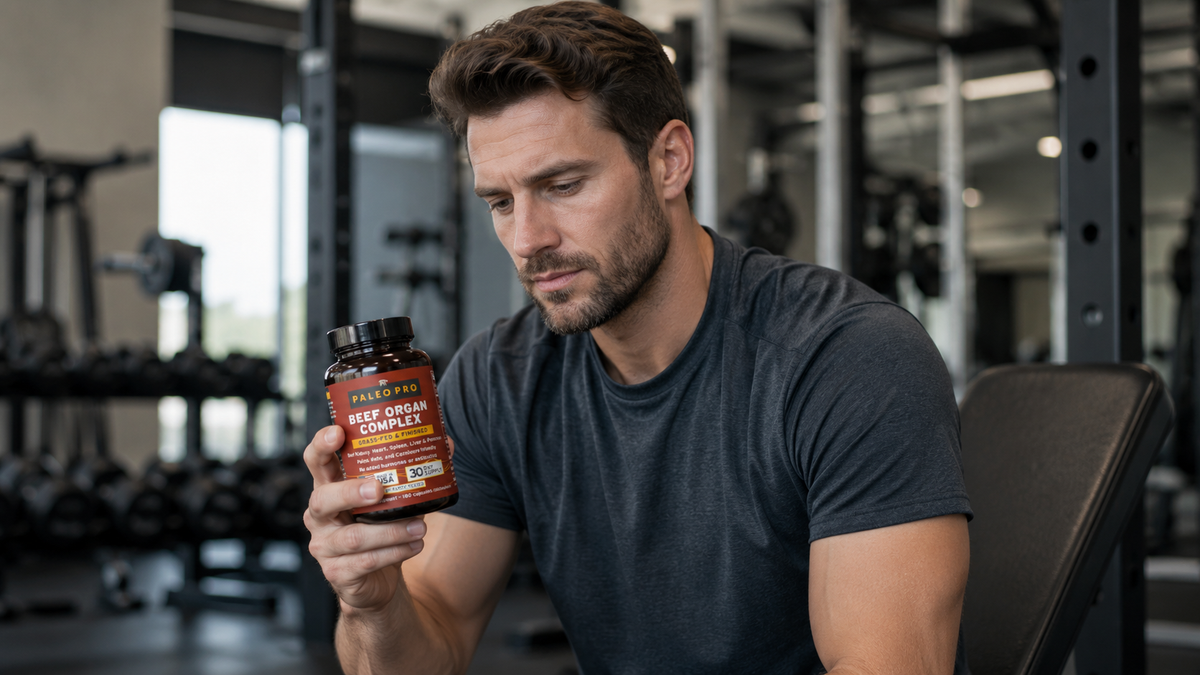
Beef organ supplements support men's health by supplying nutrients tied to male vitality — zinc, selenium, B12, and iron — in whole-food form. But the popular claim that beef organs or testicles "boost testosterone" isn't supported by evidence: these nutrients support normal testosterone production only when you're deficient, and don't raise it above normal. Take organs for nose-to-tail nutrition, not as a testosterone drug.
"Beef organs for testosterone" is one of the biggest promises in the men's supplement world, and it deserves a straight answer instead of hype. The honest version is more useful than the marketing: there are real nutrients in organ meats that matter for men's health, and there's a testosterone claim that doesn't hold up when you look at the evidence. Here's both, without the salesmanship — because you can't make a good decision on a claim that isn't true.
Do beef organ supplements boost testosterone?
Directly? No. No beef organ supplement — including beef testicles — has been shown to raise testosterone in men. A systematic analysis of "testosterone boosting" supplements found most had no ingredient with a mechanism to support the claim, and specifically found no data supporting orchic (testicle) extract for testosterone [1].
Here's the honest mechanism. The one nutrient in organ meats with a real link to testosterone is zinc — but the relationship is corrective, not additive. Zinc deficiency lowers testosterone, and restoring zinc in deficient men brings it back up [2]. In a landmark study, restricting zinc dropped young men's testosterone sharply, and supplementing marginally deficient older men roughly doubled theirs [3]. But in men who already get enough zinc, adding more does not push testosterone above normal [2]. So organ nutrition can help protect testosterone by preventing deficiency — it cannot "boost" a healthy man past his baseline. That distinction is the whole story, and it's the part the ads leave out.

A grass-fed, five-organ blend with real zinc, selenium, and B12 — honest whole-food nutrition for men, third-party tested and filler-free.
What organ nutrients actually support men's health
Set the testosterone hype aside and organ meats still earn their place for men, through nutrients that genuinely matter:
- Zinc — needed for normal testosterone production, immune function, and sperm health. Liver is a solid whole-food source (far more than testicle, incidentally) [4].
- Selenium — essential for sperm membrane protection and healthy fertility, concentrated in kidney.
- Vitamin B12 and heme iron — for energy metabolism and oxygen delivery, which underpin the "vitality" and workout-recovery benefits men actually notice [4].
- Vitamin A and copper — for immune function, connective tissue, and overall robustness.
These are real, and a nutrient-dense multi-organ blend — liver, heart, kidney, spleen, pancreas — delivers them in whole-food form. This is the honest case for organs for men: not a hormone hack, but broad nutritional support for an active life.
Beef testicles for testosterone: the honest truth
Beef testicles deserve their own straight talk, because the "eat the ball, boost the hormone" idea is everywhere — and the evidence is genuinely against it.
- The math doesn't work. Freeze-dried testicle contains only trace testosterone. A typical daily dose provides a tiny fraction of a percent of what a man's body makes on its own — and testosterone is a steroid hormone with very poor oral bioavailability, so most of even that trace is destroyed by digestion and the liver before it reaches your bloodstream [1].
- History already ran this experiment. The whole idea traces to an 1889 self-experiment whose "rejuvenation" was later shown to be a placebo — the extract contained testosterone thousands of times too low to have any biological effect [5].
- The nutrients are modest. Testicle is a lean organ with only modest zinc and iron — less, gram for gram, than liver [4]. If zinc for testosterone support is the goal, liver (or a plain zinc supplement) delivers far more.
None of this makes beef testicles worthless — it makes them an ancestral, nose-to-tail food, not a hormone therapy. If you eat them for the whole-animal tradition and the possibility of undiscovered co-factors, that's a fair, honest reason. If you're buying them expecting a testosterone spike, the science says you'll be disappointed.
So should men take organ supplements?
Yes — if your expectations match the evidence. For men, the honest value is nutrient density, not hormonal magic:
- Choose a liver-forward multi-organ blend for the best nutrient support per serving — real zinc, selenium, B12, iron, and vitamin A [4]. It's the better-evidenced choice for actual nutrition.
- Add or choose beef testicles for the ancestral, nose-to-tail philosophy — with clear eyes about the testosterone claim.
- Don't expect a testosterone boost from any of them if you're already healthy and well-nourished. What you can reasonably expect is support for energy, recovery, and overall nutrient status — the things men most often actually report.
A quick safety note: source matters for any organ supplement (grass-fed, third-party tested), and men with hormone-sensitive conditions, and competitive athletes subject to anti-doping testing, should be cautious with testicle products specifically and check with a professional. Our beef testicle supplement guide covers that in full.
Frequently asked questions
Do beef organ supplements boost testosterone? Not directly. The only relevant nutrient, zinc, supports testosterone production when you're deficient but doesn't raise it above normal in men who get enough [2][3]. No organ supplement, including testicles, has been shown to boost testosterone in healthy men [1]. They support men's health through nutrition, not hormones.
Do beef testicles increase testosterone? No credible evidence supports this. Testicle tissue contains only trace testosterone, most of which doesn't survive digestion, and the historical claim was shown to be a placebo effect [1][5]. Beef testicles are a nose-to-tail ancestral food, not a testosterone treatment.
What organ supplement is best for men? For nutrient support, a liver-forward multi-organ blend gives the most zinc, selenium, B12, iron, and vitamin A per serving [4]. It's better-evidenced for actual nutrition than testicle supplements, which are best understood as an ancestral-tradition choice.
Are beef organ supplements good for building muscle? They support the nutrients behind training — iron and B12 for energy and oxygen delivery, zinc for recovery — but they aren't protein powder or a steroid. They help most as nutritional support alongside adequate protein and training, not as a shortcut.
Does zinc from organ meat raise testosterone? Only if you were zinc-deficient to begin with. Zinc is required for normal testosterone production, so correcting a shortfall restores levels — but extra zinc in an already-sufficient man doesn't push testosterone higher [2][3].
Are beef organ supplements safe for men? For most healthy men, yes, at labeled servings from a grass-fed, third-party-tested source. Testicle products specifically warrant caution for men with hormone-sensitive conditions and for drug-tested athletes; check with a clinician if either applies to you.
The honest bottom line for men: beef organ supplements are legitimate whole-food nutrition — zinc, selenium, B12, iron — that supports vitality and recovery. They are not testosterone boosters, and the brand that tells you so is the one worth trusting.
Want real nutrient density for an active routine? Beef Organ Complex is a grass-fed, five-organ blend — liver, heart, kidney, spleen, and pancreas — third-party tested and filler-free, backed by a 60-day money-back guarantee. Eating nose-to-tail on principle? Our grass-fed Beef Testicles are there for the tradition — honestly, not as a hormone hack.
Sources
- Clemesha, C.G., Thaker, H., & Samplaski, M.K. (2020). "'Testosterone Boosting' Supplements Composition and Claims Are not Supported by the Academic Literature." World Journal of Men's Health, 38(1), 115–122. PMID: 31385468
- Te, L., Liu, J., Ma, J., & Wang, S. (2023). "Correlation between serum zinc and testosterone: A systematic review." Journal of Trace Elements in Medicine and Biology, 76, 127124. PMID: 36577241
- Prasad, A.S., et al. (1996). "Zinc status and serum testosterone levels of healthy adults." Nutrition, 12(5), 344–348. PMID: 8875519
- Fuerniss, H.F., et al. (2024). "Nutrient Analysis of Raw United States Beef Offal Items." Nutrients, 16(18), 3104. PMID: 39339704
- Cussons, A.J., Bhagat, C.I., Fletcher, S.J., & Walsh, J.P. (2002). "Brown-Séquard revisited: a lesson from history on the placebo effect of androgen treatment." Medical Journal of Australia, 177(11–12), 678–679. PMID: 12463999
