Keto vs Carnivore: Complete Comparison (Which Diet Is Right for You?)
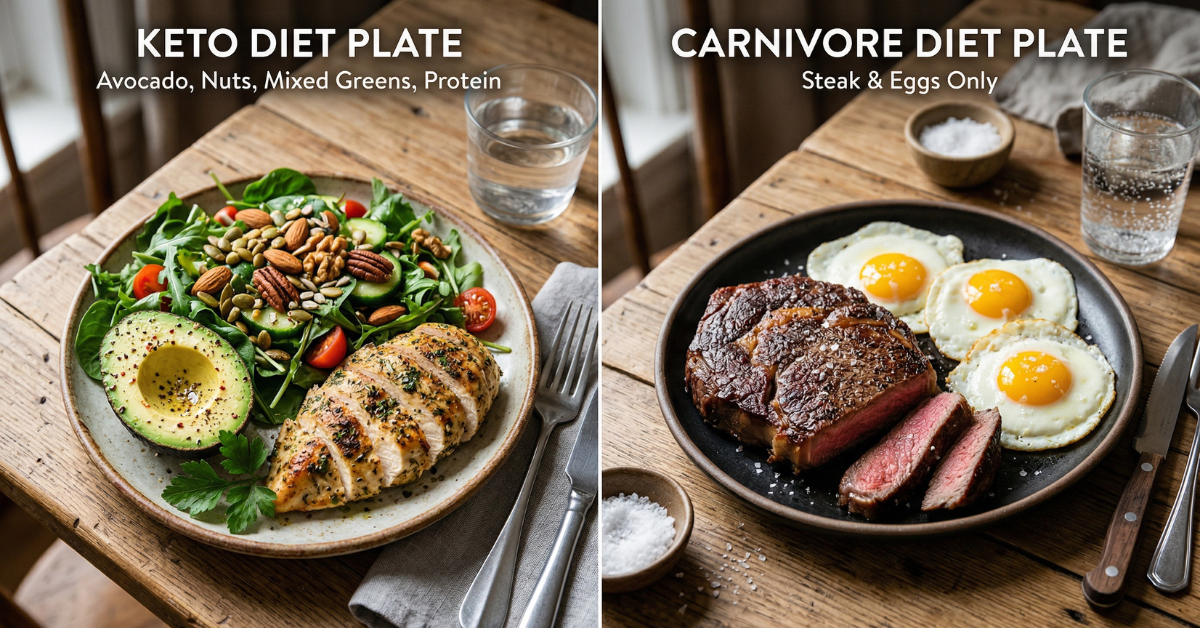
Keto restricts carbohydrates to 20-50g daily while allowing any food that fits the macros. Carnivore eliminates all plant foods entirely and eats only animal products. Both produce weight loss through similar metabolic pathways — reduced insulin, increased fat oxidation, appetite suppression. The difference is in food quality, simplicity, and sustainability. Keto offers more variety but more complexity. Carnivore offers more simplicity but more restriction. Neither has long-term clinical trial data. Here's the honest comparison.
Both diets overlap significantly — a strict carnivore dieter is almost certainly in ketosis, and a well-executed keto diet can look very similar to carnivore. But the philosophy and execution differ enough that the choice matters.
The Head-to-Head Comparison
| Factor | Keto | Carnivore |
|---|---|---|
| Core rule | Stay under 20-50g net carbs | Eat only animal foods |
| Macros | ~70% fat, 25% protein, 5% carbs | No tracking — typically ~60-70% fat, 30-40% protein |
| Food variety | Wide — any food within carb limit | Narrow — meat, fish, eggs, organs, animal fats |
| Tracking required | Yes — net carbs, macros | No — just eat animal foods |
| Plant foods | Allowed (low-carb vegetables, nuts, berries) | Excluded entirely |
| Processed "diet" foods | Common (keto bars, bread, desserts) | None |
| Seed oils | Technically allowed | Eliminated by default |
| Dairy | Included | Version-dependent |
| Ketosis | Goal — maintained by carb limit | Likely but not guaranteed (high protein can limit ketosis) |
| Clinical evidence | Moderate — dozens of RCTs | Minimal — surveys and case series only |
| Time to adapt | 1-2 weeks | 2-4 weeks |
Weight Loss: Which Is Better?
Both diets produce weight loss through overlapping mechanisms:
Shared Mechanisms
Insulin reduction. Both diets dramatically lower insulin levels by restricting carbohydrates. Lower insulin reduces fat storage, increases fat mobilization, and decreases sodium retention (causing initial water weight loss).
Appetite suppression. Both produce ketones — β-hydroxybutyrate directly suppresses appetite hormones [1]. Both increase protein relative to the Standard American Diet, engaging the protein leverage effect [2].
Thermic effect. Both emphasize protein and fat over carbohydrates. Protein has the highest thermic effect (~30% of calories burned during digestion vs ~3% for fat and ~8% for carbs) [3].
Where Carnivore May Have an Edge
Greater protein leverage. Carnivore dieters typically eat 150-250g protein/day vs 75-130g on keto. Higher absolute protein means stronger satiety signals and greater calorie suppression.
Food variety restriction. Less variety means sensory-specific satiety kicks in faster — you get satisfied sooner because there aren't 15 different flavors competing for your attention [4]. This is powerful for weight loss but difficult for long-term adherence.
No "keto junk food" trap. Carnivore's strict animal-only rule eliminates the processed keto products (bars, cookies, bread substitutes, fat bombs) that can stall weight loss. These products fit keto macros but often trigger overconsumption.
Where Keto May Have an Edge
Better adherence long-term. More food variety means more people stick with it. The best diet is the one you actually follow. Keto's flexibility — salads, nuts, berries, keto recipes — makes social situations, travel, and daily life easier.
More clinical data. Keto has been studied in dozens of randomized controlled trials for weight loss, type 2 diabetes, and epilepsy. Carnivore has survey data and case series. If evidence quality matters to you (and it should), keto has a stronger foundation.
Potential for deeper ketosis. Carnivore's high protein intake can limit ketosis through gluconeogenesis — protein is converted to glucose when eaten in excess of needs. Standard keto's moderate protein and high fat may maintain deeper ketosis, which some people find enhances the appetite-suppressing effects.
The Verdict on Weight Loss
For most people, both diets produce similar weight loss over 3-6 months. The mechanism is the same: caloric reduction through appetite suppression. Carnivore may produce faster initial results due to stronger protein leverage and food variety restriction. Keto may produce more sustainable results due to better long-term adherence.
The Lennerz survey found carnivore dieters achieved a median BMI drop from 27.2 to 24.3 over a median of 14 months [5]. Multiple keto RCTs show 5-10% body weight loss over 6-12 months. The numbers are comparable.
Food Quality: The Real Difference
This is where the diets diverge most meaningfully.
The Keto Food Quality Problem
Keto's rules are purely mathematical: stay under your carb limit. This means the following are all "keto-approved":
- Soybean oil (0g carbs)
- Sugar-free candy with maltitol
- Processed "keto" bread made with modified wheat starch
- Keto ice cream with 15 ingredients
- Almond flour cookies with erythritol
- Fat bombs made with seed oil-based chocolate
None of these would be allowed on carnivore. Carnivore's animal-only rule functions as a built-in food quality filter that keto's macro-based approach lacks.
Carnivore's Quality Advantage
By restricting to animal foods, carnivore automatically eliminates:
- Seed oils (the most inflammatory component of the modern diet)
- Processed carbohydrate products
- Artificial sweeteners (debated effects on gut microbiome and insulin response)
- Emulsifiers, thickeners, and preservatives
- Plant defense compounds (lectins, oxalates, phytates — problematic for some people)
You don't need to read a single ingredient label on carnivore. If it comes from an animal, it's in. This simplicity is both the diet's greatest strength and its greatest limitation.
Simplicity and Lifestyle
Keto's Complexity
Keto requires tracking — at least initially. Net carbs, total carbs, macros, hidden sugars, carb counts in sauces and condiments. Eating out means checking menus and calculating. Cooking means following recipes with specific macro targets.
Many people find keto's mental load exhausting, especially after the initial motivation fades. "Can I eat this?" requires math. The decision fatigue is real.
Carnivore's Simplicity
Carnivore requires one question: "Did this come from an animal?" Yes → eat it. No → don't. No tracking, no apps, no calculating. The cognitive load is near zero.
This simplicity is why carnivore often works for people who've failed on keto — not because the metabolism is different, but because the decision-making is eliminated.
Social Situations
Keto: More manageable. Most restaurants have options — salads, grilled protein, vegetables. Dinner parties can be navigated with some flexibility.
Carnivore: Harder. "I only eat meat" requires explanation at every social meal. Restaurants are doable (bunless burgers, steak, eggs) but limited. Family dinners can feel isolating.
The ketovore approach — primarily carnivore with select low-carb plants — is the compromise many people end up at.
Side Effects Comparison
| Side Effect | Keto | Carnivore |
|---|---|---|
| Keto/carnivore flu | 1-2 weeks | 2-4 weeks (longer adaptation) |
| LDL cholesterol | Often increases | Almost always increases — often dramatically |
| Digestive issues | Uncommon (fiber still present) | Common in weeks 1-3 (bile acid adjustment) |
| Nutrient deficiencies | Uncommon (varied diet) | Possible without organs (vitamin C, folate, calcium) [6] |
| Social difficulty | Moderate | High |
| Food boredom | Low | Moderate to high |
Who Should Choose Keto
- People who enjoy cooking and recipe variety
- People who want a well-researched dietary approach with clinical trial backing
- People who need social flexibility (frequent dining out, family meals)
- People comfortable with macro tracking
- People who tolerate plant foods well and don't have autoimmune concerns
PaleoPro for keto: Paleo Protein — beef protein isolate + egg white protein, zero carbs, clean ingredients. Fits keto macros perfectly without the dairy, sweeteners, and additives in most protein powders.
Who Should Choose Carnivore
- People who want maximum simplicity — no tracking, no counting, no deciding
- People who've tried keto and stalled (food quality upgrade often restarts results)
- People using diet as an elimination protocol for autoimmune or gut conditions
- People who respond poorly to plant foods (digestive issues, joint pain, skin problems)
- People who prefer structured rules over flexible guidelines
- People who failed on other diets due to decision fatigue
PaleoPro for carnivore: Carnivore Complete — beef protein isolate + organ nutrients (liver, heart, kidney, spleen). Designed specifically for the carnivore diet.
The Hybrid Option: Ketovore
Many people find their sweet spot between keto and carnivore — the ketovore diet. It maintains carnivore's animal-food base and food quality standards while allowing select low-carb plants (avocado, berries, fermented vegetables). No processed keto products. No macro tracking. Just animal foods + a small plant safety valve.
This is where Paul Saladino, one of the most prominent former strict carnivore advocates, ended up after two years of strict carnivore. It's also where many long-term carnivore dieters naturally gravitate.
FAQ
Is keto or carnivore better for weight loss? Both produce similar weight loss through the same mechanisms — insulin reduction, appetite suppression, and increased protein intake. Carnivore may produce faster initial results due to stronger protein leverage and food variety restriction. Keto may be more sustainable long-term due to greater food variety. The best choice is the one you'll actually follow.
Is carnivore diet just keto? No. Keto is a macronutrient ratio (high fat, moderate protein, low carb). Carnivore is a food-source restriction (animal foods only). A carnivore dieter may or may not be in ketosis — high protein intake can limit ketone production. A keto dieter can eat plant foods, processed foods, and seed oils as long as macros are met. The philosophy is fundamentally different.
Which has more side effects — keto or carnivore? Carnivore has a longer adaptation period (2-4 weeks vs 1-2 for keto), more dramatic LDL cholesterol increases, and higher risk of nutrient deficiencies without organ meats. Keto has fewer side effects overall because the diet is less restrictive. Both produce "flu-like" adaptation symptoms.
Can I switch from keto to carnivore? Yes — and it's easier than going from a standard diet to carnivore because you've already adapted to fat as fuel. The main change is eliminating remaining plant foods and potentially increasing protein. Most keto-to-carnivore transitions have a shorter adaptation period (3-7 days vs 2-4 weeks).
Which is more sustainable long-term? Keto offers more variety and social flexibility, which favors long-term adherence. Carnivore is simpler to follow (no tracking) but more restrictive, which can lead to burnout. Many people start with carnivore for 30-90 days and transition to ketovore for long-term sustainability.
Do I need supplements on both? Keto: usually just electrolytes during adaptation. Carnivore: electrolytes during adaptation, plus organ meats or an organ supplement long-term for nutrient completeness. Vitamin D is recommended on both if sun exposure is low.
Sources
- Gibson, A.A., et al. (2015). "Do ketogenic diets really suppress appetite? A systematic review and meta-analysis." Obesity Reviews, 16(1), 64-76. PMID: 25402637
- Simpson, S.J. & Raubenheimer, D. (2005). "Obesity: the protein leverage hypothesis." Obesity Reviews, 6(2), 133-142. PMID: 15836464
- Paddon-Jones, D., et al. (2008). "Protein, weight management, and satiety." American Journal of Clinical Nutrition, 87(5), 1558S-1561S. PMID: 18469287
- Raynor, H.A. & Epstein, L.H. (2001). "Dietary variety, energy regulation, and obesity." Psychological Bulletin, 127(3), 325-341. PMID: 11393299
- Lennerz, B.S., et al. (2021). "Behavioral Characteristics and Self-Reported Health Status among 2029 Adults Consuming a 'Carnivore Diet'." Current Developments in Nutrition, 5(12), nzab133. PMID: 34934897
- Goedeke, S., et al. (2025). "Assessing the Nutrient Composition of a Carnivore Diet: A Case Study Model." Nutrients, 17(1), 140. PMID: 39796574
Choosing carnivore? Start with Carnivore Diet for Beginners or the 30-Day Carnivore Plan. Choosing keto? Our Keto Protein Powder guide covers what to look for. For the hybrid approach, read Ketovore Diet Explained. And for carnivore-optimized nutrition, Carnivore Complete provides beef protein plus organ nutrients in one scoop.