Monk Fruit vs Stevia vs Sucralose in Protein Powder
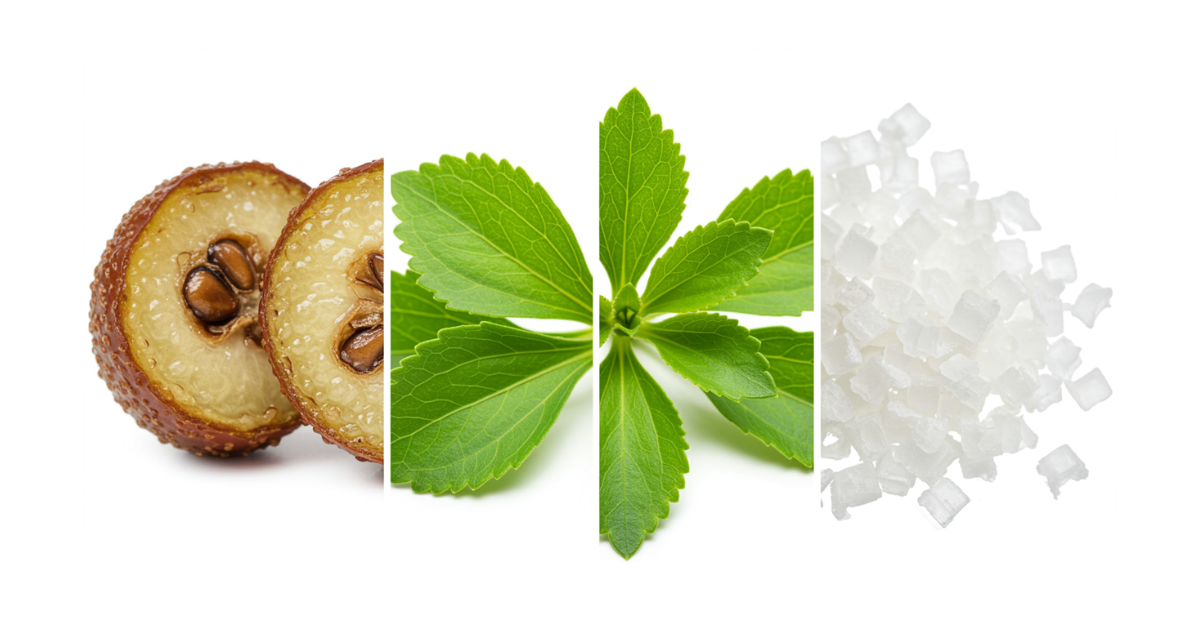
Monk fruit, stevia, and sucralose are high-intensity sweeteners used in protein powder. All can reduce added sugar, but they differ in source, regulation, and sensory profile. No one sweetener tastes best to everyone. Compare the exact ingredient, the finished flavor, and your own response instead of treating “natural” or “artificial” as a complete verdict.
The sweetener is a tiny part of the scoop and a large part of whether you finish the bag. That makes it worth reading one line below the nutrition panel.
How do monk fruit, stevia, and sucralose compare?
The useful differences are on the ingredient list and in the glass. FDA treats sucralose as an approved food additive. Certain purified steviol glycosides and monk fruit extracts have been the subject of GRAS notices that FDA did not question for their intended uses.[1]
| Question | Monk fruit extract | Purified steviol glycosides | Sucralose |
|---|---|---|---|
| Source | Extract from Siraitia grosvenorii fruit | Purified compounds from Stevia rebaudiana | Sweetener made from modified sucrose |
| FDA pathway | Uses covered by GRAS notices | Uses covered by GRAS notices | Approved food additive |
| Relative sweetness | About 100 to 250 times sucrose | About 200 to 400 times sucrose | About 600 times sucrose |
| Sensory issue to check | Lingering bitter, metallic, or chemical notes can occur | Bitter and lingering notes can occur | Sweetness can linger; finished flavor still varies |
| Where it appears | Ingredient list, sometimes as luo han guo | Ingredient list, often as stevia extract or a named rebaudioside | Ingredient list as sucralose |
| Best reason to choose it | You like the finished formula | You like the finished formula | You like the finished formula |
That last row is deliberately boring. A sensory panel can describe a sweetener in water. It cannot tell you how cocoa, vanilla, salt, protein source, and serving size will taste together in your shaker.
The best buying move is to find a finished formula whose sweetener and full ingredient list you can identify.
What does monk fruit taste like?
Monk fruit extract can taste sweet, but it is not automatically free of aftertaste. In a small study, 20 participants evaluated 15 sweeteners plus sucrose in water. The monk fruit sample had a distinct time profile and prominent lingering bitter, metallic, and chemical side-taste citations.[2]
That result corrects a common online claim that monk fruit has been proven cleaner or more sugar-like than stevia. The study was small, used sweeteners in water, and did not test protein powder. It shows why universal taste claims are shaky. It does not prove that every monk fruit formula tastes bitter.
Finished products can taste very different because flavor systems change perception. Cocoa, vanilla, salt, acidity, serving concentration, and the protein base all matter. If a brand offers samples or a guarantee, that is more useful for your taste decision than a sweeping “no aftertaste” promise.
Why can stevia taste bitter?
Stevia is a plant; the sweeteners used in food are purified steviol glycosides. Mechanistic and sensory research found that several steviol glycosides activate sweet receptors and the bitter receptors hTAS2R4 and hTAS2R14.[3] That supports a real reason some stevia products carry bitter notes.
It does not support the inherited claim that a fixed percentage of people are genetically unable to tolerate stevia. Taste varies with the specific glycoside, concentration, food matrix, and individual. Newer formulations may use different rebaudiosides or blends to manage the aftertaste.
If you consistently dislike it, check for all of these label names:
- stevia extract
- steviol glycosides
- rebaudioside A, M, or D
- Reb A, Reb M, or Reb D
A product can advertise another sweetener on the front and still use stevia in a blend. The ingredient list settles the question.
What should you know about sucralose?
Sucralose is an FDA-approved high-intensity sweetener. FDA lists it among the sweeteners considered safe for the general population under specified conditions of use.[1] Calling it approved does not mean every person must choose it. It means the safety question has a regulatory answer that should be represented accurately.
Research on non-nutritive sweeteners and the microbiome is still developing. In a randomized controlled trial, four sweetener groups produced distinct microbiome changes, and saccharin and sucralose impaired glycemic responses in the study population.[4] Responses varied among individuals, and the trial does not show that one serving of sucralose in protein powder causes a disease.
That is the honest boundary. Sucralose is permitted for use. People who prefer to avoid it can do so by reading the ingredient list. People who use it do not need a scare story attached to their shaker.
Does natural mean better?
“Natural” does not tell you whether a sweetener tastes good to you, how much is in a serving, or whether another ingredient causes a problem. Monk fruit and stevia come from plant sources but undergo extraction and purification. Sucralose is synthetic. Those facts may matter to your food philosophy, but they do not finish the decision.
Ask four practical questions:
- Do I enjoy the finished flavor at the labeled serving size?
- Does the label name every sweetener clearly?
- Does the formula fit my dietary or allergen needs?
- Can I buy a small size or use a meaningful return policy before committing?
Taste is personal. Label transparency is not.
Which sweetener should you choose in protein powder?
Choose by the problem you are trying to solve.
| Your priority | Sensible place to start | What to verify |
|---|---|---|
| Avoid stevia | Monk fruit, sucralose, sugar-sweetened, or unsweetened powder | No steviol glycosides or rebaudiosides in the ingredient list |
| Avoid sucralose | Monk fruit, stevia, sugar-sweetened, or unsweetened powder | No sucralose in the ingredient list |
| Avoid every sweetener | Unsweetened powder | No sweetener, flavor blend, or sweetened creamer in the full preparation |
| Limit added sugar | High-intensity sweetener or unsweetened powder | Added Sugars line and serving size |
| Find the best taste | Sample several finished products | Same liquid, serving size, and temperature for each test |
For a focused label guide, read protein powder without stevia. If you are sorting out nutrient claims, the sugar-free protein powder guide explains the difference between sugar-free, no added sugar, and unsweetened.
PaleoPro uses monk fruit in Aztec Vanilla, Ancient Cacao, and Mayan Mocha. Plain Naked has no sweetener. All four flavors contain grass-fed beef protein isolate and egg white protein, so the product contains egg.[5]
How should you compare taste at home?
Use the same test for every powder. Mix the labeled serving with the same amount and temperature of liquid. Taste it immediately, then again after a minute. Notice sweetness at the start, bitterness or metallic notes later, and whether the flavor lingers.
Do not change three variables at once. A banana, coffee, or nut butter can rescue almost anything, but then you are comparing smoothie recipes rather than powders. First learn what the powder tastes like. Then build the drink you want.
Frequently asked questions
Is monk fruit better than stevia?
Neither is universally better. Both can provide high-intensity sweetness with little or no caloric contribution, and both can produce side tastes depending on the extract and finished formula. Choose by the ingredient list and your response to the product.
Does monk fruit have an aftertaste?
It can. A small sensory study found lingering bitter, metallic, and chemical side-taste citations for the monk fruit sample tested in water.[2] A flavored protein powder may taste different because the complete formula changes perception.
Why does stevia taste bitter to me?
Some steviol glycosides activate bitter as well as sweet taste receptors.[3] The specific glycoside, dose, food matrix, and individual all affect perception. If you dislike it consistently, look for steviol glycosides and rebaudiosides on labels.
Is sucralose safe?
FDA approves sucralose for use in food and considers approved high-intensity sweeteners safe under their conditions of use.[1] Research continues on individual metabolic and microbiome responses. That uncertainty does not justify calling approved use dangerous.
Do these sweeteners raise blood sugar?
FDA says high-intensity sweeteners generally do not raise blood sugar levels.[1] Individual responses and the rest of the product still matter. A protein shake also contains protein and may include carbohydrates from flavor ingredients.
Can a protein powder contain more than one sweetener?
Yes. Brands often blend sweeteners to change taste or cost. Read the full ingredient list for monk fruit, stevia or named rebaudiosides, sucralose, sugar alcohols, and added sugars.
Is unsweetened protein powder the simplest choice?
It is the most direct way to avoid sweeteners. It may still contain an emulsifier, salt, flavor, or another protein source, so “unsweetened” does not mean one ingredient or allergen-free.
Your best sweetener is the one you knowingly choose and enjoy in the finished product. The label supplies the facts. Your palate gets the final vote.
Want to try a monk-fruit formula or skip sweeteners entirely? Compare Paleo Protein Powder flavors, including Plain Naked, or browse the protein collection. Use the 60-day money-back guarantee if the finished taste is not for you.
Sources
- U.S. Food and Drug Administration. High-Intensity Sweeteners. Accessed 2026-09-17.
- Tan VWK, Wee MSM, Tomic O, Forde CG. “Temporal sweetness and side tastes profiles of 16 sweeteners using temporal check-all-that-apply (TCATA).” Food Research International. 2019;121:39-47. PubMed 31108762.
- Hellfritsch C, Brockhoff A, Stähler F, Meyerhof W, Hofmann T. “Human Psychometric and Taste Receptor Responses to Steviol Glycosides.” Journal of Agricultural and Food Chemistry. 2012;60(27):6782-6793. PubMed 22616809.
- Suez J, et al. “Personalized microbiome-driven effects of non-nutritive sweeteners on human glucose tolerance.” Cell. 2022;185(18):3307-3328. DOI 10.1016/j.cell.2022.07.016.
- PaleoPro. Paleo Protein Powder. Product and flavor labels checked 2026-09-17.
