What's Inside a Beef Organ Complex? Liver, Heart, Kidney, Spleen & Pancreas
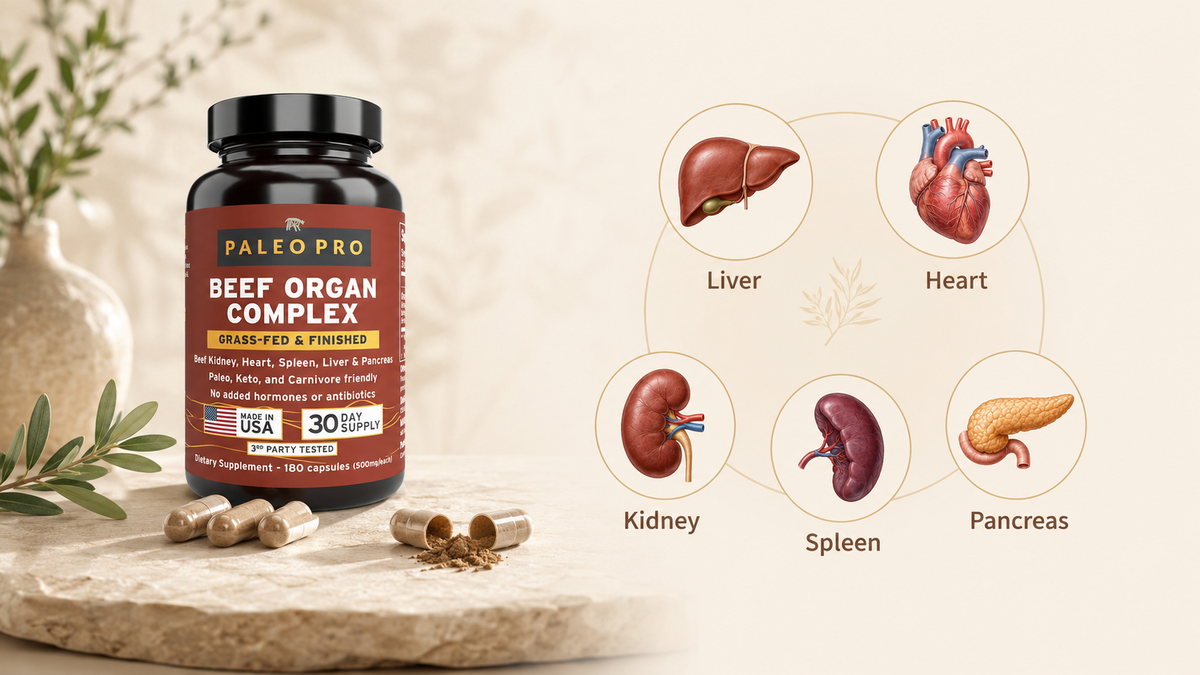
A beef organ complex is a supplement that combines several nutrient-dense organs in one capsule — most often liver, heart, kidney, spleen, and pancreas. Each organ brings a different set of nutrients: liver for vitamin A, B12, and copper; heart for CoQ10; kidney for selenium; spleen for heme iron; pancreas for digestive support. Together they cover a broader nutrient range than any single organ.
"Nose-to-tail" gets said a lot, but rarely explained. The idea behind a beef organ complex is simple and old: different organs concentrate different nutrients, so eating a range of them covers more ground than any one alone. This is the organ-by-organ breakdown — what each part actually contributes, why spleen and kidney deserve more attention than they get, and why a thoughtful blend beats a single-organ supplement for everyday use.
What's inside a beef organ complex?
A typical five-organ complex contains liver, heart, kidney, spleen, and pancreas — the classic nose-to-tail set. Each is there for a reason, not for volume. Liver is the famous one, but it's genuinely only part of the story: heart, kidney, and spleen each supply nutrients that liver is only moderate in, or lacks. The point of a blend is coverage — a wider spread of vitamins and minerals in their whole-food form, with the added benefit of keeping any single nutrient (especially liver's very high vitamin A) more moderate per serving.
Here's what each organ brings to the capsule.
What each organ does
- Liver — the nutrient anchor. It's the richest source of preformed vitamin A (retinol), ready to use with no conversion [1], plus whole-food vitamin B12, copper, and choline, a nutrient most people under-consume and most multivitamins skip entirely [2].
- Heart — the CoQ10 organ. Beef heart is the richest dietary source of coenzyme Q10, at roughly 11–13 mg per 100g — three to four times more than muscle meat [3]. CoQ10 is central to how cells produce energy, and the body's own production declines with age.
- Kidney — the selenium concentrator. Kidney is one of the densest food sources of selenium, which supports thyroid function and the body's antioxidant enzymes [4] — and it delivers it without liver's very high vitamin A.
- Spleen — the iron champion. Spleen is one of the densest sources of heme iron of any food, several times higher than liver [5]. More on that below.
- Pancreas — the traditional finisher. Pancreas rounds out the nose-to-tail profile and has long been included in organ blends as part of whole-animal eating.
Read together, the logic is clear: no single organ does everything, so a blend of five gives you the broadest coverage in one capsule.
Beef spleen benefits: the overlooked iron organ
Spleen is the organ almost nobody talks about, and that's a miss — it's one of the richest heme-iron foods that exists, estimated at several times the iron content of liver [5]. Heme iron, the form found in animal foods, is absorbed far more efficiently than the non-heme iron in plants and iron pills — roughly 15–35% versus as little as 2–20% — and with fewer digestive side effects [5]. For anyone focused on iron intake, spleen is a quiet standout, which is exactly why it belongs in a serious organ blend.
Spleen tissue also contains bioactive peptides that have been studied for immune-related effects. Honestly, though, that research is preliminary — mostly animal and lab work, with no human trials showing that eating desiccated spleen delivers those peptides in an active form. The iron content alone justifies spleen's place; the immune claims should be treated as speculative, not established.
Beef kidney: selenium without the vitamin A load
Kidney's advantage is specific and useful: it concentrates selenium — a mineral essential for converting thyroid hormone and running the glutathione antioxidant system — at levels several times higher than liver [4]. Crucially, it delivers that selenium without liver's extremely high vitamin A and copper. That's one of the best arguments for a blend over liver alone: kidney and spleen add nutrients liver is short on, while diluting the nutrients liver has in excess. A "beef kidney supplement" rarely exists on its own, but inside an organ complex, kidney is pulling real weight.
Why a blend beats a single organ
Put it together and the case for a complex over a single organ is straightforward:
- Broader nutrient coverage — CoQ10 from heart, selenium from kidney, extra heme iron from spleen, plus liver's vitamin A, B12, copper, and choline. No single organ offers all of that.
- A more moderate vitamin A load. Liver alone is so rich in preformed vitamin A that daily high doses can push past the 3,000 mcg RAE (10,000 IU) upper limit over time [6]. Spreading liver across five organs keeps vitamin A more moderate per serving — better suited to everyday use.
- Closer to how organs were traditionally eaten — the whole range, not one part.
A single-organ liver supplement still has its place when you specifically want maximum vitamin A and B12. But for broad, everyday nose-to-tail nutrition, a blend is the more sensible default.
Frequently asked questions
What is in a beef organ complex? Most contain five organs — liver, heart, kidney, spleen, and pancreas. Liver supplies vitamin A, B12, copper, and choline; heart supplies CoQ10; kidney supplies selenium; spleen supplies heme iron; pancreas rounds out the nose-to-tail profile [1][3][4][5].
What are beef spleen benefits? Spleen is one of the richest sources of heme iron of any food — several times more than liver — in the highly absorbable form found in animal foods [5]. That makes it a standout for iron intake. It also contains peptides studied for immune effects, though that research is still preliminary.
Is a beef kidney supplement worth taking? Kidney is prized for selenium, which supports thyroid and antioxidant function, and it provides it without liver's high vitamin A [4]. You'll rarely find kidney sold alone, but as part of an organ complex it adds nutrients liver lacks.
Which organ is the most nutritious? Liver is the single most nutrient-dense organ — richest in vitamin A, B12, and copper [1]. But "most nutritious" depends on the nutrient: heart wins on CoQ10, kidney on selenium, spleen on iron. That's the whole reason blends exist.
Is a beef organ complex better than just liver? For everyday use, usually yes — a blend covers more nutrients and keeps liver's very high vitamin A more moderate per serving [6]. Choose single-organ liver only if you specifically want to maximize vitamin A and B12.
Do I need all five organs? Not strictly, but each adds something liver alone doesn't — CoQ10, selenium, extra heme iron. If your goal is broad whole-food nutrition, the five-organ blend is the most complete option in one capsule.
Five organs, five different jobs — that's the whole idea of a nose-to-tail complex. Liver anchors it, but heart, kidney, spleen, and pancreas are what make a blend more than the sum of its parts.
Want the full nose-to-tail profile in one capsule? Beef Organ Complex is a grass-fed, five-organ blend — liver, heart, kidney, spleen, and pancreas — third-party tested and filler-free, backed by a 60-day money-back guarantee. Prefer just the most nutrient-dense organ? Try our grass-fed Beef Liver. New to organs? Start with do beef organ supplements work.
Sources
- Tang, G. (2010). "Bioconversion of dietary provitamin A carotenoids to vitamin A in humans." American Journal of Clinical Nutrition, 91(5), 1468S–1473S. PMID: 20200262
- Zeisel, S.H., & da Costa, K.A. (2009). "Choline: an essential nutrient for public health." Nutrition Reviews, 67(11), 615–623. PMID: 19906248
- Mattila, P., & Kumpulainen, J. (2001). "Coenzymes Q9 and Q10: Contents in Foods and Dietary Intake." Journal of Food Composition and Analysis, 14(4), 409–417. PMID: 11257723
- USDA FoodData Central — Beef kidney and organ nutrient profiles (selenium, B vitamins). fdc.nal.usda.gov
- Gallo Ruelas, M., et al. (2024). "A comparative analysis of heme vs non-heme iron administration: a systematic review and meta-analysis of randomized controlled trials." European Journal of Nutrition, 64(1), 30. PMID: 39708071
- NIH Office of Dietary Supplements (2024). "Vitamin A and Carotenoids — Health Professional Fact Sheet" (UL 3,000 mcg RAE / 10,000 IU per day). ods.od.nih.gov
