The Best Ancestral Supplements Alternative (2026): An Honest Comparison
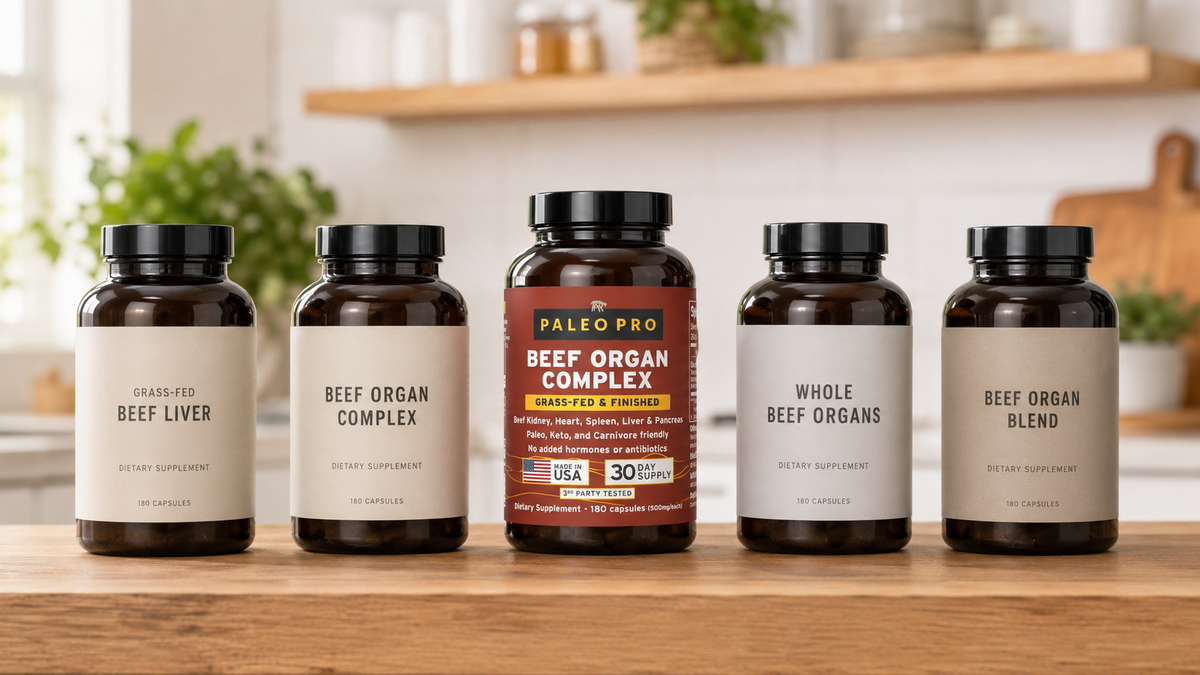
Ancestral Supplements and Paleovalley are two of the best-known grass-fed organ brands. Ancestral offers a five-organ blend and a liver-only capsule (both 3,000mg, freeze-dried); Paleovalley offers a three-organ complex (3,600mg). Both are quality products at a premium price. A strong alternative matches their grass-fed sourcing and third-party testing at a lower cost per bottle.
Ancestral Supplements more or less created the modern organ-capsule category, and Paleovalley built a loyal following right behind it. If you're reading their reviews, you've probably also noticed the price — $35 to $48 a bottle — and wondered whether you're paying for the nutrition or the name. This is the honest comparison: what Ancestral and Paleovalley each get right, where they differ, and what to look for in an alternative that delivers the same grass-fed, third-party-tested organ nutrition without the premium.

Want just the liver? Grass-fed, 3,000mg a serving — the same dose as the premium brands, $29.99.
Ancestral Supplements and Paleovalley: how they stack up
Both brands earn their reputations. Ancestral freeze-dries grass-fed, pasture-raised organs from New Zealand and Australia, publishes third-party testing, and offers the widest lineup in the category — a five-organ blend plus standalone liver and other single organs. Paleovalley's Organ Complex is a simpler three-organ formula, freeze-dried at low temperature, with no fillers or flow agents.
| Ancestral Beef Organs | Ancestral Beef Liver | Paleovalley Organ Complex | |
|---|---|---|---|
| Organs | 5 — liver, heart, kidney, spleen, pancreas | Liver only | 3 — liver, heart, kidney |
| Dose / serving | 3,000 mg (6 caps) | 3,000 mg (6 caps) | 3,600 mg (6 caps) |
| Sourcing | Grass-fed, NZ & Australia | Grass-fed, NZ & Australia | Grass-fed, USA |
| Processing | Freeze-dried | Freeze-dried | Freeze-dried |
| Third-party tested | Yes | Yes + GMP | Not stated on product page |
| Price (one-time) | ~$48 | ~$38 | ~$34.99 (+ shipping) |
The honest differences:
- Organs. Ancestral's blend has five organs to Paleovalley's three — Paleovalley leaves out spleen and pancreas and leans hard on liver (2,700mg of its 3,600mg total). If you want spleen's heme iron or a broader nose-to-tail profile, Ancestral covers more ground.
- Testing. Ancestral publishes third-party testing and is GMP-certified. Paleovalley, as best we can tell from its product page, doesn't publish a third-party testing claim — a gap worth noting, because a regulatory analysis found the majority of bovine-organ supplements misstate something on their label [1].
- Processing. Both freeze-dry, which genuinely retains more nutrients than high-heat desiccation [2]. That's a real strength of both, and something to look for in any alternative.
- Price. Paleovalley is cheaper up front (~$34.99 vs Ancestral's ~$48 for the blend), though it adds shipping; Ancestral's liver-only sits at ~$38.
Both are good products. But "good" at $48 a bottle, or "good" without a published purity test, leaves an obvious opening: a five-organ, grass-fed, third-party-tested blend that costs less than either — which is exactly the alternative most people running this search are after.

Want just the liver? Grass-fed, 3,000mg a serving — the same dose as the premium brands, $29.99.
What makes a good organ supplement (and a good alternative)
Strip away the brand names and a quality organ supplement comes down to a few checks:
- Grass-fed, pasture-raised sourcing. Organs concentrate whatever the animal was raised on, so clean sourcing is both a nutrition and a safety issue.
- A blend that covers the nutrient-dense organs: liver (the most nutrient-dense organ, rich in vitamin A, B12, and copper [5]), kidney (selenium), spleen (one of the densest heme-iron foods there is [3]), and heart (the richest dietary source of CoQ10 [4]).
- Freeze-dried or gently dried to protect heat-sensitive nutrients [2].
- Third-party tested, because most of the category misstates its labels [1] — a published purity test is how you know the bottle matches the claim.
- Honest dosing and no fillers — a clean label that tells you the organs and the amounts.
- A price you can sustain. Organ supplements work over months, not days, so cost per month is part of whether a product is genuinely worth it.
Judge any product — Ancestral, Paleovalley, or an alternative — against those, and the marketing stops mattering.
The best Ancestral Supplements alternative for the money
An alternative worth switching to has to match the essentials — grass-fed, pasture-raised organs, a real multi-organ blend, third-party testing, no fillers — and beat the price. PaleoPro's Beef Organ Complex is a five-organ, grass-fed, pasture-raised blend (liver, heart, kidney, spleen, and pancreas), third-party lab verified in the USA, filler-free, at $32.99 — the same five-organ profile as Ancestral's blend, third-party tested like Ancestral, at roughly two-thirds the price.
If it's specifically the liver you want, the head-to-head is even simpler. Ancestral's Grass Fed Beef Liver and PaleoPro's grass-fed Beef Liver are both 3,000mg per six-capsule serving. Ancestral's is freeze-dried at ~$38; PaleoPro's is desiccated at $29.99. Ancestral's freeze-drying is a genuine advantage for nutrient retention [2] — whether it's worth the extra ~$8 a bottle is your call, and an honest one to weigh.
One more honest note for daily use: a multi-organ blend spreads liver's very high vitamin A across five organs, keeping it more moderate per serving than a liver-only capsule — worth knowing if you plan to take it every day (our guide to beef liver side effects covers why). That's a point in favor of the blend over straight liver for everyday use, whichever brand you choose.
One fair caveat the other way: Ancestral offers a much broader catalog of standalone single organs — spleen, thyroid, and more — that a focused brand doesn't. If you're hunting for an obscure single organ, Ancestral has the range. But for the core nutrition most people actually want — a nutrient-dense multi-organ blend, or straight liver — the value math favors the alternative.
Frequently asked questions
Is Ancestral Supplements worth it? Ancestral is a legitimate, well-sourced, freeze-dried, third-party-tested organ supplement — genuinely good. Whether it's "worth it" comes down to price: at about $48 for the organ blend, five-organ, third-party-tested alternatives deliver comparable grass-fed nutrition for less. You're partly paying for the brand that pioneered the category.
What is a good alternative to Ancestral Supplements? Look for a five-organ, grass-fed, pasture-raised blend that's third-party tested and filler-free. PaleoPro's Beef Organ Complex matches Ancestral's five-organ profile (liver, heart, kidney, spleen, pancreas) and third-party testing at $32.99 — roughly two-thirds of Ancestral's price.
Ancestral Supplements vs Paleovalley — which is better? Ancestral has more organs (five vs three) and publishes third-party testing plus GMP certification; Paleovalley is cheaper up front and freeze-dried, but doesn't publish a testing claim on its product page. Both are grass-fed and freeze-dried. Ancestral for breadth and verified testing; Paleovalley for a simpler, lower-cost liver-forward blend.
Is Paleovalley Organ Complex third-party tested? Paleovalley's product page doesn't publish a third-party testing claim as of this writing. That doesn't mean it isn't tested — but since most of the organ category misstates its labels [1], a published purity test is something worth confirming before you buy.
How much does Ancestral Supplements cost? Ancestral's Grass Fed Beef Organs blend is about $48 for a one-time bottle (30 servings, ~$1.60 a day), and its liver-only capsule is about $38, with roughly 15% off on subscription. Comparable five-organ, third-party-tested blends are available for less — as with most of the category, price tracks brand and marketing as much as sourcing.
Are cheaper organ supplements lower quality? Not necessarily. Price tracks brand and marketing as much as sourcing. What actually predicts quality is grass-fed, pasture-raised sourcing, third-party testing, and honest labeling [1] — check those, not the price tag. A lower-priced supplement that clears all three can match a premium one.
What's the difference between Ancestral's beef liver and beef organs? Beef Liver is liver only (3,000mg) — the most nutrient-dense single organ, best for vitamin A, B12, and iron. Beef Organs is a five-organ blend (liver, heart, kidney, spleen, pancreas, 3,000mg total) for broader nose-to-tail coverage. Pick liver for maximum liver nutrients; pick the blend for range.
Ancestral and Paleovalley are both real, quality organ supplements, and if you're loyal to either, you're not being fooled — you're paying a premium for a good product. But if you want the same grass-fed, third-party-tested organ nutrition for less, the alternative is straightforward.
Ready to switch without paying the premium? Beef Organ Complex is a grass-fed, five-organ blend — liver, heart, kidney, spleen, and pancreas — third-party tested, filler-free, and $32.99, backed by a 60-day money-back guarantee. Want just the liver? Grass-fed Beef Liver matches the 3,000mg serving for $29.99. New to organ supplements? Start with do beef organ supplements work.
Sources
- Silva, C.S., Dahm, M.M., & Hellberg, R.S. (2022). "Bovine Liver Supplement Labeling Practices and Compliance With U.S. Regulations." Journal of Dietary Supplements, 19(1), 4–19. PMID: 33148079
- Kang, S.N., et al. (2017). "Nutritional Quality and Physicochemical Characteristics of Defatted Bovine Liver Treated by Supercritical Carbon Dioxide and Organic Solvent." Korean Journal for Food Science of Animal Resources, 37(1), 29–40. PMID: 28316468
- Gallo Ruelas, M., et al. (2024). "A comparative analysis of heme vs non-heme iron administration: a systematic review and meta-analysis of randomized controlled trials." European Journal of Nutrition, 64(1), 30. PMID: 39708071
- Mattila, P., & Kumpulainen, J. (2001). "Coenzymes Q9 and Q10: Contents in Foods and Dietary Intake." Journal of Food Composition and Analysis, 14(4), 409–417. PMID: 11257723
- USDA FoodData Central — Beef liver, braised (FDC ID 168626); nutrient-density reference for organ meats. fdc.nal.usda.gov
