Beef vs Chicken Bone Broth: Which Has More Collagen?
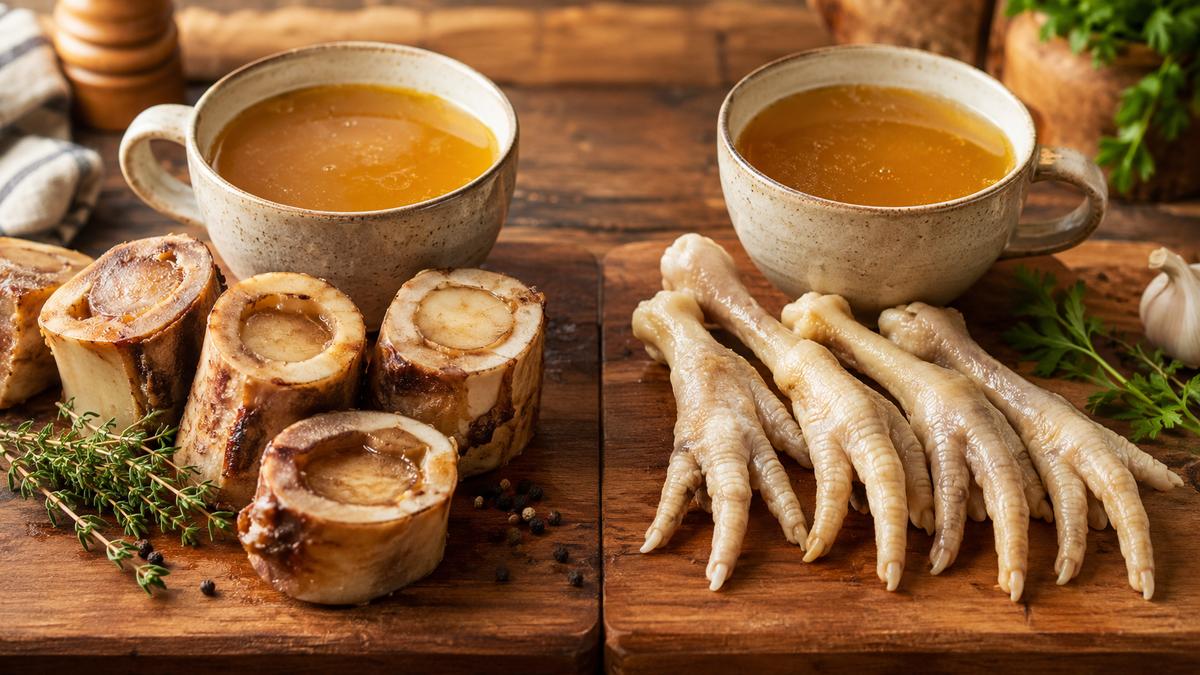
Both have collagen — but beef bone broth is generally the richer source. Big, dense beef bones like knuckle, marrow, and oxtail are loaded with collagen and give you that thick, gelatinous broth that sets in the fridge. Chicken bone broth has collagen too, especially from the feet and cartilage, and it's slightly higher in Type II. For total collagen per pot, though, beef usually wins.
If you've ever wondered why some broths turn to Jell-O overnight and others stay watery, the animal — and the specific bones — is a big part of the answer.

16g of grass-fed beef collagen per scoop — the collagen-dense Type I and III protein your skin, joints, and gut are built from, measured every time.
Does chicken bone broth have collagen?
Yes, and more than people assume — as long as the right parts go in the pot. Chicken feet are almost pure collagen and connective tissue, and a broth made with them gels beautifully. Necks, backs, and wings add more. The problem is that most home cooks make chicken broth from a picked-over rotisserie carcass, which is mostly stripped bone and very little connective tissue. That broth is delicious and nearly collagen-free.
So "does chicken bone broth have collagen" has the same annoying answer as most nutrition questions: it depends on what you actually put in. Feet and cartilage, yes. Leftover carcass, barely. Which points at the thing that really matters — not the animal on the label, but how collagen-dense the bones are and whether you can count on the dose you get out.
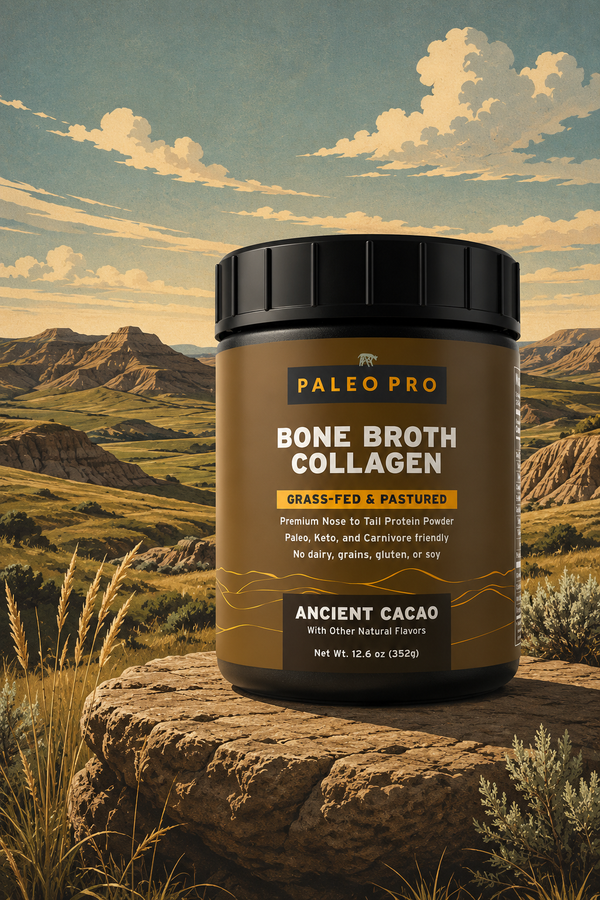
16g of grass-fed beef collagen per scoop — the collagen-dense Type I and III protein your skin, joints, and gut are built from, measured every time.
Does beef bone broth have collagen?
Yes, and typically the most of any common broth. Beef bones are big, and the joints, knuckles, feet, and marrow bones are packed with the collagen-rich cartilage and connective tissue that convert to gelatin during a long simmer. That's why a good beef bone broth is the one most likely to set into a firm, wobbly gel when it cools — the visual proof that a lot of collagen made it into the liquid.
Beef broth also brings a bit more heme iron and a heartier, savory flavor. Simmered from grass-fed bones, it's the kind of broth that feels like a meal in a mug. The collagen is Type I and III — the types that make up skin, bone, tendons, and the gut lining [1].
Beef vs chicken: which has more collagen?
Here's the head-to-head, honestly:
| Beef bone broth | Chicken bone broth | |
|---|---|---|
| Total collagen | Higher — dense bones, more connective tissue | Lower on average (unless made with feet) |
| Best collagen sources | Knuckle, marrow, oxtail, feet | Feet, cartilage, necks |
| Dominant types | Type I and III | Type I and III, with more Type II from cartilage |
| Flavor | Rich, hearty, savory | Lighter, milder |
| Gels when chilled? | Strongly, when made right | Moderately; strongly with feet |
The short version: for raw collagen quantity, beef bones give you more to work with. Chicken's advantage is a lighter flavor and a bit more Type II collagen from cartilage, which is the type most associated with joint surfaces [1]. Neither is "wrong" — but if maximum collagen is the goal, beef is the workhorse.
Does the type of collagen matter — beef or chicken?
A little, and it's worth understanding without overthinking it. Collagen comes in types, and the two that matter most for supplements are:
- Type I and III — the structural collagen in skin, bones, tendons, and the gut wall. This is the bulk of what beef bones (and bovine hide collagen) provide, and the most-studied type for skin and bone [1].
- Type II — concentrated in joint cartilage. Chicken sternal cartilage is the richest natural source, and a specialized undenatured form of it (UC-II) is studied specifically for joint comfort [2].
For most people chasing general collagen benefits — skin, hair, nails, gut, overall protein — Type I and III do the heavy lifting, which favors beef. If your single focus is joint cartilage, chicken-derived Type II has its own research lane. We break the whole family down in collagen types explained. For everyday use, don't let the type debate paralyze you: a broad Type I/III source covers the most ground.
Beef or chicken — which should you actually use?
Match it to what you want:
- Use beef bone broth if you want the most collagen per serving, a richer flavor, and a bit more iron — and if you like a broth substantial enough to stand in for a snack.
- Use chicken bone broth if you prefer a lighter taste, are making it from collagen-rich parts like feet, or specifically want more Type II from cartilage.
- Use a standardized powder if you want the answer to "how much collagen am I actually getting" to be a number instead of a shrug. A grass-fed beef bone broth collagen gives you the collagen-dense Type I and III protein of beef bones measured to the same dose every scoop — no sorting through which bones to buy, no 24-hour simmer.
The truth underneath all of this: the animal matters less than the bones and the dose. Beef tends to win on total collagen, but a thin beef broth loses to a feet-rich chicken broth every time. If you're cooking, use collagen-dense parts and simmer long. If you want certainty, use a measured product.
Frequently asked questions
Does chicken bone broth have collagen? Yes, especially when made with chicken feet, necks, and cartilage, which are collagen-rich and make the broth gel. Broth made from a picked-over rotisserie carcass has very little. The key is the parts, not just the bird.
Does beef bone broth have more collagen than chicken? Usually, yes. Beef bones — knuckle, marrow, oxtail, feet — are dense and rich in connective tissue, so beef broth tends to deliver more total collagen and gel more firmly than chicken broth made from typical scraps.
Which has more collagen, beef or chicken bones? Beef, on average, because the bones are larger and carry more collagen-rich cartilage and connective tissue. Chicken can compete only when you use collagen-dense parts like feet.
Is beef or chicken collagen better? Beef collagen is mostly Type I and III — best for skin, bone, and gut. Chicken cartilage is richer in Type II, associated with joints. For broad, general benefits, Type I/III (beef) covers the most ground; for a pure joint-cartilage focus, Type II (chicken) has its own research.
Does chicken or beef bone broth taste better? That's personal. Beef is richer and heartier; chicken is lighter and milder. Many people keep both — beef for a substantial mug, chicken for a lighter sip or a cooking base.
How do I know if my bone broth has enough collagen? Chill it. If it sets into a firm gel, it's collagen-rich; if it stays watery, it pulled out very little. That's the only feedback homemade broth gives you — which is why a standardized collagen powder is the reliable way to hit a specific dose.
So beef takes the collagen crown, mostly because its bones bring more to the pot. But the real lesson is that dense, collagen-rich bones and a long simmer beat any label — and if you'd rather skip the guessing entirely, a measured scoop of beef collagen gets you there every time.
Prefer certainty over a simmer? Grass-Fed Bone Broth Collagen + Turmeric delivers 16g of grass-fed beef collagen per scoop — the Type I and III protein your skin, joints, and gut run on — with turmeric, zero added sugar, and a 60-day money-back guarantee.
Sources
- Cleveland Clinic (2022). "Collagen: What It Is, Types, Function & Benefits." Reviewed overview of collagen Types I–V and their sources and functions.
- Lugo, J.P., et al. (2016). "Efficacy and tolerability of an undenatured type II collagen supplement in modulating knee osteoarthritis symptoms." Nutrition Journal, 15, 14. PMID: 26822714
