Bone Broth vs Collagen Peptides: How to Choose
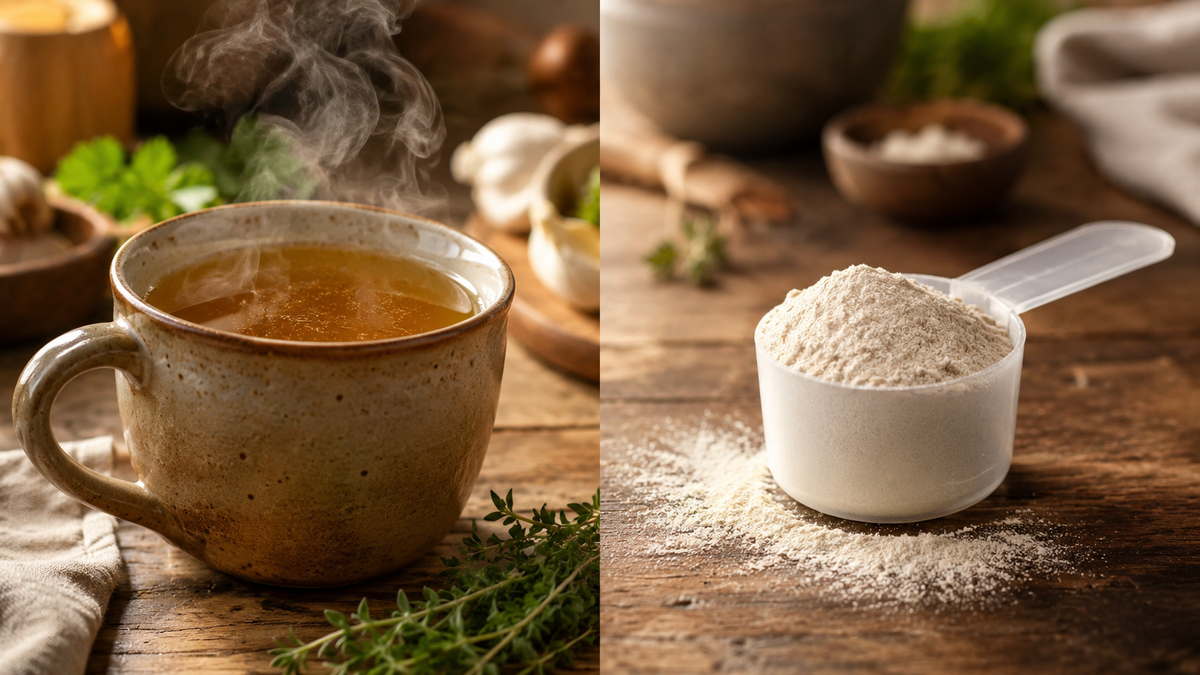
Bone broth is a prepared food whose collagen has become gelatin during cooking. Collagen peptides are collagen proteins broken into smaller fragments by hydrolysis and sold in measured servings. Neither format is automatically better. Compare the protein amount, ingredient source, flavor, preparation, and evidence for the exact material you plan to use.
The word collagen makes these products sound interchangeable. The labels usually tell a more useful story.

16g of protein per serving from grass-fed beef collagen, with turmeric root.
What is the practical difference between bone broth and collagen peptides?
Bone broth and collagen peptides can supply many of the same collagen-rich amino acids, but they reach the cup by different routes. Broth is made by cooking bones and connective tissue in water. Collagen peptides are manufactured by hydrolyzing collagen into smaller protein fragments.
| Question | Prepared bone broth | Collagen peptide powder |
|---|---|---|
| What are you buying? | A food or beverage | A concentrated protein ingredient |
| How is collagen listed? | Often not listed separately | Protein grams appear on the label |
| Is the dose predictable? | It varies by recipe and batch | It is measured by serving |
| What does it taste like? | Usually savory | Plain or flavored, depending on the formula |
| What else is present? | Depends on the recipe and packaged broth | Depends on the ingredient statement |
| What is it best for? | A broth, soup base, or food ritual | A repeatable collagen serving |
A 2019 laboratory comparison found that bone broths varied widely in collagen-related amino acids and generally did not match the concentrations supplied by the collagen supplements used as its benchmark [1]. That study tested broths, not every concentrated bone-broth powder. Its useful lesson is narrower: never estimate a collagen dose from the word broth alone.
The better choice starts with the Nutrition Facts and ingredient statement, because those show what is in the product you will use. For the biological terminology behind the label, see collagen types explained.
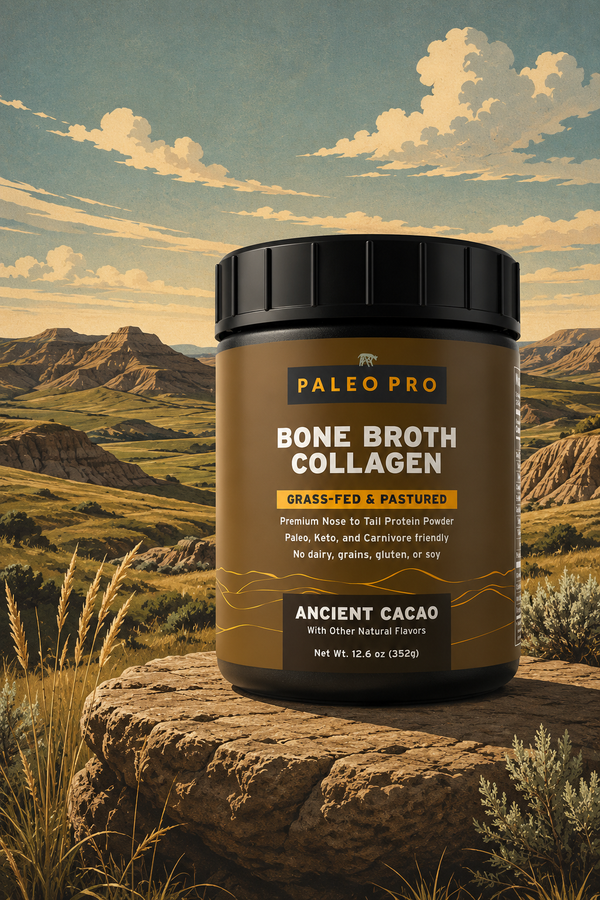
16g of protein per serving from grass-fed beef collagen, with turmeric root.
What do broth, gelatin, hydrolyzed collagen, and peptides mean?
These terms describe form and processing. They do not create four unrelated proteins.
Collagen is a family of structural proteins found in animal connective tissues. Cooking collagen in water changes its structure and produces gelatin, which can thicken as it cools. Further enzymatic processing breaks the protein into smaller pieces sold as hydrolyzed collagen or collagen peptides.
Your digestive system still processes each form. A small human study found hydroxyproline-containing peptides in blood after volunteers consumed gelatin hydrolysates [2]. That supports absorption of some collagen-derived peptides. It does not prove that every peptide powder produces the same clinical result or that ordinary broth is ineffective.
Processing also affects the kitchen experience. Gelatin can set or thicken. Hydrolyzed peptides are generally designed to disperse without forming a gel. A flavored powder may behave differently from an unflavored single-ingredient powder because cocoa, flavors, sweeteners, and other ingredients also matter.
Does bone broth contain more than collagen?
Sometimes, but the label has to do the proving.
A homemade or packaged broth can include sodium, fat, carbohydrate, and small amounts of minerals. Those amounts change with the bones, water, cooking method, and other ingredients. A collagen peptide powder may contain one protein ingredient, or it may include flavors, sweeteners, emulsifiers, and other additions.
Avoid the shortcut that says all broth contains meaningful amounts of calcium, hyaluronic acid, glucosamine, or chondroitin. The presence of those compounds in animal tissue does not establish the amount in your bowl or scoop. If a nutrient matters to your decision, look for a quantified value or a product-specific analysis.
The same rule applies to collagen types. A source such as hide, cartilage, bone broth, fish, or eggshell membrane can suggest which collagens were present in the starting tissue. It does not tell you the amount of each type in a finished hydrolyzed blend unless the manufacturer supplies that information.
Which format has better human evidence?
Most clinical studies test a defined collagen ingredient at a defined daily dose. They do not test the entire retail category.
A 2024 meta-analysis of 35 randomized trials found small-to-moderate improvements in pain and function among people with osteoarthritis who received collagen derivatives [3]. The trials included different materials and protocols. That evidence supports further discussion of collagen derivatives for osteoarthritis symptoms; it does not establish that any mug of broth or any collagen powder will reproduce the pooled result.
Skin evidence deserves more caution. A 2025 meta-analysis found favorable pooled results across all included trials, but no significant benefit for hydration, elasticity, or wrinkles when the authors limited analysis to higher-quality studies or studies without pharmaceutical-company funding [4]. That makes a universal skin promise hard to defend.
Prepared bone broth has much less direct clinical research as a standardized intervention. Researchers cannot easily generalize from one recipe to another when the amino-acid content changes from batch to batch. Our guide to how much collagen bone broth contains explains that variability in detail. If you are choosing around research, match these details before borrowing a result:
- Ingredient form
- Daily dose
- Study population
- Measured outcome
- Duration
- Funding and risk of bias
A study on a branded peptide, undenatured type II collagen, or a multi-ingredient formula is not a trial of your finished bone broth.
How should you compare labels?
Start with a short checklist.
Protein per serving
A collagen powder should state protein grams per serving. Packaged broth also lists protein, though not all of that number must be separately identified as collagen. Homemade broth has no standard label, so the amount remains an estimate unless it is tested.
For dried broth sold as a protein supplement, our guide to bone broth protein powder breaks down what the protein is.
Ingredient identity
Look for plain language such as bovine collagen peptides, gelatin, chicken bone broth, marine collagen, or beef collagen. If the formula uses several sources, the label may not disclose how much comes from each one.
Serving size
A large scoop can create a larger protein number. Compare grams of protein at the serving you will use.
Other ingredients
Flavor systems, sweeteners, sodium, allergens, and emulsifiers can decide whether a product fits your routine. They do not make the collagen inherently more or less effective, but they matter to the person drinking it.
Claims beside the facts
Phrases such as whole food, premium, multi-type, and grass-fed describe sourcing or positioning. They do not substitute for the protein amount, ingredient list, allergen disclosure, or clinical evidence.
When is bone broth the better choice?
Choose prepared bone broth when you want a savory food, a soup base, or a warm drink that contributes some protein. It can make sense when the experience of broth is part of the goal.
The tradeoff is precision. Broth recipes vary. The 2019 analysis found meaningful variation even among broths made under controlled conditions [1]. If you need a repeatable collagen-protein number, use a packaged product that states it rather than assuming a homemade batch supplies a research-level dose.
Also check sodium and the full ingredient list. A broth can be a useful food without being a concentrated collagen supplement.
When are collagen peptides the better choice?
Choose peptides when you want a measured serving, a neutral or flavored powder, and a format that can fit several drinks or foods. Peptides also make study matching easier because many trials report the ingredient and dose in grams.
Convenience has a practical advantage: the product you use consistently is easier to evaluate than a routine you abandon after three days. Still, consistency does not turn a loosely related study into proof. Match your expectation to the evidence for that material and outcome.
For a product that combines a measured collagen serving with a broth-style format, Grass-Fed Bone Broth Collagen + Turmeric currently lists 16 grams of protein per scoop from beef collagen, plus turmeric root. Paleo Pro's Protein+ Multi-Collagen lists 20 grams of total protein and four collagen sources in a protein-and-collagen blend [5]. Those are label facts, not promises that either formula duplicates a clinical trial. The collagen collection puts the current formats side by side.
Can you use bone broth and collagen peptides together?
Yes, for most healthy adults they are foods or protein ingredients rather than opposing systems. The more useful question is whether combining them serves a purpose.
Adding a peptide powder to broth can increase the measured protein in the cup. It can also change flavor, texture, sodium, and total calories. Count the full serving and follow each product's directions. More collagen is not automatically more useful, and a higher dose should not replace medical care for joint pain, bone loss, or digestive symptoms.
If collagen is taking the place of other protein foods, remember that collagen has a different amino-acid pattern from complete dietary proteins. It can contribute grams on a label without serving the same nutritional role as eggs, meat, dairy, soy, or a verified complete-protein blend.
Frequently asked questions
Is drinking bone broth the same as taking collagen peptides?
No. Both can supply collagen-rich amino acids, but broth is a variable food while collagen peptides are a measured hydrolyzed ingredient. The protein dose, other ingredients, taste, and preparation differ.
Which absorbs better, bone broth or collagen peptides?
Hydrolyzed peptides are already broken into smaller fragments, and some collagen-derived peptides appear in blood after ingestion [2]. That does not establish a meaningful clinical advantage over every broth or gelatin product.
Does bone broth have enough collagen to replace a supplement?
It might contribute collagen protein, but homemade broth is too variable to assume a specific dose. Use a tested label or product analysis if the number matters.
Are collagen peptides a complete protein?
Collagen contributes protein grams but has an imbalanced indispensable amino-acid profile and lacks tryptophan. Use complete protein foods or a verified complete formula for primary protein needs.
Do collagen peptides dissolve in hot liquid?
Many hydrolyzed powders are designed to mix in hot or cold liquid, but flavor and mixing behavior vary by formula. Follow the product directions and add gradually if clumping is a problem.
Is bone broth better for gut health?
Human evidence does not establish that ordinary bone broth or a finished collagen powder heals the gut. Broth can be a tolerated food for some people, but digestive symptoms need individual assessment.
What should I buy first?
Choose broth for a savory food experience. Choose collagen peptides for a measured, repeatable serving. Compare protein grams, ingredient source, allergens, flavor, and the evidence for your intended outcome.
The decision is less dramatic than the category makes it sound. Pick the form that fits the job, then judge the label in front of you.
Sources
- Alcock RD, Shaw GC, Burke LM. “Bone Broth Unlikely to Provide Reliable Concentrations of Collagen Precursors Compared With Supplemental Sources of Collagen Used in Collagen Research.” International Journal of Sport Nutrition and Exercise Metabolism. 2019;29(3):265-272. PMID: 29893587
- Iwai K, et al. “Identification of Food-Derived Collagen Peptides in Human Blood After Oral Ingestion of Gelatin Hydrolysates.” Journal of Agricultural and Food Chemistry. 2005;53(16):6531-6536. doi:10.1021/jf050206p
- Liang CW, et al. “Efficacy and Safety of Collagen Derivatives for Osteoarthritis: A Trial Sequential Meta-Analysis.” Osteoarthritis and Cartilage. 2024;32(5):574-584. PMID: 38218227
- Myung SK, Park Y. “Effects of Collagen Supplements on Skin Aging: A Systematic Review and Meta-Analysis of Randomized Controlled Trials.” The American Journal of Medicine. 2025;138(9):1264-1277. doi:10.1016/j.amjmed.2025.04.034
- Paleo Pro. “Grass-Fed Bone Broth Collagen + Turmeric” and “Protein+ Multi-Collagen.” Product pages and current product data, accessed 2026-09-17. Bone Broth Collagen and Protein+ Multi-Collagen
