Best Protein Drinks and Shakes for Older Adults: What Actually Matters on the Label
The best protein drink for an older adult fits the job. For a protein gap, choose a complete protein with a meaningful amount per serving. For low appetite or weight gain, calories and micronutrients may matter just as much. For a medical nutrition need, use the product and texture a clinician recommends.
What makes a protein drink useful for older adults?
A useful drink does something specific that food is not doing easily enough. It may add protein to breakfast, provide a portable option after resistance training, or supply calories when appetite is low.
That means there is no single label that wins every time. Start with the job:
- Close a protein gap: Prioritize complete protein and a serving that fits the meal.
- Add calories: Look for enough energy, carbohydrate, fat, and protein rather than the leanest possible formula.
- Replace a meal: Choose a nutritionally complete product or build a shake with food, not protein powder alone.
- Follow a medical plan: Use the product, portion, and liquid thickness recommended by the care team.
Older adults often need to pay more attention to protein distribution and meal size. That does not mean every person over 50 needs the same number of grams or a supplement.
How much protein should a drink provide?
The adult RDA is 0.8 grams of protein per kilogram of body weight per day.[1] The PROT-AGE position paper recommends 1.0 to 1.2 grams per kilogram per day for many adults over 65, with individual adjustments for activity and health status.[2] Those are daily frameworks, not a prescription for every reader.
A retrospective analysis of laboratory studies in healthy men estimated that muscle protein synthesis reached a plateau at about 0.40 grams per kilogram in a meal for older participants, compared with about 0.24 grams per kilogram for younger participants.[3] The analysis was small and male-only, so the number should guide a conversation rather than become a universal threshold.
For shopping, roughly 20 to 30 grams of complete protein per serving is a useful comparison range. A smaller drink can still help if the meal already contains protein. A larger person or meal with very little other protein may need more.
For more detail on daily intake and label choices after 60, read the protein powder guide for adults over 60 and 70. A registered dietitian or clinician can personalize the target when weight loss, frailty, kidney function, diabetes, surgery, or another condition is involved.
Ready-to-drink shake or protein powder?
Both formats can work. The tradeoff is convenience versus control.
| Factor | Ready-to-drink | Powder |
|---|---|---|
| Preparation | Open and drink | Needs liquid and mixing |
| Portability | Easy to carry | Easy to store; shaker needed away from home |
| Serving control | Fixed bottle | Amount and liquid can be adjusted |
| Calories | Ranges from lean protein drinks to calorie-dense nutrition shakes | Depends on powder and what you add |
| Texture | Consistent within a product | Can be made thinner or thicker |
| Cost | Compare the price per bottle | Compare the price per labeled serving |
| Once opened | Usually requires refrigeration and prompt use | Dry powder stores longer when handled as directed |
Choose ready-to-drink when preparation is the barrier. Choose powder when you want to control the liquid, portion, flavor, and add-ins. Neither format is automatically more nutritious.
What should you check on the label?
Read the current package in this order.
- Protein source and grams. Whey, milk protein, egg, soy, verified beef formulas, and well-designed plant blends can provide complete protein. Collagen is incomplete and serves a different purpose.
- Calories for the goal. A lean protein drink suits one job. A calorie-dense nutrition shake suits another. Do not treat higher calories as a flaw when weight maintenance or gain is the point.
- Added sugar and total carbohydrate. A lower-sugar option may fit some plans. Someone who needs energy may benefit from carbohydrate. Use the medical plan, not a universal zero-sugar rule.
- Allergens and lactose. Whey and casein are milk proteins. Egg and soy are also major allergens. Lactose intolerance is different from a milk allergy.[4][5]
- Meal completeness. Protein powder alone usually lacks the fiber, fats, and range of micronutrients in a meal.
- Serving practicality. Check container size, opening method, mixing directions, refrigeration, and whether the serving is comfortable to finish.
- Testing and claims. Look for a named certification or useful current report. A product should not promise to treat age-related muscle loss or another disease.
The label should make the product's job obvious. If the front says “nutrition shake,” confirm whether it is designed to supply a meal's calories and micronutrients. If it says “protein powder,” expect to add the rest of the meal yourself.
Does protein quality matter with age?
Yes, especially when a drink supplies most of a meal's protein. A complete protein contains all nine essential amino acids. Whey, egg white, soy isolate, and properly verified animal-protein formulas can be complete. A pea-and-rice blend can improve the balance of the two plant proteins.
Collagen lacks tryptophan and is not a complete-protein replacement. It may fit a collagen-specific goal, but do not count a collagen-only drink as the same thing as a complete protein serving.
Total diet still matters. A smaller drink alongside eggs, meat, fish, dairy, soy, or legumes can make a complete meal even when the bottle does not do everything alone. Our high-protein foods for seniors guide offers food-first ways to close the same gap.
How do protein and resistance training work together?
Protein supplies amino acids; resistance training gives muscle a reason to adapt. Sports-nutrition guidance supports adequate protein alongside training rather than treating a supplement as the active ingredient.[6]
Evidence in postmenopausal women illustrates the point. A systematic review found that whey combined with resistance training improved selected lean-mass and strength outcomes, while whey without resistance training did not significantly improve strength or lean mass.[7] That finding is specific to the studies included and does not make whey mandatory.
The practical move is to choose an activity appropriate to your ability and circumstances, then make the meal around it sufficient. A physical therapist, qualified trainer, or clinician can adapt strength work around joint limitations, balance concerns, surgery, or another health condition.
When does texture or medical context change the choice?
A drink is only useful if it can be consumed safely and comfortably.
- Trouble swallowing: Do not thin or thicken liquids by guesswork. A speech-language pathologist or care team can recommend the correct consistency.
- Low appetite or unintended weight loss: A lean protein powder may not provide enough energy. Ask whether a calorie-dense complete nutrition shake is more appropriate.
- Kidney disease or reduced kidney function: Set protein intake with the treating clinician or dietitian.
- Milk allergy: Avoid whey and casein even when a product is lactose-free.[5]
- Lactose intolerance: The amount of lactose and personal threshold matter; a milk-free formula removes that variable.[4]
- Medication timing or fluid limits: Confirm the serving and schedule with the care team.
These are product-selection questions, not reasons to give up on protein. The right format may be food, powder, a ready-to-drink shake, or a medical nutrition product.
Where does Paleo Protein fit?
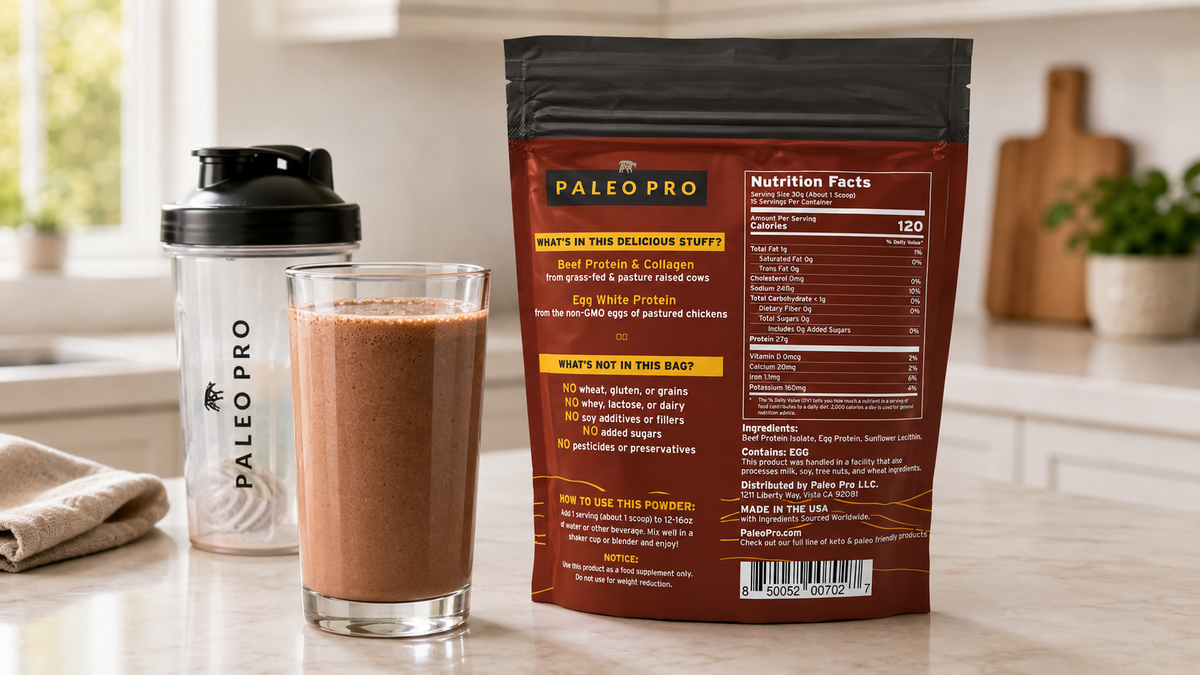
For someone who eats animal protein and wants a dairy-free powder, Paleo Protein Powder combines grass-fed beef protein isolate with egg white protein. The current label lists 26 grams of complete protein, about 120 calories, and 0 to 1 gram of carbohydrate per serving.
It contains egg and is made without whey, casein, soy, gluten, or gums. Mix one serving with 12 to 16 ounces of water or another beverage. It can close a protein gap, but it is not a nutritionally complete meal or a medical nutrition product.
Frequently Asked Questions
What is the best protein drink for seniors?
Choose by the job. For a protein gap, prioritize complete protein and a practical serving. For low appetite or weight gain, a calorie-dense complete nutrition shake may be the better tool.
How much protein should an older adult get per day?
Needs vary. The adult RDA is 0.8 grams per kilogram per day, while PROT-AGE recommends 1.0 to 1.2 grams per kilogram for many adults over 65.[1][2] Health and activity can change the target.
Is 30 grams of protein too much in one shake?
Not automatically. Body size, total daily intake, the rest of the meal, and medical context matter. Someone with kidney disease or another relevant condition should use a clinician-set target.
Are protein drinks good for adults over 70?
They can be a practical way to supplement food when appetite, preparation, travel, or meal size makes protein difficult. They do not replace resistance training or a varied diet.
Is a nutrition shake the same as a protein shake?
No. A nutrition shake may be designed to provide calories, carbohydrate, fat, vitamins, and minerals. Protein powder mainly contributes protein and usually needs food or add-ins to become a meal.
Is collagen a good protein drink for older adults?
Collagen can serve a collagen-specific purpose, but it is incomplete because it lacks tryptophan. Keep complete proteins elsewhere in the meal or day.
Can an older adult drink a protein shake every day?
Many can, but the drink should fit total intake, medications, allergens, and health conditions. Daily use is a convenience choice, not a requirement.
Compare the current protein supplements for older adults and choose the format that matches the job. PaleoPro covers purchases with a 60-day money-back guarantee.
Sources
- Institute of Medicine. Dietary Reference Intakes for Energy, Carbohydrate, Fiber, Fat, Fatty Acids, Cholesterol, Protein, and Amino Acids. 2005. National Academies Press.
- Bauer J, et al. “Evidence-based recommendations for optimal dietary protein intake in older people: a position paper from the PROT-AGE Study Group.” Journal of the American Medical Directors Association. 2013;14(8):542-559. PubMed.
- Moore DR, et al. “Protein ingestion to stimulate myofibrillar protein synthesis requires greater relative protein intakes in healthy older versus younger men.” Journals of Gerontology Series A. 2015;70(1):57-62. PubMed.
- National Institute of Diabetes and Digestive and Kidney Diseases. Symptoms & Causes of Lactose Intolerance.
- U.S. Food and Drug Administration. Food Allergies: What You Need to Know.
- Jäger R, et al. “International Society of Sports Nutrition Position Stand: protein and exercise.” Journal of the International Society of Sports Nutrition. 2017;14:20. PMC.
- Kuo YY, et al. “Effect of Whey Protein Supplementation in Postmenopausal Women: A Systematic Review and Meta-Analysis.” Nutrients. 2022;14(19):4210. PubMed.
