High-Protein Foods for Older Adults: What to Eat to Hit the Number
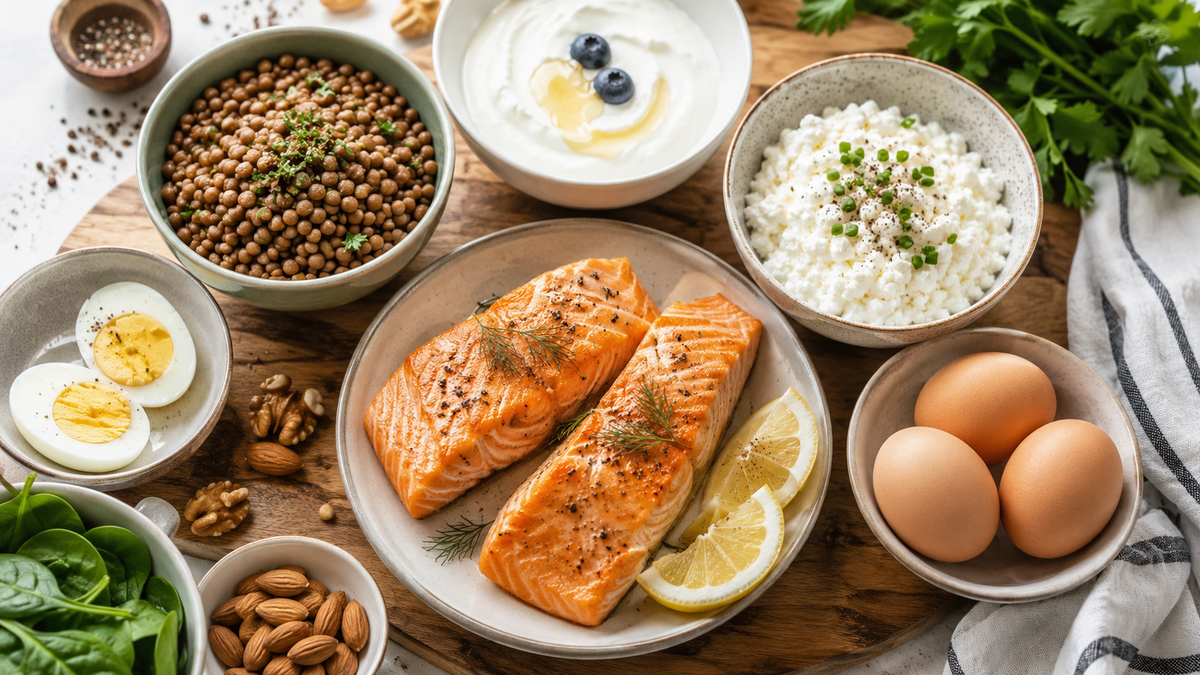
The highest-protein foods worth building meals around are eggs, fish, poultry, lean beef, Greek yogurt, cottage cheese, lentils, and beans. Most adults over 50 should aim for 25 to 30 grams per meal rather than a daily average, since protein has to clear a threshold at each sitting to do its job. Breakfast is where nearly everyone falls short.
Nobody needs another list of foods with protein in them. What's useful is the arithmetic: how many grams each one actually delivers, and where the day quietly leaks 20 grams before lunch.
How much protein do you actually need after 50?
More than the label on the side of the cereal box implies, and the gap is bigger than most people expect.
The protein RDA is 0.8 grams per kilogram of body weight [1]. That figure was set as a floor, the intake that prevents deficiency in roughly 97.5% of healthy adults. It was never a target for maintaining muscle. PROT-AGE, the international working group on protein and aging, recommends 1.0 to 1.2 g/kg per day for adults over 65, and 1.2 to 1.5 with resistance training or during illness [2].
There's a second number that matters more day to day. After about 50, the same dose of protein produces less muscle protein synthesis than it once did, a phenomenon called anabolic resistance. In controlled work, older adults needed about 0.40 grams per kilogram in a single meal to max out the response, against 0.24 in younger adults [3]. Roughly 25 to 30 grams in one sitting.
| Body weight | Daily target (1.0 to 1.2 g/kg) | Per meal (about 0.4 g/kg) | Typical shortfall |
|---|---|---|---|
| 130 lb (59 kg) | 59 to 71 g | 24 g | Breakfast |
| 150 lb (68 kg) | 68 to 82 g | 27 g | Breakfast |
| 175 lb (79 kg) | 79 to 95 g | 32 g | Breakfast and lunch |
| 200 lb (91 kg) | 91 to 109 g | 36 g | Breakfast and lunch |
That last column isn't a guess. A slice of toast with butter and coffee runs about 6 to 8 grams of protein. A bowl of cereal with milk lands near 10. Lunch is often a sandwich or a salad at 15 to 20. Then dinner arrives carrying 40 grams alone, which is more than the body can put to work in one sitting anyway.
So the fix usually isn't eating more food. It's moving protein earlier, which means knowing what actually carries it.

26g of complete protein in ten seconds, for the breakfast that keeps coming up 20 grams short.
Which foods have the most protein?
Grams per realistic portion, not per 100 grams of a food nobody eats 100 grams of.
| Food | Typical portion | Protein | Notes |
|---|---|---|---|
| Chicken breast | 4 oz cooked | 35 g | Highest protein per calorie of the common meats |
| Salmon | 4 oz cooked | 29 g | Adds omega-3 fats |
| Lean ground beef (90%) | 4 oz cooked | 27 g | Also iron, zinc, B12 |
| Canned tuna | 1 can, drained | 27 g | Cheapest complete protein by weight |
| Cottage cheese | 1 cup | 24 g | Cheap, soft, no cooking |
| Greek yogurt | 1 cup plain | 20 g | Check sugar on flavored versions |
| Lentils | 1 cup cooked | 18 g | Plus 15 g fiber |
| Black beans | 1 cup cooked | 15 g | Pair with grains for a complete profile |
| Eggs | 2 large | 12 g | Complete, soft, inexpensive |
| Milk | 1 cup | 8 g | Easy to add rather than drink alone |
| Peanut butter | 2 tbsp | 7 g | Calorie-dense for the protein it carries |
| Almonds | 1 oz | 6 g | Snack, not a protein source |
Two things stand out once it's laid out this way.
The first is that plant sources carry less protein per portion and are generally lower in the essential amino acids, particularly leucine. That doesn't make them bad, and lentils bring fiber that meat doesn't. It does mean the portions have to be bigger to hit the same threshold, which runs straight into a smaller appetite.
The second is the bottom of the table. Nuts and nut butter get talked about as protein foods and they aren't, really. An ounce of almonds is 6 grams of protein and 164 calories. Good snack, poor protein strategy.
Which is why the practical question isn't which foods contain protein. It's which ones get you 25 grams in a portion you'll actually finish.
What does a day that hits the number look like?
Concrete beats theoretical, so here's roughly 100 grams without anything exotic.
Breakfast, about 30 g. Three eggs scrambled (18 g) with a cup of cottage cheese on the side or stirred in (24 g) overshoots comfortably. Or two eggs plus a cup of Greek yogurt. The point is that breakfast has to carry real weight, because it's the meal where the day is usually lost.
Lunch, about 30 g. A can of tuna (27 g) on greens, or four ounces of leftover chicken (35 g) over whatever's in the fridge.
Dinner, about 35 g. Four to five ounces of salmon, beef, or chicken. This is the meal most people already get right.
If one of those falls apart, and one usually does, that's the gap a scoop fills. Not as a meal replacement. As the thing that turns a 10-gram breakfast into a 30-gram one without cooking.
That's the honest role of a powder in this picture. Food first, because food brings fiber, micronutrients, and satiety a scoop doesn't. Powder for the meal that keeps coming up short.
How do you eat more protein when appetite is smaller?
This is the real problem past 70, and it's a different problem from not knowing what to eat.
- Front-load the day. Appetite is usually strongest in the morning and fades by evening. Most people eat protein in exactly the opposite pattern.
- Add rather than replace. A scoop of powder into oatmeal, an egg into soup, cottage cheese onto toast. Adding protein to food you're already eating beats adding a meal you have to want.
- Choose soft when chewing is the barrier. Eggs, fish, yogurt, cottage cheese, lentils, and ground meat all clear 15 grams without much work. A steak is a lot of chewing for the same grams.
- Drink some of it. Liquids go down when solids don't. A smoothie with yogurt, milk, and fruit reaches 30 grams easily and takes two minutes.
- Cook once, eat three times. Cooking for one is the most underrated obstacle in this whole conversation. A roast chicken on Sunday is three lunches that require no decisions.
If the constraint is appetite rather than knowledge, a shake solves a real problem. We went through how to pick one in what actually matters on a protein drink label, and how the recommendation shifts by decade in protein powder after 60 and after 70.
Does protein from food beat protein from a supplement?
For most purposes, yes, and it's not particularly close on the things that aren't protein.
Whole foods bring fiber, micronutrients, and the volume that makes a meal satisfying. Beef carries iron, zinc, and B12. Salmon carries omega-3s. Lentils carry 15 grams of fiber per cup. A scoop of protein carries protein.
Where a supplement wins is narrower and still real: convenience, a known dose, and no cooking. If breakfast is chronically 8 grams because mornings are rushed or appetite hasn't arrived yet, a complete protein you can stir into coffee or oatmeal closes that gap in ten seconds, and a gap closed daily beats a better plan you don't follow.
One thing to be clear about: collagen isn't the answer to this particular question. It's genuinely useful for joints, skin, and connective tissue, and it's low in leucine and missing tryptophan entirely, so it doesn't do the muscle job [4]. Keep taking it. Just don't count those grams toward the target in the table above.
And protein of any kind supports muscle alongside resistance training rather than instead of it. The training is what signals the adaptation. Food and supplements supply the material.
Frequently asked questions
What are the best high-protein foods for older adults? Eggs, fish, poultry, lean beef, Greek yogurt, cottage cheese, lentils, and beans deliver the most protein per realistic portion. Animal sources carry more complete amino acid profiles and more leucine per serving, which matters more with age. Cottage cheese, eggs, and yogurt are especially practical because they need no cooking and are easy to chew.
How much protein does a 75 year old need? The PROT-AGE working group recommends 1.0 to 1.2 grams per kilogram of body weight per day for adults over 65, and 1.2 to 1.5 grams with resistance training or during illness. At 150 pounds that's roughly 68 to 82 grams daily. Spreading it across meals at 25 to 30 grams each works better than hitting the total in one sitting.
What is the easiest way for seniors to get more protein? Fix breakfast first, since it's where most people fall 20 grams short. Adding eggs, Greek yogurt, or cottage cheese to a morning that was previously toast and coffee moves the daily number more than any change at dinner. Adding protein to meals you already eat works better than adding meals.
Which foods have the most protein per calorie? Chicken breast, white fish, canned tuna, egg whites, and non-fat Greek yogurt carry the most protein per calorie. That ratio matters more with age because appetite often shrinks while the protein requirement rises, so each calorie has to do more work. Nuts and nut butters are calorie-dense and comparatively low in protein.
Can older adults get enough protein from plant foods? Yes, but it takes larger portions and more attention to variety. Plant proteins are generally lower in leucine, the amino acid most tied to triggering muscle protein synthesis, so portions have to be bigger to clear the per-meal threshold. Combining legumes with grains across the day covers the amino acid profile. The practical obstacle is volume when appetite is limited.
Is it too late to build muscle after 70? No. Resistance training produces measurable strength and muscle gains in adults well into their 80s, and adequate protein supports that adaptation. The evidence consistently shows training driving the result, with protein supplying the raw material. Neither accomplishes much without the other.
How much protein is in an egg? One large egg has about 6 grams of protein, so two eggs deliver roughly 12 grams and three deliver 18. Eggs are a complete protein containing all nine essential amino acids, they're inexpensive, and they're soft enough to be practical when chewing is a barrier.
The short version
Most people don't have a protein problem across the whole day. They have a breakfast problem, and it costs them about 20 grams before 9am. Fix that one meal and the daily number mostly takes care of itself.
Build from the top of the table: eggs, fish, poultry, lean beef, Greek yogurt, cottage cheese, lentils. Aim for 25 to 30 grams a sitting rather than a daily average. And use a scoop for the meal that keeps falling apart, not as a substitute for the ones that don't.
When breakfast needs 20 more grams and you have ten seconds, Paleo Protein delivers 26 grams of complete protein at about 120 calories with zero sugar. Grass-fed beef protein isolate and egg white protein, no dairy, four ingredients. Browse protein supplements for older adults.
Sources
- Institute of Medicine (2005). Dietary Reference Intakes for Energy, Carbohydrate, Fiber, Fat, Fatty Acids, Cholesterol, Protein, and Amino Acids. National Academies Press. DOI: 10.17226/10490
- Bauer J, et al. (2013). "Evidence-based recommendations for optimal dietary protein intake in older people: PROT-AGE Study Group." JAMDA, 14(8), 542-559. PMID: 23867520
- Moore DR, et al. (2015). "Protein ingestion to stimulate myofibrillar protein synthesis requires greater relative protein intakes in healthy older versus younger men." J Gerontol A Biol Sci Med Sci, 70(1), 57-62. PMID: 25056502
- Churchward-Venne TA, et al. (2014). "Leucine supplementation of a low-protein mixed macronutrient beverage enhances myofibrillar protein synthesis in young men." Am J Clin Nutr, 99(2), 276-286. PMID: 24284442
