Protein Powder After 60 and After 70: How the Recommendation Changes
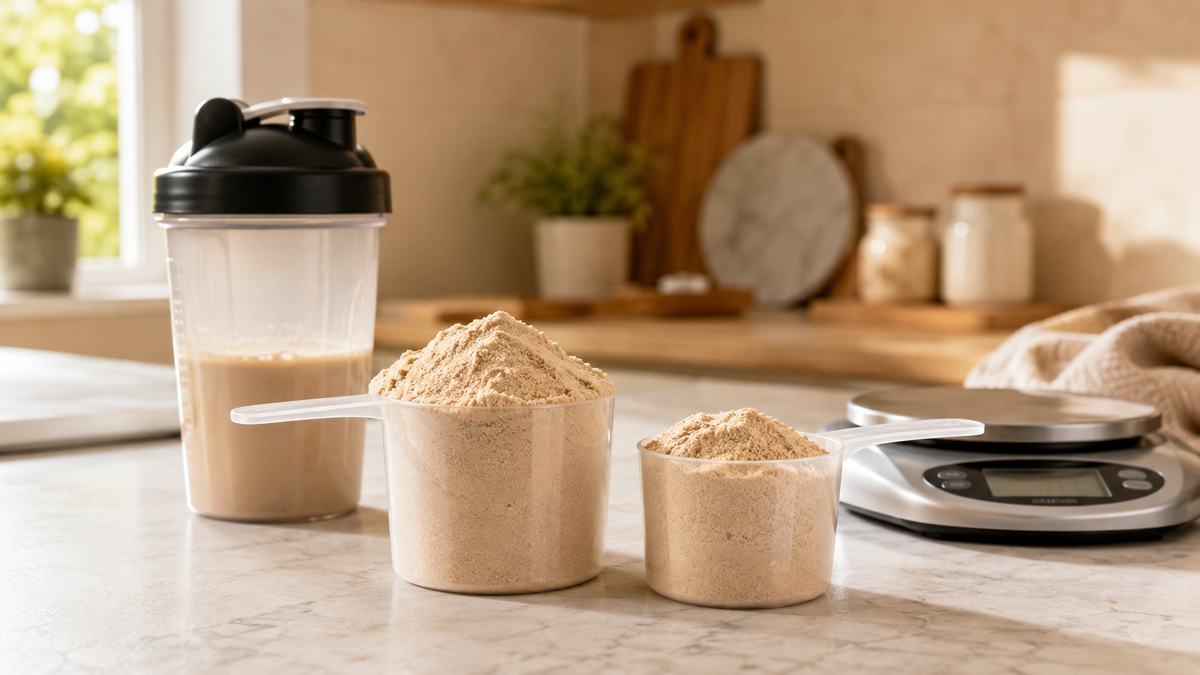
Protein needs rise with age rather than fall. Adults over 65 do better at 1.0 to 1.2 grams of protein per kilogram of body weight daily, against an RDA of 0.8, and the per-meal dose matters as much as the daily total. Past 70 the practical constraints change more than the target does: appetite, chewing, and cost start driving the decision.
The tricky part is that almost nothing about this is intuitive. Most people assume a smaller, older body needs less of everything. Protein is the exception, and the gap between assumption and evidence is where a lot of muscle quietly goes.
Why do protein needs go up instead of down after 60?
Because the same protein stopped doing the same work.
The mechanism is called anabolic resistance, and it's been measured directly rather than inferred. In a controlled dose-response study, healthy older men needed about 0.40 grams of protein per kilogram of body weight in a single meal to maximize muscle protein synthesis. Younger men reached the same ceiling on about 0.24 [1]. Same meal, same body weight, different response. The machinery still works. It just needs a louder signal.
That finding reshapes the advice in two directions at once. The daily number goes up: PROT-AGE, the international working group on protein and aging, recommends 1.0 to 1.2 g/kg per day for adults over 65, and 1.2 to 1.5 g/kg with resistance training or during illness [2]. And the distribution matters, because a threshold that has to be crossed per meal can't be satisfied by a daily average.
Meanwhile the RDA sits at 0.8 g/kg, where it has been since 2005 [3]. That number isn't wrong, it's just answering a narrower question. It was set as the intake that prevents deficiency in about 97.5% of healthy adults. Preventing deficiency and defending muscle mass are not the same target, and the RDA never claimed to be the second one.
So the thing to actually look for in a protein powder after 60 isn't a bigger tub. It's a dose that clears the per-meal threshold in one serving, in a form you'll drink every day without thinking about it.

26g of complete protein in one scoop, enough to clear the per-meal threshold at most body weights. No dairy, no lactose, nothing to push through.
How much protein after 60 versus after 70?
The gram target barely moves between the two. What changes is how hard it is to hit.
| Adults 50 to 65 | Adults over 65 | Over 70, in practice | |
|---|---|---|---|
| Daily target | 1.0 to 1.2 g/kg | 1.0 to 1.2 g/kg, 1.2 to 1.5 with training or illness | Same target, lower typical intake |
| Per meal | About 0.4 g/kg, roughly 25 to 30 g | About 0.4 g/kg | Same, but meals get smaller |
| Main obstacle | Habit and breakfast | Appetite, protein spread unevenly across the day | Appetite, chewing, dentition, cost, cooking for one |
| What usually helps | Fixing breakfast | A per-meal floor, not a daily average | Softer formats, liquid calories, smaller more frequent doses |
The clinical literature on adults over 70 spends much less time on the target and much more on intake actually falling short of it. That's the real shift. Someone at 75 typically knows they should eat more protein. The barrier is that a chicken breast is a lot of chewing, cooking for one person is a chore, and appetite arrives less reliably than it used to.
Which is why a powder tends to earn its place more in that decade, not less. It's the format that solves for the constraint rather than the knowledge.
When does whey protein stop being the obvious choice?
Around the point your gut starts filing complaints. Not before.
Let's be fair to whey first, because the conquest pitch you usually read here isn't honest. Whey is a complete protein, it's the most-studied protein supplement on the market, it's high in leucine, and it absorbs quickly. In head-to-head muscle outcomes it performs well. If whey works for you at 68, there is no research-backed reason to abandon it.
The reasons people do move off it are practical rather than theoretical:
- Lactose. Roughly 68% of adults worldwide have reduced ability to digest lactose after infancy, and the proportion rises with age [4]. Whey concentrate carries 5 to 8% lactose. Isolate carries traces, which is enough for some people and not others.
- Gut comfort generally. Beyond lactose, some people react to the dairy proteins themselves. Bloating and discomfort are the single most common reason someone quits a protein habit that was otherwise going fine.
- Everything else in the tub. This isn't whey's fault, but the category it sits in tends toward long ingredient lists: gums for texture, artificial sweeteners, fillers. More things to react to.
- Insulin response. Whey is notably insulinogenic, more so than other protein sources even when blood glucose doesn't move [5]. That's irrelevant for most people and relevant for a few.
The honest summary: whey is a good protein with one common failure mode. If you've never had that failure mode, ignore all of this. If you have, the fix isn't to push through it, because the protein you'll actually take every day beats the protein that's theoretically optimal.
Dairy-free complete proteins solve it at the source. Beef protein isolate paired with egg white protein delivers all nine essential amino acids with zero lactose and zero dairy of any kind.
What should you look for in a protein powder after 60?
Five things, and only the first two are about the protein.
- 25 to 30 grams per serving. Enough to clear the per-meal threshold in one scoop rather than one and a half.
- Complete protein, with real leucine. Leucine is the amino acid most tied to triggering muscle protein synthesis, and the threshold sits near 2.5 grams per dose [6]. Collagen is low in leucine and missing tryptophan, so collagen grams don't do this job. Keep taking it for joints. Just don't count it.
- Low sugar and low calorie density. Appetite shrinks while the requirement rises. Every calorie has to earn its place, and 200 calories of sugar in a protein drink is a poor trade.
- Something your gut tolerates on day 40, not just day one. This is the criterion that decides whether a tub gets finished.
- A short ingredient list. Fewer inputs, fewer things to react to, and a shorter list is usually a sign the base protein didn't need masking.
Notice that "for seniors" on the label isn't on that list. There is no regulated meaning to it, and in the nutrition-drink category it usually signals a formula built around calories rather than protein. We went through that label math in detail in what actually matters on a protein drink label.
A powder is also the wrong first move if food is still doing the job. If you'd rather build the number from meals, here are the highest-protein foods per realistic portion.
Does protein powder actually build muscle after 70?
It supports the process. Training drives it. That distinction is the whole answer.
The evidence for resistance training in adults over 70 is strong and consistent. The evidence for protein as a standalone intervention is much weaker, and it's worth being straight about that. A randomized trial in postmenopausal women following a resistance protocol found no difference in lean mass gain between 1.2 g/kg and the 0.8 g/kg RDA group. Both gained about 1.2 kg over the study, and training accounted for it [7].
Read that carefully, though, because it's often misread in both directions. It does not say protein is pointless. It says protein is permissive: it supplies the raw material, and without the training signal the material has nothing to do. Adequate protein plus training beats training on inadequate protein. Protein alone changes very little.
The practical version: pick something up twice a week, hit the per-meal protein threshold most days, and don't expect a powder to do the work of a gym. Anyone promising otherwise is describing a product that doesn't exist.
If a GLP-1 medication is part of your picture, the protein math gets sharper still, since appetite suppression makes the daily target harder to hit at exactly the moment lean mass is most at risk. We covered that separately in how much protein to eat on a GLP-1.
Frequently asked questions
How much protein does a 70 year old need per day? The PROT-AGE working group recommends 1.0 to 1.2 grams of protein per kilogram of body weight per day for adults over 65, rising to 1.2 to 1.5 grams with resistance training or during illness. For someone at 150 pounds that's roughly 68 to 82 grams a day. The 0.8 g/kg RDA is a floor set to prevent deficiency, not a target for maintaining muscle mass.
Is whey protein good for people over 70? Whey is a complete, well-studied protein that performs well in muscle outcome studies, so it remains a reasonable choice if it agrees with you. The most common reason people move away from it is lactose: about 68% of adults worldwide have reduced lactose digestion, and whey concentrate contains 5 to 8% lactose. If whey causes bloating or discomfort, a dairy-free complete protein solves it at the source.
What is the best type of protein powder for older adults? The best type is a complete protein delivering 25 to 30 grams per serving with a low sugar and calorie load, in a form that's comfortable to digest daily. Beef protein isolate, egg white protein, whey isolate, and blends built to be complete all qualify. Collagen does not, because it is low in leucine and missing tryptophan.
Do protein needs increase after 70? The recommended target stays roughly the same past 70 at 1.0 to 1.2 g/kg, but actual intake commonly falls below it because appetite, chewing, and cooking for one become obstacles. The practical challenge shifts from knowing the number to hitting it, which is why easier-to-consume formats become more useful with age rather than less.
Can protein powder cause kidney problems in older adults? In healthy adults, protein intakes in the 1.0 to 1.6 g/kg range are well tolerated, and the Institute of Medicine set no tolerable upper limit for protein, citing insufficient evidence to define one. The important exception is anyone with reduced kidney function, who should set a protein target with their doctor rather than from a general guideline.
Should older adults take protein powder with or without exercise? Both together is the answer that works. Resistance training is what signals muscle to adapt, and protein supplies the material to do it. Studies consistently show training driving the gains while adequate protein permits them. Protein without training produces very little change in muscle mass.
How many grams of protein per meal after 60? Roughly 25 to 30 grams for most body weights, based on research showing older adults need about 0.40 grams per kilogram of body weight in a single meal to maximize muscle protein synthesis, compared with 0.24 in younger adults. Spreading protein across three meals works better than concentrating it in one, because the threshold applies per meal rather than per day.
The short version
The target barely moves between 60 and 75. What moves is everything around it: appetite, chewing, cooking, the reliability of a habit. So pick for the constraint you actually have. If your gut is fine on whey, keep going. If it isn't, stop pushing through it and switch, because the protein you take daily beats the one you take grudgingly.
And keep the resistance training. That's not the upsell talking. That's the part the research is most sure about.
Paleo Protein delivers 26 grams of complete protein at about 120 calories with zero sugar, from grass-fed beef protein isolate and egg white protein. No dairy, no lactose, no gums, and about 1.8 grams of leucine per serving. See our protein supplements for older adults.
Sources
- Moore DR, et al. (2015). "Protein ingestion to stimulate myofibrillar protein synthesis requires greater relative protein intakes in healthy older versus younger men." J Gerontol A Biol Sci Med Sci, 70(1), 57-62. PMID: 25056502
- Bauer J, et al. (2013). "Evidence-based recommendations for optimal dietary protein intake in older people: PROT-AGE Study Group." JAMDA, 14(8), 542-559. PMID: 23867520
- Institute of Medicine (2005). Dietary Reference Intakes for Energy, Carbohydrate, Fiber, Fat, Fatty Acids, Cholesterol, Protein, and Amino Acids. National Academies Press. DOI: 10.17226/10490
- National Institute of Diabetes and Digestive and Kidney Diseases. "Definition & Facts for Lactose Intolerance." niddk.nih.gov
- Nilsson M, et al. (2007). "Glycemia and insulinemia in healthy subjects after lactose-equivalent meals of milk and other food proteins." Am J Clin Nutr, 85(4), 996-1004. DOI: 10.1093/ajcn/85.4.996
- Churchward-Venne TA, et al. (2014). "Leucine supplementation of a low-protein mixed macronutrient beverage enhances myofibrillar protein synthesis in young men." Am J Clin Nutr, 99(2), 276-286. PMID: 24284442
- Rossato LT, et al. (2017). "Higher Protein Intake Does Not Improve Lean Mass Gain When Compared with RDA Recommendation in Postmenopausal Women Following Resistance Exercise Protocol: A Randomized Clinical Trial." Nutrients, 9(9), 1007. PMID: 28895933
