Does Bone Broth Have Collagen? (And Exactly How Much)
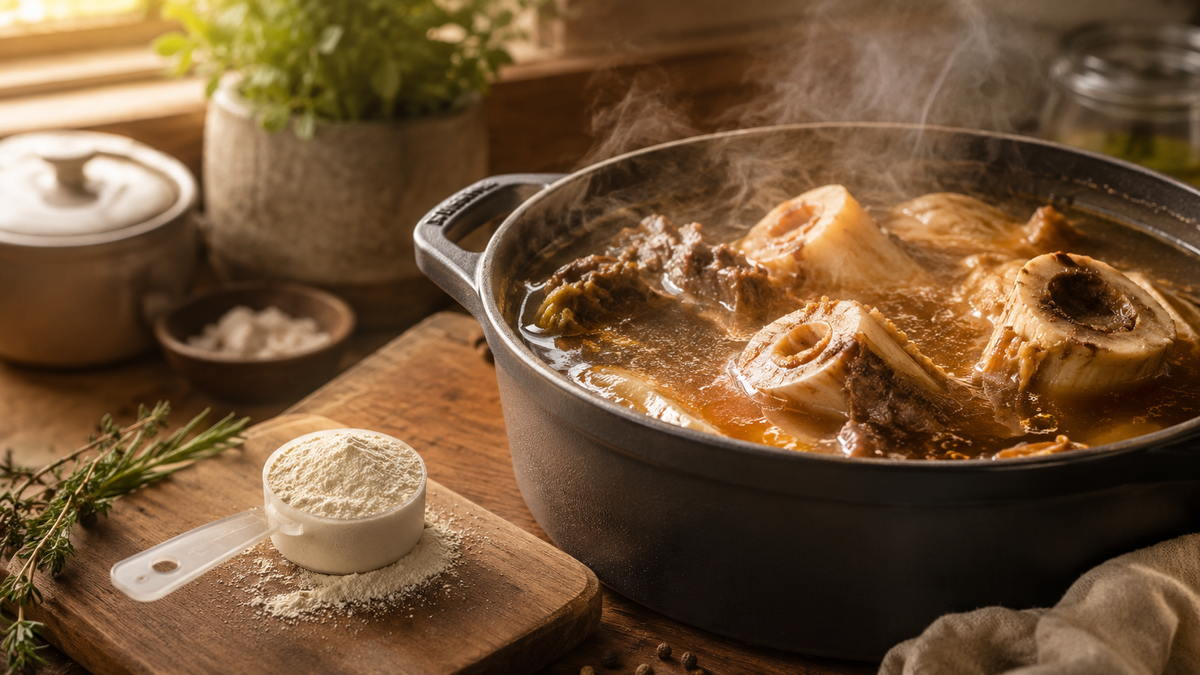
Yes. Bone broth has collagen. When you simmer bones and connective tissue, the collagen inside them breaks down into gelatin and dissolves into the water, along with minerals and amino acids like glycine and proline. The catch: how much collagen you actually get is wildly inconsistent — it swings with the bones you use, the bone-to-water ratio, and how long you let it go.
So the real answer isn't "yes." It's "yes, but." And the "but" is the part most bone-broth-is-a-collagen-miracle articles quietly skip. Let's not skip it.

16g of grass-fed collagen protein in every scoop — the reliable dose a simmering pot of bones can never promise, with turmeric and zero added sugar.
Does bone broth actually contain collagen?
Bones, cartilage, tendons, and the connective tissue clinging to them are built largely from collagen — the most abundant protein in any animal, including the cow. Heat that collagen in water for long enough and it does something useful: it hydrolyzes. The long, tightly wound collagen fibers unravel and break into gelatin, which dissolves into the broth.
You've already seen the proof if you've ever chilled a good pot of homemade broth and found it wobbling like Jell-O the next morning. That jiggle is the collagen. It set into gelatin as it cooled. A watery broth that stays liquid in the fridge pulled far less collagen out of the bones — same recipe, very different result.
When you drink it, your gut breaks that gelatin down further into amino acids and short peptides your body can absorb and put to work [1]. Glycine, proline, and hydroxyproline — the three amino acids that make up more than half of collagen — are the ones you're really after, and bone broth delivers them [2].
So the collagen is real, and your body can use it. The problem is that a pot of simmering bones has no idea how much it's handing you. Which means the question worth asking isn't whether bone broth has collagen. It's whether you can count on how much.
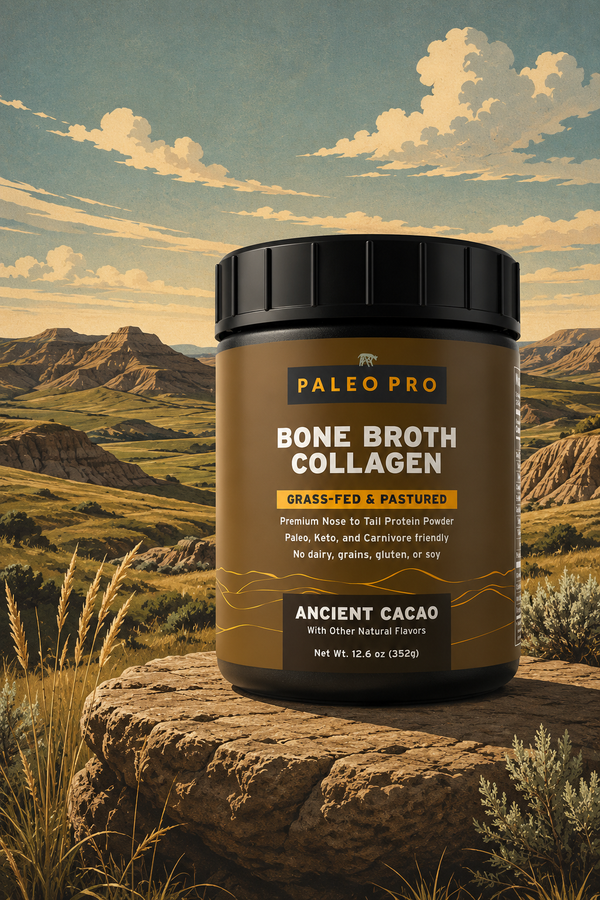
16g of grass-fed collagen protein in every scoop — the reliable dose a simmering pot of bones can never promise, with turmeric and zero added sugar.
How much collagen is in bone broth?
Here's where honesty matters. Homemade bone broth is a genuinely unreliable way to hit a specific collagen target. The amount lands somewhere between "a few grams" and maybe 10 grams of collagen protein per cup — and it's frequently at the low end.
The best study on this compared homemade bone broth to the standardized collagen doses used in actual research. It found that broth delivered far lower and far more variable concentrations of collagen-building amino acids than a typical 20-gram supplement serving — and that the amino acid content of non-standardized broth was all over the map [3]. Translation: your broth might be great, or it might be mostly flavored water, and you have no way to know which.
An amino acid breakdown of beef bone broth shows why the payoff is real when the extraction goes well:
| Amino acid | Beef bone broth (mg/g protein) | What it does |
|---|---|---|
| Glycine | ~3.7 | Makes up ~1/3 of collagen; supports the gut lining, sleep, and your body's own collagen synthesis |
| Proline | ~2.2 | Core building block of collagen; supports joint cartilage and skin |
| Hydroxyproline | ~2.0 | Found almost only in collagen; stabilizes the triple-helix structure |
| Glutamine/glutamate | ~2.6 | Primary fuel for the cells lining your gut |
Source: amino acid analysis of beef bone broth [2].
The nutrients are the right ones. The dose is the problem. So if you've read a blog post that confidently tells you a cup of bone broth contains "20 grams of collagen," be skeptical — nobody measured your pot, and the research says the number is far lower and far shakier than that.
Why is homemade bone broth's collagen so unpredictable?
Four things move the needle, and almost nobody controls all four:
- The bones. Collagen-rich cuts — knuckles, feet, oxtail, marrow bones — give you dramatically more than the picked-over carcass of a roast chicken. Same simmer, wildly different yield.
- The ratio. More bones to less water means a more concentrated broth. Eyeballing it, as most of us do, means the concentration changes batch to batch.
- The time. Collagen needs hours to convert to gelatin. A quick two-hour stock pulls far less than a 12-to-24-hour simmer.
- The details. A splash of vinegar helps draw collagen out; a hard boil instead of a low simmer can break it down differently; skimming changes what's left.
This is why the chill-and-wobble test is the only feedback most home cooks ever get. It tells you roughly whether you extracted a lot or a little. It does not tell you that today's batch has 6 grams and last week's had 11. For flavor, none of this matters. For actually hitting a daily collagen dose, it matters a lot.
Is the collagen in bone broth the same as collagen powder?
Same protein, different packaging. Bone broth gives you collagen as gelatin — larger, whole-food molecules that come bundled with minerals, hyaluronic acid, and other compounds from the connective tissue. Collagen peptides are that same collagen, just pre-hydrolyzed into smaller fragments in a factory instead of a stockpot, which makes them a bit more readily absorbed and far more consistent in dose [1].
Neither is fake or superior across the board — they're two forms of the same thing, and we break both of them down into usable pieces during digestion anyway. If you want the full comparison, we walk through it in bone broth vs. collagen peptides, and we break down the different collagen types in collagen types explained.
The practical upshot: the "which form" debate matters less than the "how much, how reliably" question. A gelatin-rich broth and a measured scoop of collagen can both get you there. Only one of them tells you the number.
How do you get a reliable collagen dose from bone broth?
You standardize it. The whole reason a bone broth collagen powder exists is to take the one thing homemade broth can't promise — a consistent dose — and put it in a scoop. You get the collagen bone broth is prized for, measured to the same amount every single day, without babysitting a stockpot for 24 hours.
That reliability is worth the most to the people who need collagen protein but struggle to cook for it. If you're on a GLP-1 medication like Ozempic or Zepbound, appetite and nausea can make solid food a chore — and a warm, savory mug of grass-fed bone broth collagen is one of the easiest ways to get protein down when nothing else sounds good. Same logic for busy mornings: hot water, one scoop, done.
The honest pitch is simple. Homemade broth is wonderful, and if you love making it, keep making it. But if your goal is a dependable daily dose of collagen protein — not a rough guess that changes with every batch — a standardized powder is the tool that actually does that job.
Frequently asked questions
Does bone broth have collagen? Yes. Simmering bones and connective tissue releases their collagen into the broth as gelatin, along with minerals and amino acids like glycine and proline. When you drink it, your body breaks that gelatin down into usable building blocks. The amount, though, varies a lot depending on the bones and how long you simmer [3].
How much collagen is in a cup of bone broth? It's inconsistent — roughly a few grams up to about 10 grams of collagen protein per cup, and often on the low end. Research found homemade broth delivered far lower and more variable amounts of collagen-building amino acids than a standard 20-gram collagen supplement dose [3]. A measured powder is the only way to know the number.
Is bone broth a good source of collagen? It can be, when it's made with collagen-rich bones and simmered long enough to gel. It also brings extras like minerals and hyaluronic acid that a pure collagen powder doesn't. The weakness is consistency: you can't count on a specific dose from homemade broth the way you can from a standardized product.
Is there collagen in store-bought bone broth? There's some, but shelf-stable cartons are usually thin and diluted compared with a properly gelled homemade batch, so the collagen content tends to be low. If the carton doesn't list protein grams, treat the collagen amount as small and uncertain.
Can you take collagen and bone broth together? Yes — they're the same family of protein and completely safe to combine. In fact, a bone broth collagen powder does exactly that: it gives you broth-style collagen at a measured dose in a single scoop.
Does the collagen in bone broth actually get absorbed? Yes. You don't absorb collagen whole — you digest it into amino acids and small peptides, some of which show up intact in the bloodstream and signal your body to support its own collagen production [1]. Bone broth and collagen powder both feed that process.
You came for a yes-or-no answer and got an honest one: bone broth absolutely has collagen, but a pot of bones can't promise you how much. If you love making broth, make it. If you want a collagen dose you can actually count on, that's a job for a measured scoop, not a guess.
Want the collagen without the 24-hour simmer? Grass-Fed Bone Broth Collagen + Turmeric gives you 16g of grass-fed collagen protein per scoop — monk-fruit sweetened, four clean ingredients, hot or cold — and a 60-day money-back guarantee if it's not for you.
Sources
- Iwai, K., et al. (2005). "Identification of food-derived collagen peptides in human blood after oral ingestion of gelatin hydrolysates." Journal of Agricultural and Food Chemistry, 53(16), 6531–6536. PMID: 16076145
- Flynn, M.G., & Shaw, C. (2019). "Amino acid composition of beef bone broth." Journal of Undergraduate Chemistry Research, 18(4).
- Alcock, R.D., Shaw, G.C., & Burke, L.M. (2019). "Bone Broth Unlikely to Provide Reliable Concentrations of Collagen Precursors Compared With Supplemental Sources of Collagen Used in Collagen Research." International Journal of Sport Nutrition and Exercise Metabolism, 29(3), 265–272. PMID: 29893587
