Bone Broth Protein Powder: What's in It, and Is It a Complete Protein?
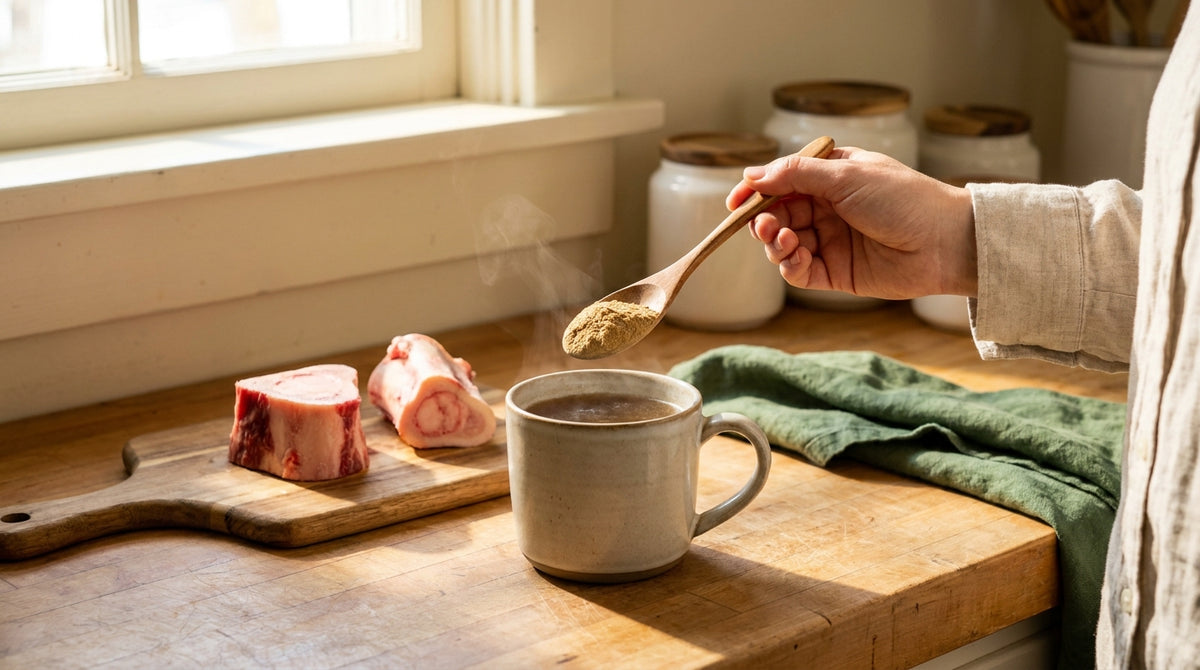
Bone broth protein powder is bone broth that's been concentrated and dried, and most of its protein is collagen. That makes it real protein, but an incomplete one: collagen has no tryptophan (Paul, Leser and Oesser, Nutrients, 2019), so on its own it can't replace meat, eggs or whey. Making it complete takes another protein.
Updated 2026-10-23. Sources and labels checked 2026-10-22.
Key numbers
- 4.7 g protein in a cup of home-prepared beef stock (USDA FoodData Central, FDC 172883) [9].
- 7 to 10 g protein per cup on store-bought bone broth labels in USDA's branded database [10].
- About 40% of the amino acids in commercial beef bone broth are glycine, proline and hydroxyproline, the collagen signature (Shaw and Flynn, 2019; small undergraduate analysis) [4].
- About 3.7% leucine in that broth protein, against 11.0% for whey and 7.0% for egg [4][7].
- 30 g twice a day for six days in older women: whey raised longer-term muscle protein synthesis, collagen didn't (Oikawa et al., 2020) [8].
"Bone broth protein" sounds like two good things in one scoop. It's one thing, described two ways. Once you know what's in the tub, you can decide whether it's the protein you need or the collagen you want, and read the label to check you're getting it.

Grass-fed beef collagen you can sip like broth: 16g of protein and 70 calories per scoop.
What is bone broth protein powder made from?
It starts as broth. Bones and the connective tissue attached to them simmer in water for hours, and the liquid is concentrated and dried into a powder. In one food-engineering study, researchers boiled beef marrow bones into broth and then spray-dried it, testing maltodextrin and whey protein isolate as carrier agents to help the powder form [1].
That detail matters if you read labels. A carrier or added protein changes what's in the scoop. Whey means dairy, and maltodextrin means added carbohydrate, so the ingredient list is worth a look even when the front of the tub says only "bone broth."
The protein itself comes from what bones and connective tissue are made of. Collagen is the most abundant protein in mammals [2], and type I collagen is a core part of bone, working alongside its mineral [3]. Our guide to whether bone broth has collagen covers how that collagen ends up in the pot, and the collagen and bone broth guide maps every format side by side.
How much collagen is in bone broth protein?
Most of the protein, judging by the amino acids. Collagen has a signature pattern: glycine sits at every third position in its triple helix, and proline and hydroxyproline fill many of the others [2]. The best composition data we found for store-bought broth comes from a small undergraduate chemistry analysis of 15 broths, published in an undergraduate research journal, so treat it as a supporting data point. In beef broth, glycine was the most concentrated amino acid, with hydroxyproline and proline close behind [4]. The peer-reviewed study we found measured six key amino acids in broths made several ways, not the full profile, so it can't give those shares [5].
| Amino acid (commercial beef bone broth) | mg per gram of broth | Share of the 18 amino acids reported |
|---|---|---|
| Glycine | 3.71 | 18.8% |
| Glutamine/glutamate | 2.58 | 13.0% |
| Proline | 2.21 | 11.2% |
| Hydroxyproline | 1.97 | 9.9% |
| Leucine | 0.73 | 3.7% |
| All eight essential amino acids measured (tryptophan not reported) | 3.60 | 18.2% |
Source: Shaw and Flynn, 2019 [4]. Shares are our arithmetic from the paper's table, checked 2026-09-25 and again 2026-10-22.
Glycine, proline and hydroxyproline together make up about 40% of the amino acids reported, which is what you'd expect from a protein that's mostly collagen. The study measured ready-to-drink broths, not powders, but a powder is the same material with the water removed, so the pattern should carry over unless the maker adds another protein.
Consistency depends on the process. Researchers who analyzed broths made several ways found a large spread in amino acid content from recipe to recipe, while broth made to a fixed recipe stayed consistent batch to batch [5]. A commercial powder made to a set process should behave like the second case. The protein grams on the label tell you how much you're getting per scoop.
Is bone broth a complete protein?
Not on its own. A complete protein supplies all nine essential amino acids in adequate amounts. Collagen lacks tryptophan entirely, which is why protein-quality scoring rates it incomplete [6]. A protein dominated by collagen inherits that gap, so bone broth is an incomplete protein whether it's in a mug or a tub.
It's also light on essential amino acids overall, including leucine, the one most tied to muscle. Here's how the beef bone broth amino acid profile compares with other proteins analyzed in a separate lab study:
| Protein | Essential amino acids, share of total | Leucine, share of total |
|---|---|---|
| Commercial beef bone broth | about 18% (tryptophan not reported) | about 3.7% |
| Egg protein | 32% | 7.0% |
| Human skeletal muscle protein | 38% | 7.6% |
| Milk protein | 39% | 9.0% |
| Whey protein | 43% | 11.0% |
Broth row: our calculation from Shaw and Flynn [4]. Other rows: Gorissen et al. [7], a peer-reviewed lab study using a different method. Checked 2026-10-22.
The comparison is directional, not exact. The direction is clear, though. Bone broth protein carries roughly half the essential amino acid share of egg or milk protein, and about half the leucine. So yes, bone broth has leucine, just not much of it.
That shows up in muscle research. In a randomized trial in 22 healthy women around age 69, 30 grams of whey raised muscle protein synthesis at rest and after exercise, while the same amount of collagen raised it only after exercise, by less, and not at all across the six-day measurement [8]. If muscle is your reason for buying protein, a collagen-dominated powder is the wrong main tool.
How do you make bone broth a complete protein?
You pair it with a protein that brings the missing amino acids. Collagen's weak spots are tryptophan and leucine, and complete proteins have plenty of both. You don't need them in the same mug. Your body pools amino acids from the meal, and from the day.
- Eat it with a complete protein. A mug of broth next to eggs, fish or a piece of meat covers the gap.
- Cook protein into it. Crack an egg into hot broth, or turn it into soup with shredded chicken or beef.
- Add a complete powder. An unflavored complete protein stirred into warm broth works if the texture suits you.
- Count it honestly. Count broth grams toward your daily total, and keep most of your protein coming from complete sources.
A research modeling paper found collagen can make up a sizable share of daily protein while essential amino acid needs are still met, as long as the rest of the diet supplies them [6]. One disclosure on that paper: its first author provides research services to a collagen supplement maker.
How does bone broth protein compare with collagen peptides and beef protein isolate?
Bone broth protein and collagen peptides are close cousins. Both are collagen-dominated, and both are incomplete. Beef protein isolate is a different case, because it varies by source and process.
| Powder type | What the protein mostly is | Complete? | What to check |
|---|---|---|---|
| Bone broth protein | Collagen from simmered bones and connective tissue, plus some protein from tissue left on the bones [4] | No | Carriers or added proteins; protein grams per scoop |
| Collagen peptides (beef collagen and others) | Collagen broken into smaller pieces (hydrolyzed) | No | Source animal; grams per scoop |
| Beef protein isolate | Varies: some are collagen-rich, some publish a full amino acid profile | Only if the finished product shows all nine essential amino acids | A product-specific amino acid table |
| Beef isolate plus egg white | Beef protein with a complete egg protein | Can be, at the finished-blend level | Protein grams; egg allergen |
| Whey | Milk protein | Yes | Dairy tolerance |
Table checked 2026-10-22.
If you're weighing broth against peptides, bone broth vs collagen peptides goes deeper on format, and our guide to beef collagen explains what "bovine" on a label does and doesn't tell you. For beef isolates, is beef protein a complete protein? shows how to verify one.
How much protein is in bone broth protein powder?
It depends on the scoop. Powders list protein per serving on the nutrition panel, so compare grams per scoop and calories per gram of protein across products rather than trusting the front label. As a reference point, a cup of liquid bone broth usually has about 5 to 10 grams of protein: USDA data for home-prepared beef stock works out to 4.7 grams per cup [9], and store-bought broth labels in USDA's branded database run 7 to 10 grams per cup [10]. The small undergraduate analysis of 15 store-bought broths landed in the same range, at about 5.6 grams per cup [4].
A concentrated powder exists to beat that number without the stockpot. More grams of the same collagen-dominated protein don't change its amino acid pattern, though. Bone broth vs protein powder isn't a fair fight on completeness. It's a fair fight on what you want in your mug.
What should you check on a bone broth protein label?
Read the ingredient list first. On a food label, ingredients appear in descending order by weight [11], so the first one tells you what the scoop mostly is.
| If the first ingredient says | What you're likely buying |
|---|---|
| Bone broth, bone broth protein, or bone broth concentrate | Dried broth: collagen-dominated protein with some other tissue components |
| Collagen, beef collagen, or collagen peptides | A collagen powder; the protein is collagen, whatever the front says |
| Whey, egg white, or a named protein isolate, with broth further down | A blend where another protein may carry the amino acid load |
Then check four more things:
- Protein grams per scoop. This tells you quantity, not quality.
- Percent Daily Value for protein, if listed. By regulation, the %DV must be calculated from protein corrected for quality [12], so it's a useful clue when a brand chooses to show it.
- Carriers and add-ins. Maltodextrin, whey or other proteins change the carbohydrate, the allergens and the amino acid profile [1].
- Sodium. Broth carries sodium; USDA's home-prepared beef stock has about 475 mg per cup [9]. Powders vary, and the number is on the nutrition panel.
Bone broth protein powder benefits, as sold, are mostly collagen benefits. Our review of bone broth collagen benefits sorts those by goal and by how good the studies are.
Which should you choose: bone broth protein, collagen, or a complete protein?
Choose by the job you want the scoop to do.
| Your goal | What fits |
|---|---|
| A warm, savory mug with collagen-type protein | Bone broth protein or a collagen powder |
| A measured collagen dose you can repeat every day | A collagen powder with protein grams on the label |
| Enough protein for a meal, or for muscle | A complete protein: whey, egg, soy, or a verified beef or beef-and-egg blend |
| Both in one scoop | A complete protein with collagen added (see our guide to protein powder with collagen) |
Does Paleo Pro make a bone broth protein powder?
No, and I'd rather tell you that than let a product name blur it. Paleo Pro's Grass-Fed Bone Broth Collagen + Turmeric is grass-fed beef collagen. Its label lists beef collagen as the only protein: 16 grams of protein and 70 calories per 18-gram scoop, with natural flavors, monk fruit extract and turmeric root [13]. It isn't dried broth, and it's incomplete like every collagen. You sip it hot like broth or stir it into anything warm.
If you want beef collagen in a mug, that's its job.
If you want complete protein, Paleo Protein is the one. It combines grass-fed beef protein isolate with egg white protein for 26 grams of protein and about 120 calories per 30-gram scoop [14]. It contains egg.
Our collagen collection has both collagen formats side by side.
Frequently asked questions
Is bone broth protein a complete protein?
No, not on its own. Most of its protein is collagen, which lacks the essential amino acid tryptophan and is low in leucine. A product can reach complete status by adding enough of another protein, such as egg or whey, so check the ingredient list.
Does bone broth protein powder have collagen?
Yes. Collagen is most of it. In a small undergraduate analysis of store-bought beef bone broth, glycine, proline and hydroxyproline, the amino acids that define collagen, made up about 40% of the amino acids reported.
How much collagen is in bone broth?
Most of the protein in bone broth is collagen, but the amount per cup varies with the recipe. Homemade broth ranges widely, while broth made to a fixed recipe stays consistent. Store-bought labels show 7 to 10 grams of protein per cup.
Is bone broth protein better than whey?
For muscle and complete protein, no. Whey is complete and rich in leucine, and in a trial in older women it stimulated muscle protein synthesis more than collagen did. Bone broth protein suits people who want collagen-type protein without dairy, if the label shows no whey.
How do you make bone broth a complete protein?
Pair it with a complete protein in the same meal or day: eggs, fish, meat, or a complete protein powder. Those supply the tryptophan and leucine that collagen lacks, and your body pools amino acids across meals.
Is bone broth protein powder dairy-free?
Broth itself contains no dairy, but a powder can include whey as a carrier or an added protein, and at least one production study tested exactly that. Read the ingredient list and the allergen statement before you assume.
Want collagen you can sip like broth? Bone Broth Collagen gives you 16 g of grass-fed beef collagen protein, plus turmeric, in 70 calories. Need complete protein? Paleo Protein delivers 26 g from beef and egg white. Both come with a 60-day money-back guarantee.
Sources
- Haluk E, Yeliz K, Orhan Ö. "Production of Bone Broth Powder with Spray Drying Using Three Different Carrier Agents." Korean Journal for Food Science of Animal Resources. 2018;38(6):1273-1285. PMID: 30675120
- Ricard-Blum S. "The collagen family." Cold Spring Harbor Perspectives in Biology. 2011;3(1):a004978. PMID: 21421911
- Viguet-Carrin S, Garnero P, Delmas PD. "The role of collagen in bone strength." Osteoporosis International. 2006;17(3):319-336. PMID: 16341622
- Shaw MH, Flynn NE. "Amino Acid Content of Beef, Chicken and Turkey Bone Broth." Journal of Undergraduate Chemistry Research. 2019;18(4):15-17. PDF
- Alcock RD, Shaw GC, Burke LM. "Bone Broth Unlikely to Provide Reliable Concentrations of Collagen Precursors Compared With Supplemental Sources of Collagen Used in Collagen Research." International Journal of Sport Nutrition and Exercise Metabolism. 2019;29(3):265-272. PMID: 29893587
- Paul C, Leser S, Oesser S. "Significant Amounts of Functional Collagen Peptides Can Be Incorporated in the Diet While Maintaining Indispensable Amino Acid Balance." Nutrients. 2019;11(5):1079. PMID: 31096622
- Gorissen SHM, Crombag JJR, Senden JMG, et al. "Protein content and amino acid composition of commercially available plant-based protein isolates." Amino Acids. 2018;50(12):1685-1695. PMID: 30167963
- Oikawa SY, Kamal MJ, Webb EK, et al. "Whey protein but not collagen peptides stimulate acute and longer-term muscle protein synthesis with and without resistance exercise in healthy older women: a randomized controlled trial." American Journal of Clinical Nutrition. 2020;111(3):708-718. PMID: 31919527
- US Department of Agriculture, Agricultural Research Service. "Soup, stock, beef, home-prepared." FoodData Central, SR Legacy, FDC ID 172883. Accessed 2026-09-25. USDA FoodData Central
- US Department of Agriculture, Agricultural Research Service. FoodData Central, Branded Foods label records for bone broth, FDC IDs 2149645, 2428179, 2669477 and 1954906. Accessed 2026-09-25.
- US Code of Federal Regulations. 21 CFR 101.4(a)(1), "Food; designation of ingredients." Electronic Code of Federal Regulations, current as of 2026-09-22. eCFR
- US Code of Federal Regulations. 21 CFR 101.9(c)(7), "Nutrition labeling of food: Protein." Electronic Code of Federal Regulations, current as of 2026-09-22. eCFR
- Paleo Pro. "Grass-Fed Bone Broth Collagen + Turmeric." Product label and product page, checked 2026-10-22. Product details
- Paleo Pro. "Paleo Protein Powder." Product page, checked 2026-10-22. Product details
